
Enhanced with market attractiveness analysis, total addressable market evaluation, company benchmarking matrices, interactive Excel dashboards, expanded supply chain intelligence, emerging startup coverage, and detailed product insights, The Business Research Company’s 2026 market reports deliver more actionable and strategically valuable research.
Load Balancer Market Value Analysis: What Growth Is Expected Over The Forecast Period?
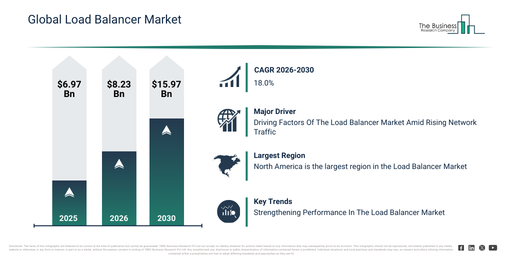
The load balancer market has observed substantial growth recently. It is anticipated to expand from $6.97 billion in 2025 to $8.23 billion in 2026, exhibiting a compound annual growth rate (CAGR) of 18.0%. This historical market expansion is primarily linked to the proliferation of web-based applications, a surge in enterprise network traffic, the enlargement of data center infrastructure, the increasing adoption of virtualization technologies, and the heightened demand for improved application uptime.
The load balancer market is set for substantial expansion in the coming years. By 2030, its value is forecast to reach $15.97 billion, exhibiting a compound annual growth rate (CAGR) of 18.0%. This projected growth during the forecast period stems from factors such as increasing migration to cloud environments, the rising adoption of microservices architectures, a growing emphasis on application scalability, the expansion of edge computing deployments, and an increasing need for secure traffic management. Key developments anticipated within this timeframe involve the increasing uptake of cloud-native load balancing solutions, a rising demand for application-level traffic optimization, the expanding use of software-based load balancers, the broadening of multi-cloud traffic management, and an enhanced focus on high availability and fault tolerance.
Download A Free Sample Report For Comprehensive Market Insights:
Load Balancer Market Expansion Supported By Key Demand Factors
The expanding volume of network traffic is propelling the load balancer market forward. Network traffic signifies the constant flow and movement of data, such as messages, files, and communication, within a network system at any given moment. Load balancers adeptly manage this network traffic by uniformly distributing incoming data requests across various servers or resources, thereby ensuring top-tier performance and reliability. For instance, in October 2023, the International Telecommunication Union (ITU), a Switzerland-based specialized agency of the United Nations, reported that approximately 67% of the world’s population (5.4 billion people) was online in 2023, both reflecting and contributing to the surge in global data traffic. Hence, the escalation in network traffic is a key driver for the growth of the load balancer market.
Load Balancer Market Segment Outlook: Which Categories Are Expanding The Fastest?
The load balancer market covered in this report is segmented –
1) By Type: Local Load Balancer, Global Load Balancer
2) By Component: Hardware, Software, Services
3) By Enterprise Size: Large Enterprises, Small And Medium-sized Enterprises
4) By Deployment: On-Premise, Cloud
5) By Industry Vertical: Banking, Financial Services And Insurance (BFSI), Information Technology (IT) And Telecom, Retail, Government, Media And Entertainment, Healthcare, Other Industries
Subsegments:
1) By Local Load Balancer: Hardware Load Balancers, Software Load Balancers, Virtual Load Balancers
2) By Global Load Balancer: DNS-Based Load Balancers, Application Delivery Controllers (ADCs), Global Server Load Balancing (GSLB) Solutions
Load Balancer Market Strategic Trends: What Is Defining The Next Phase Of Growth?
Leading companies in the load balancer market are adopting a strategic partnership approach to bolster performance. Strategic partnerships involve companies leveraging each other’s strengths and resources to achieve mutual benefits and success. For instance, in July 2024, HPE Ezmeral, a US-based technology company, collaborated with Loadbalancer.org, a US-based commercial business providing load balancing solutions. This partnership aims to improve the performance and reliability of HPE Ezmeral Data Fabric Software by optimizing storage capabilities and enhancing the overall user experience for businesses utilizing this platform. Loadbalancer’s expertise in load balancing solutions is expected to significantly boost the performance of HPE Ezmeral Data Fabric, as its robust solutions provide an additional layer of reliability and redundancy to HPE Ezmeral’s data storage infrastructure.
Load Balancer Market Key Companies And Competitive Benchmarking
Major companies operating in the load balancer market are A10 Networks Inc.; KEMP Technologies Inc.; Hewlett-Packard Development Company L. P.; Inlab Networks GmbH; Nginx Inc.; F5 Networks Inc.; Citrix Systems Inc.; Radware Ltd.; Barracuda Networks Inc.; Fortinet Inc.; Pulse Secure LLC; HAProxy Technologies Inc.; Avi Networks Inc.; Loadbalancer. org Ltd.; Array Networks Inc.; Imperva Inc.; H3C Technologies Co. Limited; Zevenet S. L.; Riverbed Technology Inc.; Cloudflare Inc.; Cisco Systems Inc.; Sangfor Technologies Co. Ltd.; Juniper Networks Inc.; NFWare Ltd.
Access The Complete Load Balancer Market Report:
Load Balancer Market Geographic Landscape: Which Region Dominates Industry Growth?
North America was the largest region in the load balancer market in 2025. Asia-Pacific is expected to be the fastest-growing region in the forecast period. The regions covered in the load balancer market report are Asia-Pacific, South East Asia, Western Europe, Eastern Europe, North America, South America, Middle East, Africa.
Get in touch with us:
The Business Research Company: https://www.thebusinessresearchcompany.com/
Americas: +1 310-496-7795
Asia: +44 7882 955267 & +91 8897263534
Europe: +44 7882 955267
Email us at: marketing@tbrc.info
Follow us on:
LinkedIn: https://in.linkedin.com/company/the-business-research-company
YouTube: https://www.youtube.com/channel/UC24_fI0rV8cR5DxlCpgmyFQ
Global Market Model: https://www.thebusinessresearchcompany.com/global-market-model

Wasay has over a decade of experience in market research, data modelling, and analytics, with prior experience at GlobalData and Decision Tree Consulting Services. At The Business Research Company , he leads research operations across syndicated studies, customized consulting engagements, and the Global Market Model platform. His professional experience includes supporting organizations such as Boston Consulting Group, KPMG, and Ernst & Young. Wasay holds a degree in Electronics and Communications Engineering, postgraduate management qualifications from International Management Institute Belgium and Indian School of Business and Entrepreneurship, and completed the Integrated Program in Business Analytics from Indian Institute of Management Indore.