
Enhanced with market attractiveness analysis, total addressable market evaluation, company benchmarking matrices, interactive Excel dashboards, expanded supply chain intelligence, emerging startup coverage, and detailed product insights, The Business Research Company’s 2026 market reports deliver more actionable and strategically valuable research.
Logistics Automation Market Value Analysis: What Growth Is Expected Over The Forecast Period?
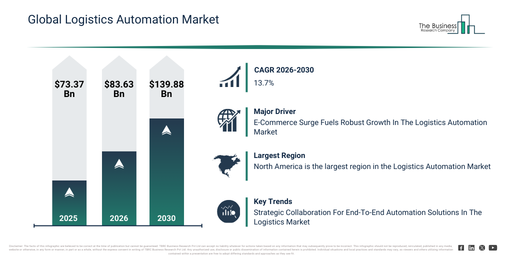
The logistics automation market has seen significant expansion in recent years. It is forecast to grow from $73.37 billion in 2025 to $83.63 billion in 2026, exhibiting a compound annual growth rate (CAGR) of 14.0%. This growth during the historical period is largely attributable to the expansion of e-commerce logistics, increasing labor costs, the drive for faster order fulfillment, warehouse capacity expansion, and the digitalization of supply chains.
The logistics automation market is set for considerable expansion over the next few years. It is predicted to grow to $139.88 billion by 2030, exhibiting a compound annual growth rate (CAGR) of 13.7%. This projected growth is driven by aspects such as AI-enabled logistics optimization, the increasing adoption of autonomous mobile robots, the integration of IoT sensors, the rising demand for last-mile automation, and a focus on operational efficiency. Significant trends anticipated during this period include automated warehouse management systems, robotic material handling, smart transportation management, real-time inventory visibility, and autonomous sorting and packaging solutions.
Download A Free Sample Report For Comprehensive Market Insights:
Logistics Automation Market Industry Drivers: What Is Driving Revenue Growth?
The expanding e-commerce sector is anticipated to propel the growth of the logistics automation market moving forward. E-commerce pertains to the online transaction of goods and services using the Internet. The e-commerce industry deploys logistics automation to manage its inventory across warehouses and distribution centers. This facilitates the seamless movement of goods among different company departments. For instance, a report published by Forbes LLC, a UK-based media company, in June 2024 revealed that the number of e-commerce users in the UK reached approximately 60 million in 2023, with projections indicating a potential rise to 62.1 million by 2025. Therefore, the continuous expansion of the e-commerce industry is a key driver for the logistics automation market growth.
Logistics Automation Market Segment Analysis Highlighting Growth Areas
The logistics automation market covered in this report is segmented –
1) By Component: Hardware, Software, Services
2) By Function: Warehouse and Storage Management, Transportation Management
3) By Organization Size: Small-Medium Size Organizations, Large Scale Organization
4) By End-User: Retail and E-Commerce, Automotive, Food and Beverage, Logistics and Transportation, Other End Users
Subsegments:
1) By Hardware: Automated Storage and Retrieval Systems (AS/RS), Conveyor and Sortation Systems, Automated Guided Vehicles (AGVs), Autonomous Mobile Robots (AMRs), Palletizing and Depalletizing Robots, Robotic Picking Systems, Warehouse Cranes and Shuttle Systems
2) By Software: Warehouse Management Systems (WMS), Transportation Management Systems (TMS), Warehouse Execution Systems (WES), Warehouse Control Systems (WCS), Inventory Management Software, Order Fulfillment and Order Management Systems
3) By Services: Automation System Integration Services, Consulting and Process Optimization Services, Installation and Commissioning Services, Maintenance and Equipment Support Services, Technical Support Services
Logistics Automation Market Industry Trends Shaping Future Revenue Growth
Leading companies in the logistics automation market are emphasizing strategic partnerships to offer dependable services to customers. Such strategic collaboration denotes a mutually beneficial alliance between two or more autonomous entities working together to achieve common goals that align with their individual strategic aims. For example, in December 2023, Logistex, a UK-based software company, collaborated with Geek+, a China-based global technology company, to provide comprehensive automation solutions for logistics to clients. This merger of Logistex’s proficiency in warehouse design and software with Geek+’s cutting-edge mobile robotic solutions yields an all-encompassing suite for streamlining fulfillment and enhancing productivity.
Logistics Automation Market Leading Companies: Who Holds Significant Market Presence?
Major companies operating in the logistics automation market are ABB Ltd; KION Group AG; Daifuku Co Ltd; Jungheinrich AG; SSI Schaefer AG; KNAPP AG; Dematic Group; TGW Logistics Group; Swisslog Holding AG; Murata Machinery Ltd; Toyota Industries Corporation; Mecalux SA; Beumer Group GmbH; Vanderlande Industries BV; Honeywell International Inc; FANUC Corporation; Yaskawa Electric Corporation; Kawasaki Heavy Industries Ltd; Manhattan Associates Inc; Blue Yonder Group; WiseTech Global Limited; Descartes Systems Group Inc
Access The Complete Logistics Automation Market Report:
Logistics Automation Market Regional Analysis And Leading Geography
North America was the largest region in the logistics automation market in 2025. Asia-Pacific is expected to be the fastest-growing region in the forecast period. The regions covered in the logistics automation market report are Asia-Pacific, South East Asia, Western Europe, Eastern Europe, North America, South America, Middle East, Africa.
Get in touch with us:
The Business Research Company: https://www.thebusinessresearchcompany.com/
Americas: +1 310-496-7795
Asia: +44 7882 955267 & +91 8897263534
Europe: +44 7882 955267
Email us at: marketing@tbrc.info
Follow us on:
LinkedIn: https://in.linkedin.com/company/the-business-research-company
YouTube: https://www.youtube.com/channel/UC24_fI0rV8cR5DxlCpgmyFQ
Global Market Model: https://www.thebusinessresearchcompany.com/global-market-model

Wasay has over a decade of experience in market research, data modelling, and analytics, with prior experience at GlobalData and Decision Tree Consulting Services. At The Business Research Company , he leads research operations across syndicated studies, customized consulting engagements, and the Global Market Model platform. His professional experience includes supporting organizations such as Boston Consulting Group, KPMG, and Ernst & Young. Wasay holds a degree in Electronics and Communications Engineering, postgraduate management qualifications from International Management Institute Belgium and Indian School of Business and Entrepreneurship, and completed the Integrated Program in Business Analytics from Indian Institute of Management Indore.