
Market attractiveness scoring, total addressable market sizing, company benchmarking matrices, interactive Excel dashboards, deeper supply chain intelligence, emerging startup tracking, and granular product-level insights are among the key offerings featured in The Business Research Company’s 2026 market reports, designed to deliver more actionable and strategically valuable research.
What Is The Low-Power Wide-Area Network (LPWAN) Market Size In 2026, And Where Is It Heading By 2030?
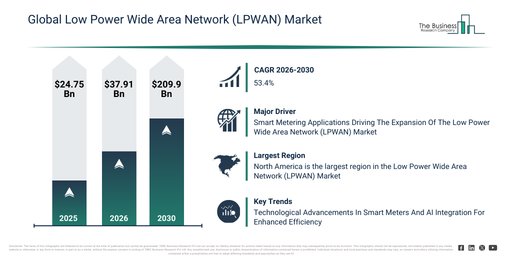
The low-power wide-area network (lpwan) market size has experienced significant expansion in recent years. It is projected to increase from $27.65 billion in 2025 to $44.8 billion in 2026, driven by a compound annual growth rate (CAGR) of 62.0%. This historical growth can be attributed to factors such as the rise of early IoT pilot deployments, the increasing embrace of smart agriculture solutions, the widening scope of asset tracking use cases, the presence of unlicensed spectrum technologies, and the growing need for low-power connectivity.
The low-power wide-area network (lpwan) market is projected to experience rapid expansion over the coming years. Its valuation is anticipated to reach $253.18 billion by 2030, exhibiting a compound annual growth rate (CAGR) of 54.2%. This projected growth is driven by factors such as greater investments in smart city infrastructure, the rising implementation of massive IoT deployments, an increasing demand for battery-efficient communication, the broader application of LPWAN in industrial monitoring, and more government-initiated digital infrastructure projects. Key trends anticipated during this period encompass the extension of LPWAN coverage into remote regions, the increasing rollout of smart metering networks, a greater uptake of low-power sensor connectivity, a heightened need for long-range IoT communication, and an intensified focus on developing energy-efficient network designs.
Request Your Free Low-Power Wide-Area Network (LPWAN) Market Sample With Segment And Regional Data:
Low-Power Wide-Area Network (LPWAN) Market Growth Drivers And Their Impact On Future Demand
The increasing adoption of smart meters is anticipated to propel the growth of the low-power wide-area network (LPWAN) market going forward. A smart meter is a device that tracks and records electricity or gas consumption in households and commercial establishments. Smart meter adoption is rising due to their precise energy monitoring, simplified billing, and enhanced energy management capabilities for both consumers and utilities. LPWAN technologies significantly improve the functionality and efficiency of smart meters by providing reliable, long-range, low-power, and cost-effective communication solutions. These features enable better data management, operational efficiency, and scalability in smart metering systems, which are crucial for modern energy management and utility services. For instance, in March 2024, according to the Smart Meter Statistics developed by the UK Statistics Authority, a UK-based government department for maintaining a national code of practice for official statistics, in 2023, energy suppliers in Great Britain installed 201,800 smart and advanced meters in smaller non-domestic sites, marking a 39% increase compared to 2022. Therefore, the increase in smart meters is driving the growth of the low-power wide-area network (LPWAN) market.
What Categories Define The Low-Power Wide-Area Network (LPWAN) Market?
The low-power wide-area network (lpwan) market covered in this report is segmented –
1) By Component: Platform, Service
2) By Technology Type: SIGFOX, Long Range Wide Area Network (LoRaWAN), Weightless, Other Technologies
3) By Deployment Model: On-Premise, Cloud
4) By Application: Smart Gas And Water Metering, Asset Tracking, Smart Buildings, Smart Parking, Precision Agriculture, Smart Waste Management, Livestock Monitoring, Other Applications
5) By End-User: Healthcare, Agriculture, Logistics And Transportation, Manufacturing, Government, Other End-Users
Subsegments:
1) By Platform: Network Management, Device Management, Application Enablement
2) By Service: Professional Services, Consulting, Deployment And Integration, Support And Maintenance, Managed Services
What New Developments Are Emerging In The Low-Power Wide-Area Network (LPWAN) Market?
Leading entities within the low-power wide-area network (LPWAN) sector are directing their efforts towards SaaS chip-to-cloud offerings, including solutions like cloud-managed LoRaWAN connectivity platforms. This strategic move aims to boost network scalability, decrease infrastructure expenditures, and streamline the integration of IoT devices. These cloud-managed LoRaWAN connectivity platforms function as SaaS systems, delivering comprehensively managed LoRaWAN Network Server (LNS) capabilities, along with device onboarding, gateway supervision, and seamless chip-to-cloud data routing, thereby eliminating the necessity for organizations to establish or sustain their own LPWAN infrastructure. As an illustration, in September 2023, Amazon Web Services (AWS), a US-headquartered cloud services provider, rolled out public-network support for AWS IoT Core for LoRaWAN. This introduction brought forth features such as a fully managed LNS incorporating gateway management (CUPS) and FUOTA support, allowing direct connections through partner public LoRaWAN networks without the need for on-premise gateways. Furthermore, it offered native chip-to-cloud integration with AWS IoT services, which facilitates considerably quicker LPWAN deployments while reducing operational overhead.
Major Players Driving Competition In The Low-Power Wide-Area Network (LPWAN) Market
Major companies operating in the low-power wide-area network (lpwan) market are Verizon Communications Inc., Comcast Corporation, AT&T Inc., Huawei Technologies Co. Ltd., Vodafone Group Plc, Cisco Systems Inc., Bouygues S.A, Qualcomm Technologies Inc., Avnet Inc., NXP Semiconductors N.V., Swisscom AG, Orange Business, Tata Communications, Semtech Corporation, Sigfox, Kerlink, Eseye, Ingenu Inc., Actility S.A., Senet Inc, WavIoT, Link Labs, LORIOT AG, Nwave, Everynet
View The Comprehensive Low-Power Wide-Area Network (LPWAN) Market Analysis:
Low-Power Wide-Area Network (LPWAN) Market Regional Leaders: Insights From The 2026 Report
North America was the largest region in the low-power wide area network (LPWAN) market in 2025. Asia-Pacific is expected to be the fastest-growing region in the forecast period. The regions covered in the low-power wide-area network (lpwan) market report are Asia-Pacific, South East Asia, Western Europe, Eastern Europe, North America, South America, Middle East, Africa.
Reach Out To Our Team:
The Business Research Company: https://www.thebusinessresearchcompany.com/
Americas: +1 310-496-7795
Asia: +44 7882 955267 & +91 8897263534
Europe: +44 7882 955267
Email us at: marketing@tbrc.info
Follow us on:
LinkedIn: https://in.linkedin.com/company/the-business-research-company
YouTube: https://www.youtube.com/channel/UC24_fI0rV8cR5DxlCpgmyFQ
Global Market Model: https://www.thebusinessresearchcompany.com/global-market-model

Wasay has over a decade of experience in market research, data modelling, and analytics, with prior experience at GlobalData and Decision Tree Consulting Services. At The Business Research Company , he leads research operations across syndicated studies, customized consulting engagements, and the Global Market Model platform. His professional experience includes supporting organizations such as Boston Consulting Group, KPMG, and Ernst & Young. Wasay holds a degree in Electronics and Communications Engineering, postgraduate management qualifications from International Management Institute Belgium and Indian School of Business and Entrepreneurship, and completed the Integrated Program in Business Analytics from Indian Institute of Management Indore.

