Built to provide research that’s more actionable and strategically valuable, The Business Research Company’s 2026 market reports include market attractiveness analysis, total addressable market sizing, company benchmarking matrices, interactive Excel dashboards, broader supply chain intelligence, emerging startup tracking, and in-depth product insights.
Managed Infrastructure Services Market Size Forecast: How Big Could The Market Get By 2030?
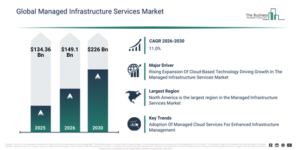
In recent years, the managed infrastructure services market has seen swift growth in its size. The market is projected to expand from $134.36 billion in 2025 to $149.1 billion in 2026, demonstrating an 11.0% compound annual growth rate (CAGR). The historical development can be attributed to growing enterprise server deployments, increasing reliance on third-party IT providers, a rising need for disaster recovery planning, the expansion of on-premise infrastructure environments, and the early adoption of remote infrastructure monitoring.
The managed infrastructure services market is projected to experience substantial expansion over the upcoming years. It is set to reach $226 billion in 2030, exhibiting a compound annual growth rate (CAGR) of 11.0%. This anticipated growth during the forecast timeframe is primarily driven by factors such as the increasing adoption of hybrid infrastructure, a heightened need for high availability systems, more stringent regulatory compliance demands, the expansion of cloud infrastructure monitoring, and the requirement for scalable infrastructure management solutions. Key developments expected throughout this period encompass proactive infrastructure monitoring offerings, hybrid infrastructure management frameworks, standardized disaster recovery solutions, security-focused infrastructure management approaches, and optimized service-level agreements.
Get A Free Sample Report With In-Depth Market Insights:
Managed Infrastructure Services Market Development Factors: What’s Supporting Demand?
The growing adoption of cloud-based technology is anticipated to drive the managed infrastructure services market’s expansion in the future. This technology involves computing services, resources, and applications accessed via the internet, thereby removing the necessity for organizations to make significant investments in physical infrastructure, its upkeep, and associated operational expenses. Managed infrastructure services utilize cloud-based technology to automate and oversee IT infrastructure solutions that are scalable, flexible, and resilient for clients, streamlining operations and allowing them to concentrate on their primary business goals. For example, data from Eurostat, a UK-based intergovernmental organization, indicated that in December 2023, 45.2% of EU enterprises acquired cloud computing services for hosting email systems, storing electronic files, and performing other duties. The procurement of cloud computing services by EU enterprises rose by 4.2% in 2023 relative to 2021. Furthermore, around 44% of conventional small businesses use cloud infrastructure or hosting services, while 66% of small tech companies and 74% of enterprises employ cloud services. Consequently, the rising uptake of cloud-based technology is propelling the expansion of the managed infrastructure services market.
Managed Infrastructure Services Market Segmentation And Category Overview
The managed infrastructure services market covered in this report is segmented –
1) By Service Type: Remote System Management And Monitoring, Disaster Recovery And Business Continuity Service, Information Security Audits And Assessment, Other Service Type
2) By Deployment Type: On-premise, Cloud
3) By End-User: Banking, Financial Services, And Insurance (BFSI), Healthcare, Manufacturing, Information Technology And Telecommunications, Defense And Government, Retail, Energy And Utilities, Other End-Users
Subsegments:
1) By Remote System Management And Monitoring: Remote Server Monitoring, Remote Network Monitoring, Remote Application Monitoring, Remote Performance Management, Cloud Infrastructure Monitoring, Remote IT Support And Troubleshooting
2) By Disaster Recovery And Business Continuity Service: Backup And Restore Services, Disaster Recovery As A Service (DRaaS), Business Continuity Planning And Testing, Data Replication And Mirroring, High Availability Solutions, Failover And Backup Infrastructure
3) By Information Security Audits And Assessment: Security Vulnerability Assessments, Compliance Audits (GDPR, HIPAA, PCI-DSS), Penetration Testing And Risk Assessment, Security Policy And Governance Audits, Network Security Audits, Endpoint Security Audits
4) By Other Service Type: IT Asset Management Services, Cloud Migration Services, Infrastructure Optimization And Tuning, Patch Management And Software Updates, Capacity Planning And Scalability Services, Technology Integration Services
Managed Infrastructure Services Market Transformation Trends: What Innovations Are Driving Change?
Major companies operating in the managed infrastructure services market are developing innovative solutions, such as managed cloud services, to gain a competitive advantage. Managed cloud services refer to comprehensive IT solutions provided by third-party service providers to oversee and optimize their clients’ cloud-based infrastructure, platforms, applications, and services. For instance, in October 2023, Rackspace Technology Inc., a US-based cloud computing company, launched Rackspace Managed Cloud (RMC), a new offering for managing multi and hybrid cloud environments. This extensive service is powered by the Rackspace cloud management platform, which helps manage the complete lifecycle of various cloud components. RMC aims to transform multi- and hybrid cloud management by providing a fully managed service that streamlines the complexities of cloud operations, allowing organizations to focus on their core business activities. This solution offers a range of benefits, including reduced operational costs, enhanced scalability, improved security, and increased agility in adopting new technologies.
Managed Infrastructure Services Market Competitive Analysis Of Leading Industry Participants
Major companies operating in the managed infrastructure services market are Amazon.com Inc.; Alphabet Inc.; Microsoft Corporation; Verizon Communications Inc.; AT&T Inc.; Deutsche Telekom AG; Dell Technologies Inc.; Accenture plc; International Business Machines Corporation; Cisco Systems Inc.; Fujitsu Limited; Canon Inc.; Hewlett Packard Enterprise Company; Toshiba Corporation; Tata Consultancy Services Limited; Telefonaktiebolaget LM Ericsson; Nokia Corporation; Cognizant Technology Solutions Corporation; Ricoh Company Ltd.; DXC Technology Company; Atos SE; Konica Minolta Inc.; Xerox Corporation; Lexmark International Inc.; Citrix Systems Inc
View The Full Managed Infrastructure Services Market Report:
Managed Infrastructure Services Market Geographic Analysis: Where Is Demand Rising Fastest?
North America was the largest region in the managed infrastructure services market in 2025. Asia-Pacific is expected to be the fastest-growing region in the forecast period. The regions covered in the managed infrastructure services market report are Asia-Pacific, South East Asia, Western Europe, Eastern Europe, North America, South America, Middle East, Africa.
Reach Out To Our Team:
The Business Research Company: https://www.thebusinessresearchcompany.com/
Americas: +1 310-496-7795
Asia: +44 7882 955267 & +91 8897263534
Europe: +44 7882 955267
Email us at: marketing@tbrc.info
Follow us on:
LinkedIn: https://in.linkedin.com/company/the-business-research-company
YouTube: https://www.youtube.com/channel/UC24_fI0rV8cR5DxlCpgmyFQ
Global Market Model: https://www.thebusinessresearchcompany.com/global-market-model

Wasay has over a decade of experience in market research, data modelling, and analytics, with prior experience at GlobalData and Decision Tree Consulting Services. At The Business Research Company , he leads research operations across syndicated studies, customized consulting engagements, and the Global Market Model platform. His professional experience includes supporting organizations such as Boston Consulting Group, KPMG, and Ernst & Young. Wasay holds a degree in Electronics and Communications Engineering, postgraduate management qualifications from International Management Institute Belgium and Indian School of Business and Entrepreneurship, and completed the Integrated Program in Business Analytics from Indian Institute of Management Indore.