Through market attractiveness analysis, total addressable market evaluation, company benchmarking matrices, interactive Excel dashboards, expanded supply chain intelligence, emerging startup coverage, and detailed product insights, The Business Research Company’s 2026 market reports provide more actionable and strategically valuable research.
Material Handling Equipment Telematics Market Value Analysis: What Growth Is Expected Over The Forecast Period?
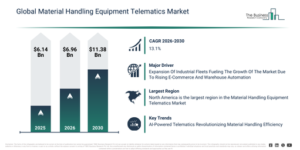
The material handling equipment telematics market has experienced rapid expansion in recent years. Its valuation is set to increase from $6.14 billion in 2025 to $6.96 billion in 2026, achieving a compound annual growth rate (CAGR) of 13.4%. This historical growth can be attributed to several factors including the rise of warehouse automation, the early adoption of fleet tracking, the broadening of logistics operations, the imperative for reduced equipment downtime, and an increasing emphasis on operational efficiency.
The material handling equipment telematics market is projected to experience swift expansion over the coming years. Its valuation is anticipated to reach $11.38 billion by 2030, exhibiting a compound annual growth rate (CAGR) of 13.1%. This projected growth is driven by factors such as the incorporation of AI-based telematics, the rise of e-commerce logistics, wider acceptance of connected equipment, the necessity for operations focused on sustainability, and the broader deployment of autonomous material handling solutions. Key trends anticipated during this period encompass real-time equipment monitoring, analytical tools for predictive maintenance, platforms for fleet optimization, interconnected warehouse functionalities, and telematics-powered safety management.
Download A Free Sample Report For Comprehensive Market Insights:
Material Handling Equipment Telematics Market Demand Drivers: What Is Fueling Industry Growth?
The anticipated expansion of industrial fleets is projected to drive forward the material handling equipment telematics market. Industrial fleets are defined as collections of vehicles, machinery, or apparatus managed or possessed by a business for industrial purposes, including construction, mining, manufacturing, or logistics. This growth in industrial fleets stems from the swift rise of e-commerce and the adoption of warehouse automation, aimed at achieving greater efficiency and automated processes for managing increasing quantities of goods throughout supply chains. Material handling equipment telematics boosts industrial fleets through offerings such as real-time operational data, facilitating predictive maintenance, optimizing fleet usage, and bolstering safety. Consequently, this results in less downtime, better resource deployment, and reduced expenditures, ultimately enhancing overall productivity and efficiency. An example illustrates this: in June 2024, data from Robotics 24/7, a US-based business-to-business (B2B) media platform, indicated that private fleet shipments expanded by 4.6%, with their volume rising by 8.4%, and the reported valuation of these shipments experienced a 2.8% year-over-year growth rate. Hence, the increasing size of industrial fleets is propelling the expansion of the material handling equipment telematics market.
#Material Handling Equipment Telematics Market Segment Landscape And Growth Potential
The material handling equipment telematics market covered in this report is segmented –
1) By Product: Aerial Work Platform, Forklift, Cranes, Earthmoving Equipment, Truck, Tractor, Telehandler, Other Products
2) By Solution: Asset Tracking, Fleet Management, Predictive Maintenance, Operational Analytics
3) By End-Use Industry: Logistics And Transportation, Warehousing And Distribution, Manufacturing, Construction, Mining
Subsegments:
1) By Aerial Work Platform: Boom Lifts, Scissor Lifts, Vertical Mast Lifts, Push Around Lifts, Spider Lifts
2) By Forklift: Electric Forklifts, Internal Combustion (IC) Forklifts, Reach Trucks, Pallet Jacks, Order Pickers
3) By Cranes: Mobile Cranes, Tower Cranes, Overhead Cranes, Gantry Cranes, Crawler Cranes
4) By Earthmoving Equipment: Excavators, Loaders, Bulldozers, Backhoe Loaders, Motor Graders
5) By Truck: Light-Duty Trucks, Medium-Duty Trucks, Heavy-Duty Trucks, Refrigerated Trucks, Flatbed Trucks
6) By Tractor: Utility Tractors, Row Crop Tractors, Industrial Tractors, Specialty Tractors, Compact Tractors
7) By Telehandler: Rotating Telehandlers, Fixed Telehandlers, High-Capacity Telehandlers, Compact Telehandlers, Heavy-Duty Telehandlers
8) By Other Products: Conveyor Systems, Automated Guided Vehicles (AGVs), Warehouse Robots, Tow Tractors, Straddle Carriers
Material Handling Equipment Telematics Market Trends Reshaping Industry Growth
Leading companies within the material handling equipment telematics market are concentrating on creating cutting-edge products, including AI-driven camera systems, aimed at boosting operational effectiveness and enabling predictive maintenance. These AI-powered camera systems, designed for material handling equipment telematics, leverage sophisticated artificial intelligence and computer vision technologies to continuously observe and assess equipment operations. Such systems capture high-definition video and employ AI algorithms to identify potential problems like obstructions, operator conduct, and shifts in the environment. An illustration of this is Gather AI, a US-based artificial intelligence firm, which introduced MHE Vision in March 2025; this is an artificial intelligence (AI)-powered camera system specifically for material handling equipment. MHE Vision incorporates artificial intelligence and machine learning to facilitate real-time inventory monitoring, achieve greater accuracy, and increase productivity. By incorporating advanced vision capabilities into forklifts and other handling equipment, MHE Vision successfully improves warehouse efficiency and minimizes inaccuracies.
Material Handling Equipment Telematics Market Competitive Landscape: Who Are The Leading Companies?
Major companies operating in the material handling equipment telematics market are Caterpillar Inc., Komatsu Ltd., Toyota Industries Corporation, Doosan Corporation, Jungheinrich Aktiengesellschaft, Cargotec Oyj, Konecranes Oyj, Manitou BF SA, Kenco Group Inc., EquipmentShare.com Inc., Samsara Inc., The Raymond Corporation, Geotab Inc., Telit Cinterion Ltd., MH Equipment Company, PowerFleet Inc., Clark Material Handling Company, Mid Columbia Forklift Inc., Blackbox GPS Technology Private Limited, Cognecto Private Limited
Access The Complete Material Handling Equipment Telematics Market Report:
Material Handling Equipment Telematics Market Global Footprint: Which Region Holds Market Leadership?
North America was the largest region in the material handling equipment telematics market in 2025. Asia-Pacific is expected to be the fastest-growing region in the forecast period. The regions covered in the material handling equipment telematics market report are Asia-Pacific, South East Asia, Western Europe, Eastern Europe, North America, South America, Middle East, Africa.
Get in touch with us:
The Business Research Company: https://www.thebusinessresearchcompany.com/
Americas: +1 310-496-7795
Asia: +44 7882 955267 & +91 8897263534
Europe: +44 7882 955267
Email us at: marketing@tbrc.info
Follow us on:
LinkedIn: https://in.linkedin.com/company/the-business-research-company
YouTube: https://www.youtube.com/channel/UC24_fI0rV8cR5DxlCpgmyFQ
Global Market Model: https://www.thebusinessresearchcompany.com/global-market-model

Wasay has over a decade of experience in market research, data modelling, and analytics, with prior experience at GlobalData and Decision Tree Consulting Services. At The Business Research Company , he leads research operations across syndicated studies, customized consulting engagements, and the Global Market Model platform. His professional experience includes supporting organizations such as Boston Consulting Group, KPMG, and Ernst & Young. Wasay holds a degree in Electronics and Communications Engineering, postgraduate management qualifications from International Management Institute Belgium and Indian School of Business and Entrepreneurship, and completed the Integrated Program in Business Analytics from Indian Institute of Management Indore.