Backed by market attractiveness analysis, total addressable market sizing, company benchmarking matrices, interactive Excel dashboards, wider supply chain intelligence, emerging startup coverage, and detailed product-level insights, The Business Research Company’s 2026 market reports are designed to offer research that is more actionable and strategically valuable than ever.
#Mathematics software Market Forecast: What Value Will The Market Reach By 2030?#_x000D_
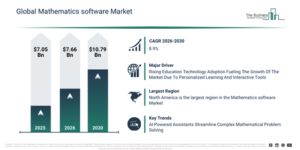
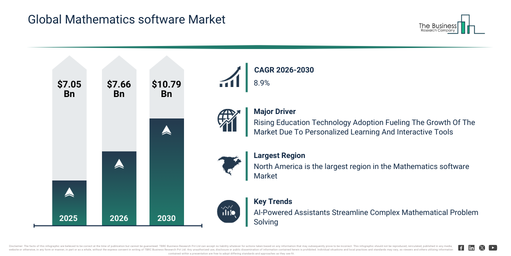
The mathematics software market size has shown strong expansion in recent years. It is projected to grow from $7.05 billion in 2025 to $7.66 billion in 2026, achieving a compound annual growth rate (CAGR) of 8.7%. This historic growth can be linked to the increasing integration of educational software in schools, a heightened demand for computational tools in research, the proliferation of e-learning platforms, the broadening of academic curriculum requirements, and the increased utilization of visualization tools in mathematics education._x000D_
_x000D_
The mathematics software market is anticipated to experience substantial growth in the forthcoming years. It is forecast to achieve a size of $10.79 billion by 2030, expanding at a compound annual growth rate (CAGR) of 8.9%. The expansion predicted for the forecast period stems from factors such as the increasing adoption of AI-powered learning software, greater integration with cloud-based Learning Management Systems (LMS), a rising requirement for real-time analytics within education, the broadening of hybrid and remote learning approaches, and the expanded deployment of mathematics software in professional research and development activities. Prominent developments expected in the forecast period include the increasing uptake of cloud-based mathematics software, a greater utilization of interactive learning and visualization instruments, an escalating demand for curriculum-aligned lesson materials, the extension of adaptive assessments and tutoring provisions, and an enhanced incorporation of analytics and reporting capabilities._x000D_
_x000D_
#Get A Free Sample Report With In-Depth Market Insights:#_x000D_
_x000D_
#Mathematics software Market Expansion Drivers: What’s Shaping Future Growth?#_x000D_
The increasing integration of educational technology is anticipated to drive the growth of the mathematics software market. Education technology adoption refers to the degree to which digital tools, software platforms, and technology-enabled solutions are incorporated and utilized in teaching, learning, and educational management processes. This adoption is escalating due to an increased emphasis on personalized learning, facilitating customized lessons and adaptive feedback for individual student requirements. Mathematics software supports this trend by providing interactive resources for learning, practice, and assessment, making it suitable for classrooms, online courses, and self-paced study. It also minimizes manual grading and lesson preparation while enhancing student engagement and conceptual understanding, thereby improving overall teaching and learning outcomes. For illustration, according to Eurostat, a Luxembourg-based government agency, 30% of internet users aged 16 to 74 had engaged with an online course or learning material by January 2024, an increase from 28% in 2022. Consequently, the growing adoption of educational technology is propelling the expansion of the mathematics software market._x000D_
_x000D_
#Mathematics software Market Segment Landscape: Which Areas Lead Development?#_x000D_
The mathematics software market covered in this report is segmented – _x000D_
_x000D_
1) By Component Type: Software, Services, Support And Maintenance_x000D_
2) By Features Offered: Interactive Visualizations, Problem-Solving Algorithms, Collaboration Tools, Customizable User Interfaces, Integration Capabilities With Other Software_x000D_
3) By Deployment Type: On-Premise, Cloud-Based, Hybrid Deployment_x000D_
4) By Application: Engineering Construction, School, Academic And Research Institutes, Other Applications_x000D_
5) By End Use Industry: Education, Healthcare, Research And Development, Financial Services, Engineering And Manufacturing_x000D_
_x000D_
Subsegments:_x000D_
1) By Software: Computer Algebra Systems, Statistical Analysis Software, Geometry And Visualization Tools, Learning Management Systems, Tutoring And Assessment Software_x000D_
2) By Services: Implementation Services, Consulting Services, Training And Education Services, Customization Services_x000D_
3) By Support And Maintenance: Technical Support, Software Updates And Upgrades, Troubleshooting Services, User Assistance And Helpdesk Services_x000D_
_x000D_
#Mathematics software Market Strategic Trends: What Defines The Next Growth Phase?#_x000D_
Major companies engaged in the mathematics software market are prioritizing the creation of technologically sophisticated solutions, such as AI-powered assistants, to improve efficiency, augment learning, and decrease the time required for intricate problem-solving. AI-powered assistants denote advanced functionalities in mathematical software that utilize artificial intelligence to generate formulas, equations, and step-by-step solutions, helping users accomplish tasks more quickly and accurately. For instance, Maplesoft, a Canada-based mathematics software company, launched the newest version of its leading product, Maple 2024, in March 2024. This powerful mathematical software suite includes a new AI Formula Assistant that provides users with formulas, equations, explanations, and Maple commands, thereby shortening the time spent on tasks and enabling creative applications of AI. It features cutting-edge algorithms for multivariate polynomial systems and integral equations, which expands its problem-solving capabilities. Additionally, it incorporates an expanded “Check My Work” feature, which scrutinizes each step of a student’s solution for errors, along with improved units support and automatic command completion to enhance usability in education and research._x000D_
_x000D_
#Mathematics software Market Key Participants And Competitive Landscape#_x000D_
Major companies operating in the mathematics software market are market are Microsoft Corporation, Siemens AG, International Business Machines Corporation, Intel Corporation, Oracle Corporation, SAP SE, Dassault Systèmes SE, Hexagon AB, Autodesk Incorporated, Cadence Design Systems Incorporated, SAS Institute Incorporated, PTC Inc., CASIO, National Instruments Corporation, MathWorks Incorporated, Wolfram Research Incorporated, Wolfram Research, and COMSOL Inc._x000D_
_x000D_
#View The Full Mathematics software Market Report:#_x000D_
_x000D_
#Mathematics software Market Geographic Analysis: Where Is Demand Accelerating Fastest?#_x000D_
North America was the largest region in the mathematics software market in 2025. Asia-Pacific is expected to be the fastest-growing region in the forecast period. The regions covered in the mathematics software market report are Asia-Pacific, South East Asia, Western Europe, Eastern Europe, North America, South America, Middle East, Africa._x000D_
_x000D_
#Reach Out To Our Team:#_x000D_
_x000D_
The Business Research Company: https://www.thebusinessresearchcompany.com/_x000D_
Americas: +1 310-496-7795_x000D_
Asia: +44 7882 955267 & +91 8897263534_x000D_
Europe: +44 7882 955267_x000D_
Email us at: marketing@tbrc.info_x000D_
_x000D_
#Follow us on:#_x000D_
_x000D_
LinkedIn: https://in.linkedin.com/company/the-business-research-company_x000D_
YouTube: https://www.youtube.com/channel/UC24_fI0rV8cR5DxlCpgmyFQ_x000D_
Global Market Model: https://www.thebusinessresearchcompany.com/global-market-model

Wasay has over a decade of experience in market research, data modelling, and analytics, with prior experience at GlobalData and Decision Tree Consulting Services. At The Business Research Company , he leads research operations across syndicated studies, customized consulting engagements, and the Global Market Model platform. His professional experience includes supporting organizations such as Boston Consulting Group, KPMG, and Ernst & Young. Wasay holds a degree in Electronics and Communications Engineering, postgraduate management qualifications from International Management Institute Belgium and Indian School of Business and Entrepreneurship, and completed the Integrated Program in Business Analytics from Indian Institute of Management Indore.