With a focus on actionable insights and strategic value, The Business Research Company’s 2026 market reports include market attractiveness scoring, total addressable market sizing, company benchmarking matrices, interactive Excel dashboards, deeper supply chain intelligence, emerging startup tracking, and granular product-level insights.
How Much Will The Metro-Edge 400 ZR Market Be Worth By 2030?
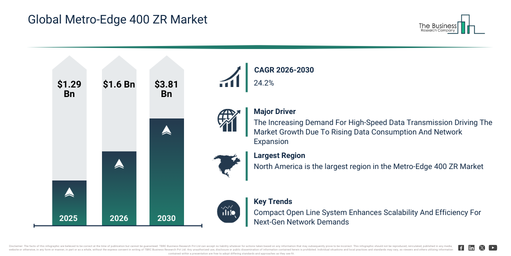
The metro-edge 400 zr market size has shown significant expansion in recent years. It is anticipated to increase from $1.29 billion in 2025 to $1.6 billion in 2026, exhibiting a compound annual growth rate (CAGR) of 24.5%. This historical growth can be attributed to several factors, including the expansion of metro and data center networks, the increasing demand for high-speed ethernet, the development of optical transport infrastructure, the adoption of dense wavelength division multiplexing, and the necessity for low-latency, high-capacity links.
The metro-edge 400 zr market is projected to experience substantial growth in the upcoming years. It is anticipated to reach a valuation of $3.81 billion by 2030, demonstrating a compound annual growth rate (CAGR) of 24.2%. This expansion during the forecast period is primarily driven by factors such as the increasing adoption of 400zr modules in metro-edge networks, the expansion of cloud connectivity, the ongoing development of high-density data center interconnects, the rising utilization of coherent optical transceivers, and the broader deployment of edge network solutions. Key trends anticipated during this period encompass high-capacity 400 gbps transmission, the demand for low-latency optical connectivity, the application of dual-polarized 16-qam modulation, the widespread implementation of forward error correction, and the integration of compact qsfp-dd and osfp form factors.
Get Access To A Free Metro-Edge 400 ZR Market Report Sample:
The Key Driver Behind The Metro-Edge 400 ZR Market’s 24.2% CAGR
The metro-edge 400 ZR market is anticipated to expand due to the escalating need for high-speed data transmission. This refers to the swift transfer of large volumes of data across communication networks, which is crucial for applications such as streaming, gaming, and cloud computing. The demand for rapid data transfer is rising as data-intensive applications and services become more widespread, requiring faster and more reliable network connections to function effectively. Metro-edge 400ZR facilitates high-speed data transmission by integrating coherent optical technology, dual-polarized 16-QAM modulation, and advanced forward error correction, thereby maximizing bandwidth efficiency, minimizing signal degradation, and enabling dependable 400 Gbps connectivity over long-distance DWDM links. For instance, in December 2024, the Office of Communications (Ofcom), a UK-based regulator for communication services, reported that high-speed broadband access for UK SMEs strengthened in 2024; full-fiber coverage reached 63 percent, marking a 12-point increase from September 2023, and gigabit-capable availability rose to 79 percent, an increase of five points over the same period. Consequently, the growing demand for high-speed data transmission is driving the expansion of the metro-edge 400 ZR market.
Metro-Edge 400 ZR Market Classification: Main Segments And Detailed Subsegments
The metro-edge 400 zr market covered in this report is segmented –
1) By Component: Transceivers, Modules, Solutions, Services
2) By Data Rate: 400 Gigabits Per Second (Gbps), Other Data Rates
3) By Application: Data Center Interconnect, Metro Networks, Long Haul, Cloud Connectivity, Other Applications
4) By End-User: Telecommunications, Cloud Service Providers, Enterprises, Other End-Users
Subsegments:
1) By Transceivers: 100 Gigabit Transceivers, 400 Gigabit Transceivers, Coherent Transceivers, Pluggable Transceivers
2) By Modules: Amplifier Modules, Multiplexer Modules, Optical Line Modules, Transponder Modules
3) By Solutions: Metro Network Solutions, Edge Network Solutions, Optical Transport Solutions, High Capacity Network Solutions
4) By Services: Installation Services, Maintenance Services, Consulting Services, Training Services
Metro-Edge 400 ZR Market Strategic Shifts: What Leading Players Are Prioritizing
Leading companies in the metro-edge 400ZR market are concentrating on creating advanced solutions, including compact open line systems, to cut expenses and enhance network scalability. An open line system (OLS) functions as an adaptable optical transport infrastructure, compatible with transponders and coherent optics from various vendors, thereby assisting operators in reducing expenditures, avoiding reliance on a single vendor, and scaling networks more effectively. For example, in March 2025, Adtran Inc., a US-based telecommunications company, launched its FSP 3000 IP OLS (Open Line System) to address the escalating network demands driven by AI. This new solution is engineered for simplified deployment through a plug-and-play architecture, offering scalability from 400G up to 1.6T per wavelength. Featuring a compact design, minimal power consumption, and integrated automation tools, the FSP 3000 IP OLS enables operators to efficiently expand capacity and speed up service deployment. It also incorporates sophisticated fiber-assurance capabilities, facilitating real-time monitoring and issue resolution to guarantee network reliability in high-traffic environments. The platform is specifically optimized for metro-edge 400ZR deployments, offering operators a cost-effective and scalable method to extend coherent optics further into metro and edge networks.
Metro-Edge 400 ZR Market Company Analysis: Major Industry Participants
Major companies operating in the metro-edge 400 zr market are Huawei Technologies Co. Ltd., Cisco Systems Inc., Fujitsu Limited, NEC Corporation, Nokia Corporation, ZTE Corporation, Molex LLC, Juniper Networks Inc., Marvell Technology Inc., Ciena Corporation, ADVA Optical Networking SE, Lumentum Holdings Inc., Accelink Technologies Co. Ltd., MACOM Technology Solutions Holdings Inc., Source Photonics Inc., Eoptolink Technology Inc. Ltd., Ekinops S.A., Smartoptics ASA, PacketLight Networks Ltd., Optcore Inc.
Get Full Access To The Metro-Edge 400 ZR Market Report 2026:
Metro-Edge 400 ZR Market Global Regional Breakdown: Key Regions Analyzed
North America was the largest region in the metro-edge 400 ZR market in 2025. Asia-Pacific is expected to be the fastest-growing region in the forecast period. The regions covered in the metro-edge 400 zr market report are Asia-Pacific, South East Asia, Western Europe, Eastern Europe, North America, South America, Middle East, Africa.
Reach Out To Our Team:
The Business Research Company: https://www.thebusinessresearchcompany.com/
Americas: +1 310-496-7795
Asia: +44 7882 955267 & +91 8897263534
Europe: +44 7882 955267
Email us at: marketing@tbrc.info
Follow us on:
LinkedIn: https://in.linkedin.com/company/the-business-research-company
YouTube: https://www.youtube.com/channel/UC24_fI0rV8cR5DxlCpgmyFQ
Global Market Model: https://www.thebusinessresearchcompany.com/global-market-model

Wasay has over a decade of experience in market research, data modelling, and analytics, with prior experience at GlobalData and Decision Tree Consulting Services. At The Business Research Company , he leads research operations across syndicated studies, customized consulting engagements, and the Global Market Model platform. His professional experience includes supporting organizations such as Boston Consulting Group, KPMG, and Ernst & Young. Wasay holds a degree in Electronics and Communications Engineering, postgraduate management qualifications from International Management Institute Belgium and Indian School of Business and Entrepreneurship, and completed the Integrated Program in Business Analytics from Indian Institute of Management Indore.