Featuring market attractiveness scoring, total addressable market sizing, company benchmarking matrices, interactive Excel dashboards, deeper supply chain intelligence, emerging startup tracking, and granular product-level insights, The Business Research Company’s 2026 market reports are built to deliver research that is both more actionable and more strategically valuable.
Millimeter Wave Technology Market Expansion Outlook: What Revenue Opportunities Are Ahead?
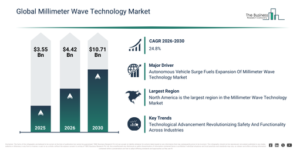
The millimeter wave technology market has experienced substantial expansion in recent years. It is projected to grow from $3.55 billion in 2025 to $4.42 billion in 2026, achieving a compound annual growth rate (CAGR) of 24.4%. The factors driving this historical growth include defense radar modernization, increasing demand for satellite communication, the expansion of spectrum availability, advancements in semiconductor innovation, and early 5G trials.
The millimeter wave technology market is projected for significant expansion over the coming years. Its valuation is anticipated to reach $10.71 billion by 2030, driven by a compound annual growth rate (CAGR) of 24.8%. This anticipated growth is primarily fueled by factors such as the deployment of dense urban 5G networks, increasing demand for autonomous vehicle sensing, investments in smart infrastructure, the emergence of next-generation satellite networks, and the expansion of industrial automation. Key trends shaping this period encompass the implementation of high-frequency radar, the broadening of satellite communication, enhanced 5G and backhaul integration, progress in advanced antenna miniaturization, and the development of high-resolution imaging systems.
Get A Free Sample Report With In-Depth Market Insights:
Millimeter Wave Technology Market Expansion Drivers: What’s Shaping Future Growth?
The adoption of autonomous vehicles is projected to stimulate the expansion of the millimeter wave technology market moving forward. Autonomous vehicles are defined as vehicles designed to operate and navigate without the need for human input. These vehicles integrate advanced sensors, cameras, radar, lidar, and artificial intelligence algorithms to understand their environment, make choices, and manage their motion. Millimeter wave technology enables autonomous vehicles to communicate instantaneously, transfer large volumes of data, and arrive at sound decisions. For instance, in 2024, the International Energy Agency (IEA), an autonomous intergovernmental organization based in France, reported that electric cars made up approximately 18% of all cars sold in 2023, an increase from 14% in 2022. Furthermore, in China, new electric car registrations reached 8.1 million in 2023, signifying a 35% rise compared to 2022. Consequently, the increasing embrace of autonomous vehicles is driving the growth of the millimeter wave technology market.
Millimeter Wave Technology Market Segment Landscape: Which Areas Lead Development?
The millimeter wave technology market covered in this report is segmented –
1) By Component: Antennas And Transceiver Components, Frequency Sources And Related Components, Communication And Networking Components, Imaging Components, RF And Radio Components, Sensors And Controls, Interface Components, Power And Battery Components, Other Components
2) By Product: Scanning Systems, Radar And Satellite Communication Systems, Telecommunication Equipment, Other Products
3) By License Type: Light Licensed Frequency Millimeter Wave, Unlicensed Frequency Millimeter Wave, Fully Licensed Frequency Millimeter Wave
4) By Frequency: 24 GHz To 57 GHz, 58 GHz To 86 GHz, 87 GHz To 300 GHz
5) By End-Use: Telecommunications, Military And Defense, Automotive And Transport, Healthcare, Electronics And Semiconductor, Security
Subsegments:
1) By Antennas And Transceiver Components: Antenna Arrays, Transmitter Modules, Receiver Modules, Integrated Circuits
2) By Frequency Sources And Related Components: Oscillators, Frequency Synthesizers, Signal Generators, Mixers
3) By Communication And Networking Components: Modulators, Demodulators, Routers, Switches
4) By Imaging Components: Millimeter Wave Cameras, Sensors, Imaging Software
5) By RF And Radio Components: Amplifiers, Filters, Waveguides
6) By Sensors And Controls: Proximity Sensors, Motion Sensors, Control Units
7) By Interface Components: Connectors, Adapters, Cables
8) By Power And Battery Components: Power Amplifiers, Battery Management Systems, Energy Harvesting Modules
9) By Other Components: Heat Sinks, Enclosures, Miscellaneous Accessories
Millimeter Wave Technology Market Strategic Trends: What Defines The Next Growth Phase?
Leading companies in the millimeter wave technology market are adopting new technologies to maintain their market standing. For instance, in January 2023, SMK Electronics Corporation, a US-based electrical and electronics manufacturing company, introduced Milweb Millimeter Wave Sensor Technology and Solution. Milweb Millimeter Wave Sensor Technology is an innovative sensor technology that uses proprietary algorithms to identify objects, surfaces, and terrain, and can even measure an individual’s heart rate and respiration at a close range. This adaptable sensor technology is applicable in various industries, such as home automation, automotive manufacturing, healthcare, and safety products. It facilitates the automation and integration of intelligent technologies, enabling manufacturers to improve product offerings with advanced safety features and functionalities. With its wide range of applications, including health monitoring, security systems, room occupancy detection, and vehicle alert systems, Milweb Millimeter Wave Sensor Technology creates new opportunities for enhanced functionality and improved safety in different environments.
Millimeter Wave Technology Market Industry Leaders And Competitive Landscape
Major companies operating in the millimeter wave technology market are Huawei Technologies Co. Ltd.; Lockheed Martin Corporation; Denso Corporation; QUALCOMM Inc.; Mitsubishi Electric Corporation; Fujitsu Limited; Ericsson; NEC Corporation; L3Harris Technologies Inc.; Toyoda Gosei Co. Ltd.; Keysight Technologies Inc.; Smiths Interconnect; Aviat Networks Inc.; Vayyar Imaging Ltd.; Siklu Communications Ltd.; REMEC Broadband Wireless Networks LLC; Radio Gigabit Inc.; Eravant; Sivers Semiconductors AB; Farran Technology Ltd.; LightPointe Communications Inc.; Millimeter Wave Products Inc.; Blu Wireless Technology Limited; Vubiq Networks Inc.; E-Band Communications LLC; BridgeComm Inc.; Movandi Corporation; Wireless Excellence Limited
View The Full Millimeter Wave Technology Market Report:
Millimeter Wave Technology Market Regional Analysis: Which Geography Leads On Revenue?
North America was the largest region in the millimeter wave technology market in 2025. Europe is expected to be the fastest-growing region in the forecast period. The regions covered in the millimeter wave technology market report are Asia-Pacific, South East Asia, Western Europe, Eastern Europe, North America, South America, Middle East, Africa.
Reach Out To Our Team:
The Business Research Company: https://www.thebusinessresearchcompany.com/
Americas: +1 310-496-7795
Asia: +44 7882 955267 & +91 8897263534
Europe: +44 7882 955267
Email us at: marketing@tbrc.info
Follow us on:
LinkedIn: https://in.linkedin.com/company/the-business-research-company
YouTube: https://www.youtube.com/channel/UC24_fI0rV8cR5DxlCpgmyFQ
Global Market Model: https://www.thebusinessresearchcompany.com/global-market-model

Wasay has over a decade of experience in market research, data modelling, and analytics, with prior experience at GlobalData and Decision Tree Consulting Services. At The Business Research Company , he leads research operations across syndicated studies, customized consulting engagements, and the Global Market Model platform. His professional experience includes supporting organizations such as Boston Consulting Group, KPMG, and Ernst & Young. Wasay holds a degree in Electronics and Communications Engineering, postgraduate management qualifications from International Management Institute Belgium and Indian School of Business and Entrepreneurship, and completed the Integrated Program in Business Analytics from Indian Institute of Management Indore.