With a focus on actionable insights and strategic value, The Business Research Company’s 2026 market reports include market attractiveness scoring, total addressable market sizing, company benchmarking matrices, interactive Excel dashboards, deeper supply chain intelligence, emerging startup tracking, and granular product-level insights.
Mobile Workforce Management Market Size Analysis: Historical Growth And Future Revenue Projections
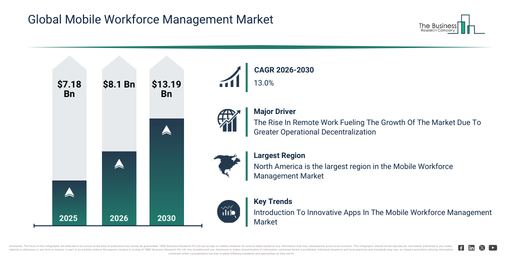
The mobile workforce management market has experienced significant expansion in recent years. It is forecast to increase from $7.18 billion in 2025 to $8.1 billion in 2026, achieving a compound annual growth rate (CAGR) of 12.8%. Historically, this growth can be attributed to the rise of remote workforces, the expansion of field service operations, the adoption of mobile devices, the demand for operational efficiency, and various workforce digitization initiatives.
The mobile workforce management market size is projected to experience substantial growth in the upcoming years. It is forecast to expand to $13.19 billion by 2030, exhibiting a compound annual growth rate (CAGR) of 13.0%. This expansion during the projection period can be attributed to factors such as AI-driven workforce optimization, IoT-enabled workforce monitoring, the rising demand for real-time analytics, increased adoption of subscription-based software, and the ongoing growth of remote workforces. Prominent trends anticipated for this forecast period encompass real-time workforce tracking, cloud-based workforce platforms, mobile-first strategies for field operations, predictive workforce analytics, and integrated communication tools.
Preview The Mobile Workforce Management Market Report With A Free Sample:
Mobile Workforce Management Market Drivers: What Is Fueling Demand Through 2030?
The increasing prevalence of remote work is anticipated to fuel the expansion of the mobile workforce management market moving forward. Remote work is defined as the practice of performing job duties away from a conventional office setup, typically from a location other than the employer’s primary physical site. Mobile workforce management supports remote work by supplying resources and procedures to effectively oversee employees who are not physically present in a central office. For example, in February 2023, the Office for National Statistics, a UK-based government department, reported that between September 2022 and January 2023, 16% of working adults exclusively worked from home, while a higher 28% reported a mix of working from home and commuting. Thus, the growth in remote work is a key driver for the mobile workforce management market.
Mobile Workforce Management Market Segmentation Analysis: Core Categories And Subcategories
The mobile workforce management market covered in this report is segmented –
1) By Type: Cloud-Based, On-Premise
2) By Component: Solutions, Services
3) By End-User: Banking, Financial Services and Insurance(BFSI), Communication, Logistics, Manufacturing, Procurement, Other End Users
Subsegments:
1) By Cloud-Based: Software As A Service (Saas) Solutions, Mobile Application Platforms, Remote Monitoring And Management Tools, Data Storage And Backup Services, Subscription-Based Models
2) By On-Premise: Installed Software Solutions, Local Server Management Systems, Customized Workforce Management Applications, In-House Data Storage And Processing, Dedicated Hardware Setups
Which Trends Will Define The Mobile Workforce Management Market Through 2030?
Leading companies operating in the mobile workforce management market are developing innovative applications, such as Skedulo Plus, to secure a competitive advantage. Skedulo Plus aims to transform how mobile workers manage their tasks and provide an uninterrupted experience for businesses utilizing mobile workforces. For example, in October 2023, Skedulo, a US-based provider of cloud-based productivity software, launched Skedulo Plus, a new mobile workforce management app designed to empower businesses with mobile workers to manage, schedule, and complete work with greater efficiency. This application delivers a robust, consumer-grade user experience that can be adapted and extended to meet the specific requirements of mobile workers. The unique functionalities of Skedulo Plus include a consumer-grade user experience, flexible architecture, multi-language support, offline data synchronization for resources in the field, the ability to accept and view jobs, availability management, among others.
Mobile Workforce Management Market Major Companies And Industry Participants
Major companies operating in the mobile workforce management market are Microsoft Corporation; Verizon Wireless; AT&T Inc.; IBM Corporation; Oracle Corporation; SAP SE; ServiceMax; ADP LLC; TELUS; Jobber; Zebra Technologies; Trimble Inc.; Kronos; Pegasystems Inc.; Verint; Calabrio; Descartes Systems Group; Red Hat Inc.; Skedulo; Actsoft Inc.; BigChange; Vox Mobile; FieldAware; ProntoForms Corporation
Buy The Full Mobile Workforce Management Global Market Report 2026:
Mobile Workforce Management Market Geographic Analysis: Which Region Accounts For The Biggest Share?
North America was the largest region in the mobile workforce management market in 2025. The regions covered in the mobile workforce management market report are Asia-Pacific, South East Asia, Western Europe, Eastern Europe, North America, South America, Middle East, Africa.
Reach Out To Our Team:
The Business Research Company: https://www.thebusinessresearchcompany.com/
Americas: +1 310-496-7795
Asia: +44 7882 955267 & +91 8897263534
Europe: +44 7882 955267
Email us at: marketing@tbrc.info
Follow us on:
LinkedIn: https://in.linkedin.com/company/the-business-research-company
YouTube: https://www.youtube.com/channel/UC24_fI0rV8cR5DxlCpgmyFQ
Global Market Model: https://www.thebusinessresearchcompany.com/global-market-model

Wasay has over a decade of experience in market research, data modelling, and analytics, with prior experience at GlobalData and Decision Tree Consulting Services. At The Business Research Company , he leads research operations across syndicated studies, customized consulting engagements, and the Global Market Model platform. His professional experience includes supporting organizations such as Boston Consulting Group, KPMG, and Ernst & Young. Wasay holds a degree in Electronics and Communications Engineering, postgraduate management qualifications from International Management Institute Belgium and Indian School of Business and Entrepreneurship, and completed the Integrated Program in Business Analytics from Indian Institute of Management Indore.