Built to provide research that’s more actionable and strategically valuable, The Business Research Company’s 2026 market reports include market attractiveness analysis, total addressable market sizing, company benchmarking matrices, interactive Excel dashboards, broader supply chain intelligence, emerging startup tracking, and in-depth product insights.
#Model Hallucination Detection Market Size Outlook: How Quickly Will Revenue Expand Through 2030?#_x000D_
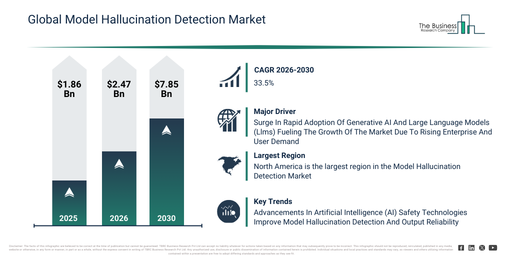
The model hallucination detection market has experienced significant expansion recently. This market is projected to expand from $1.86 billion in 2025 to $2.47 billion in 2026, demonstrating a compound annual growth rate (CAGR) of 33.2%. Historically, this expansion has been driven by factors such as the swift uptake of generative AI models, a rise in AI-produced misinformation cases, enterprises increasingly depending on automated decision systems, intensified regulatory oversight concerning AI transparency, and the proliferation of cloud-based AI solutions._x000D_
_x000D_
The model hallucination detection market size is anticipated to undergo significant expansion in the coming years, with projections indicating it will reach $7.85 billion in 2030, demonstrating a compound annual growth rate (CAGR) of 33.5%. This anticipated growth is propelled by factors such as the escalating demand for reliable AI frameworks, increased investment in AI governance infrastructure, the broader deployment of enterprise AI monitoring solutions, the expanding application of AI in high-risk sectors, and the rising necessity for real-time AI validation tools. Noteworthy trends for the forecast period encompass a surge in the adoption of AI model auditing services, the increased implementation of real-time hallucination monitoring platforms, a growing requirement for compliance and governance consulting, the broadening of data annotation and validation services, and the incorporation of explainability and visualization tools within AI testing._x000D_
_x000D_
#Get A Free Sample Report With In-Depth Market Insights:#_x000D_
_x000D_
#Model Hallucination Detection Market Growth Backed By Core Demand Fundamentals#_x000D_
The quick uptake of generative AI and large language models (LLMs) is projected to boost the expansion of the model hallucination detection market in the future. Generative AI and large language models (LLMs) represent sophisticated AI systems capable of producing human-like text, code, or other content based on user inputs. The integration of generative AI and LLMs is increasing as both businesses and individuals incorporate these technologies into their operations and routines to improve efficiency and aid decision-making. Solutions for model hallucination detection play a crucial role in guaranteeing the precision and dependability of outputs from generative AI and LLM implementations, thereby meeting the growing need for reliable AI in vital applications. As an illustration, in November 2025, data from the Federal Reserve Bank of St. Louis, a US-based government-affiliated central banking institution, indicated a substantial increase in the overall use of generative AI for both work and personal activities between August 2024 and August 2025. Specifically, in August 2024, 44.6% of adults aged 18–64 stated they used generative AI, and this proportion grew by 10 percentage points over the subsequent 12 months, reaching 54.6%. Consequently, the swift uptake of generative AI and large language models (LLMs) is fueling the expansion of the model hallucination detection market._x000D_
_x000D_
#Model Hallucination Detection Market Segment Analysis And Revenue Potential#_x000D_
The model hallucination detection market covered in this report is segmented – _x000D_
_x000D_
1) By Component: Software, Hardware, Services_x000D_
2) By Deployment Mode: On-Premises, Cloud_x000D_
3) By Enterprise Size: Small And Medium Enterprises, Large Enterprises_x000D_
4) By Application: Content Generation Validation, Conversational Artificial Intelligence (AI) Monitoring, Decision Support Systems, Enterprise Artificial Intelligence (AI) Governance_x000D_
5) By End-User: Banking, Financial Services, And Insurance (BFSI), Healthcare, Retail And E-commerce, Media And Entertainment, Manufacturing, Information Technology And Telecommunications, Other End-Users_x000D_
_x000D_
Subsegments:_x000D_
1) By Software: Model Monitoring Platforms, Hallucination Detection Algorithms, Explainability And Visualization Tools, Data Validation And Quality Management Software, Reporting And Analytics Solutions_x000D_
2) By Hardware: High Performance Servers, Graphics Processing Units, Edge Computing Devices, Data Storage Systems, Network Infrastructure Equipment_x000D_
3) By Services: Consulting And Strategy Services, System Integration And Deployment Services, Model Auditing And Validation Services, Training And Knowledge Transfer Services, Maintenance And Technical Support Services_x000D_
_x000D_
#Model Hallucination Detection Market Growth Trends Reshaping The Competitive Landscape#_x000D_
Major companies operating in the model hallucination detection market are concentrating on technological innovations, such as real-time hallucination detection models, to elevate the accuracy, dependability, and trustworthiness of AI-generated outputs across vital applications. Real-time hallucination detection models refer to AI systems that continuously observe and evaluate outputs from generative models as they are created, immediately pinpointing inaccuracies or unsupported information. For instance, in July 2024, Patronus AI, a US-based AI safety platform company, introduced Lynx, a sophisticated, open-source hallucination detection model crafted to identify inaccurate or unfaithful responses generated by large language models (LLMs) in real time. It assists enterprises and developers in enhancing the reliability of AI outputs without heavily depending on manual annotation or expensive proprietary “LLM-as-a-judge” methods. Patronus AI also unveiled HaluBench, a real-world benchmark dataset created to assess hallucination detection performance across domains like finance and medicine. Lynx reportedly surpasses leading models such as GPT-4o, GPT-4-Turbo, and Claude-3 in detecting hallucinations._x000D_
_x000D_
#Model Hallucination Detection Market Company Landscape And Competitive Strategy#_x000D_
Major companies operating in the model hallucination detection market are Arthur AI Inc, Aporia Technologies Ltd, Patronus AI Inc, Vectara Inc, Confident AI Inc, Lakera AI AG, Galileo Technologies Inc, Helicone Inc, Weights and Biases LLC, Fiddler Labs Inc, Arize AI Inc, Giskard Datatech Private Limited, Deepchecks Inc, Parea AI Inc, RivetAI Inc, Credo AI Corp, NannyML NV, Portkey AI Software India Private Limited, LatticeFlow AG, Robust Intelligence Inc, Monitaur Inc, Seldon Technologies Limited, UpTrain AI India Private Limited, Langfuse GmbH, and Magniv Inc._x000D_
_x000D_
#View The Full Model Hallucination Detection Market Report:#_x000D_
_x000D_
#Model Hallucination Detection Market Largest Region: Which Geography Holds The Biggest Share?#_x000D_
North America was the largest region in the model hallucination detection market in 2025. Asia-Pacific is expected to be the fastest-growing region in the forecast period. The regions covered in the model hallucination detection market report are Asia-Pacific, South East Asia, Western Europe, Eastern Europe, North America, South America, Middle East, Africa._x000D_
_x000D_
#Reach Out To Our Team:#_x000D_
_x000D_
The Business Research Company: https://www.thebusinessresearchcompany.com/_x000D_
Americas: +1 310-496-7795_x000D_
Asia: +44 7882 955267 & +91 8897263534_x000D_
Europe: +44 7882 955267_x000D_
Email us at: marketing@tbrc.info_x000D_
_x000D_
#Follow us on:#_x000D_
_x000D_
LinkedIn: https://in.linkedin.com/company/the-business-research-company_x000D_
YouTube: https://www.youtube.com/channel/UC24_fI0rV8cR5DxlCpgmyFQ_x000D_
Global Market Model: https://www.thebusinessresearchcompany.com/global-market-model

Wasay has over a decade of experience in market research, data modelling, and analytics, with prior experience at GlobalData and Decision Tree Consulting Services. At The Business Research Company , he leads research operations across syndicated studies, customized consulting engagements, and the Global Market Model platform. His professional experience includes supporting organizations such as Boston Consulting Group, KPMG, and Ernst & Young. Wasay holds a degree in Electronics and Communications Engineering, postgraduate management qualifications from International Management Institute Belgium and Indian School of Business and Entrepreneurship, and completed the Integrated Program in Business Analytics from Indian Institute of Management Indore.