Built to provide research that’s more actionable and strategically valuable, The Business Research Company’s 2026 market reports include market attractiveness analysis, total addressable market sizing, company benchmarking matrices, interactive Excel dashboards, broader supply chain intelligence, emerging startup tracking, and in-depth product insights.
Model Parallelism Orchestration Market Revenue Growth On Track For A 22.2% CAGR Through 2030
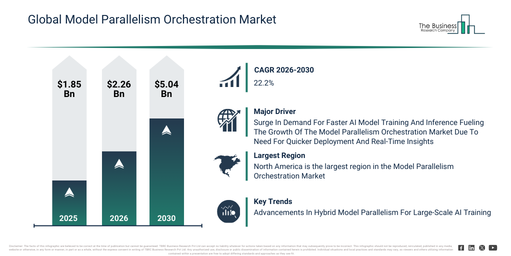
The model parallelism orchestration market size has experienced rapid growth in recent years. It is anticipated to expand from $1.85 billion in 2025 to $2.26 billion in 2026, at a compound annual growth rate (CAGR) of 22.0%. The historical growth in this market can be attributed to the increasing adoption of large-scale AI models, a rising demand for high-performance computing, the emergence of deep learning applications, the expansion of cloud infrastructure for AI training, and the necessity for efficient resource utilization.
The size of the model parallelism orchestration market is projected to experience rapid expansion over the coming years. This market is forecast to reach $5.04 billion by 2030, exhibiting a compound annual growth rate (CAGR) of 22.2%. Factors contributing to this growth during the projection period include the rapid advancement of generative AI models, the widespread embrace of distributed training frameworks, a rise in investment within AI infrastructure, the necessity for real-time inference capabilities at scale, and the incorporation of orchestration into edge and hybrid cloud environments. Key trends anticipated for this forecast timeframe encompass workload partitioning and scheduling, continuous real-time performance monitoring, robust error detection and fault tolerance mechanisms, efforts to optimize training efficiency, and seamless integration with various AI frameworks.
Get A Free Sample Report With In-Depth Market Insights:
Model Parallelism Orchestration Market Growth Factors: What’s Supporting Expansion?
The model parallelism orchestration market is anticipated to grow due to the increasing demand for faster training and inference of large AI models. This refers to reducing the time and computational resources required to train models and generate predictions. The escalating demand for quicker training and inference of large AI models is driven by the necessity for faster deployment, enabling organizations to update models rapidly and deliver real-time insights. Model parallelism orchestration supports this growing demand by distributing model workloads across multiple GPUs or accelerators, thereby improving computational efficiency and reducing processing latency. For instance, according to Eurostat, a Luxembourg-based statistical office of the European Union, 55.03% of large EU enterprises used AI technologies in December 2025. Therefore, the growing demand for faster training and inference of large AI models is expected to drive the growth of the model parallelism orchestration market.
Model Parallelism Orchestration Market Segment Performance And Emerging Opportunities
The model parallelism orchestration market covered in this report is segmented –
1) By Component: Software, Hardware, Services
2) By Deployment Mode: On Premises, Cloud
3) By Enterprise Size: Small And Medium Enterprises, Large Enterprises
4) By Application: Deep Learning, Natural Language Processing, Computer Vision, Recommendation Systems, Other Applications
5) By End User: Banking, Financial Services And Insurance, Healthcare, Information Technology And Telecommunications, Retail And E Commerce, Automotive, Other End Users
Subsegments:
1) By Software: Robot Operating Systems And Firmware, Simulation And Digital Twin Software, Motion Planning And Path Optimization, Artificial Intelligence And Machine Learning Software, Vision And Perception Software, Cell And Fleet Management Software, Manufacturing Execution System Or Enterprise Resource Planning Integration Software, Predictive Maintenance And Analytics, Cybersecurity Software, Low Code Or No Code Programming Tools
2) By Hardware: Robot Arms And Manipulators, Collaborative Robots, End Effectors And Grippers, Sensors And Perception Hardware, Actuators And Drives, Machine Vision Systems, Controllers And Programmable Logic Controllers, Automated Guided Vehicles And Autonomous Mobile Robots, Safety Systems And Fencing, Power And Cabling Infrastructure
3) By Services: System Design And Engineering, Integration And Commissioning, Maintenance And Field Support, Training And Skill Development, Retrofit And Modernization Services, Custom Application Development, Robotics As A Service, Validation And Testing Services, Consulting And Return On Investment Analysis, Research And Development And Co Innovation Services
Model Parallelism Orchestration Market Industry Trends: What’s Reshaping Demand?
Leading companies within the model parallelism orchestration market are concentrating on developing hybrid parallelism, which integrates data and model parallelisms, exemplified by large-scale training. This focus aims to enhance computational efficiency, decrease training duration, optimize resource allocation across distributed systems, and facilitate faster, more accurate AI model deployment on a large scale. Large-scale training denotes the procedure of instructing machine learning models, particularly deep learning models, using exceptionally vast datasets and/or very extensive model architectures that necessitate considerable computational resources. As an illustration, in October 2023, PyTorch, a US-based open-source machine learning platform, introduced PyTorch Monarch, an innovative framework tailored for model parallelism across thousands of GPUs. PyTorch Monarch offers automated partitioning of models, dynamic scheduling of computation across various devices, and effortless integration with existing PyTorch workflows. Its distinctive capabilities include efficient memory optimization, real-time scaling, and the capacity to support extremely large models that were formerly unachievable with conventional configurations. This technology is applied in training cutting-edge large language models, generative AI systems, and intricate simulation models, providing significant enhancements in speed and resource utilization.
Model Parallelism Orchestration Market Industry Leaders And Competitive Landscape
Major companies operating in the model parallelism orchestration market are Amazon Web Services Inc., Alphabet Inc., Microsoft Corporation, Meta Platforms Inc., Alibaba Group Holding Limited, Dell Technologies Inc., International Business Machines Corporation, Oracle Corporation, Uber Technologies Inc., Hewlett Packard Enterprise Company, NVIDIA Corporation, Databricks Inc., Domo Inc., Hugging Face Inc., Anyscale Inc., Aleph Alpha GmbH, Lambda Labs Inc., Seldon Technologies Limited, Prefect Technologies Inc., Adaptive ML Inc.
View The Full Model Parallelism Orchestration Market Report:
Model Parallelism Orchestration Market Regional Analysis And Leading Geography
North America was the largest region in the model parallelism orchestration market in 2025. Asia-Pacificis expected to be the fastest-growing region in the forecast period. The regions covered in the model parallelism orchestration market report are Asia-Pacific, South East Asia, Western Europe, Eastern Europe, North America, South America, Middle East, Africa.
Reach Out To Our Team:
The Business Research Company: https://www.thebusinessresearchcompany.com/
Americas: +1 310-496-7795
Asia: +44 7882 955267 & +91 8897263534
Europe: +44 7882 955267
Email us at: marketing@tbrc.info
Follow us on:
LinkedIn: https://in.linkedin.com/company/the-business-research-company
YouTube: https://www.youtube.com/channel/UC24_fI0rV8cR5DxlCpgmyFQ
Global Market Model: https://www.thebusinessresearchcompany.com/global-market-model

Wasay has over a decade of experience in market research, data modelling, and analytics, with prior experience at GlobalData and Decision Tree Consulting Services. At The Business Research Company , he leads research operations across syndicated studies, customized consulting engagements, and the Global Market Model platform. His professional experience includes supporting organizations such as Boston Consulting Group, KPMG, and Ernst & Young. Wasay holds a degree in Electronics and Communications Engineering, postgraduate management qualifications from International Management Institute Belgium and Indian School of Business and Entrepreneurship, and completed the Integrated Program in Business Analytics from Indian Institute of Management Indore.