Backed by market attractiveness analysis, total addressable market sizing, company benchmarking matrices, interactive Excel dashboards, wider supply chain intelligence, emerging startup coverage, and detailed product-level insights, The Business Research Company’s 2026 market reports are designed to offer research that is more actionable and strategically valuable than ever.
#Multimodal Affective Computing Market Value Analysis: What Growth Lies Ahead Over The Forecast Period?#_x000D_
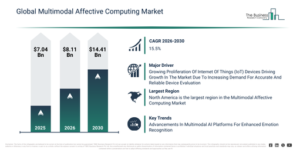
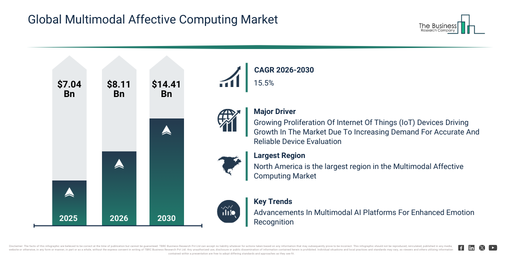
The multimodal affective computing market has experienced significant growth in recent years. Projections indicate it will grow from $7.04 billion in 2025 to $8.11 billion in 2026, exhibiting a compound annual growth rate (CAGR) of 15.2%. This historical expansion is primarily driven by an increasing demand for enhanced human-computer interaction, the rising adoption of facial and speech recognition technologies, the growing application of AI in customer experience management, the expansion of wearable biometric devices, and increasing investments in mental health technology._x000D_
_x000D_
The multimodal affective computing market is projected to experience substantial expansion over the coming years, reaching $14.41 billion by 2030, driven by a compound annual growth rate (CAGR) of 15.5%. This market’s expansion during the projection period can be attributed to several factors, including the increasing implementation of cloud-based emotion analytics platforms, a heightened need for adaptive learning systems, the greater incorporation of multimodal systems into automotive safety features, the wider adoption of edge computing for immediate affect analysis, and a growing emphasis on virtual assistants capable of understanding emotions. Key trends anticipated for the forecast period encompass a rising embrace of multimodal fusion systems, an escalating requirement for real-time emotion recognition services, the broader incorporation of wearable devices for emotion monitoring, the development of more mental health monitoring applications, and an intensified focus on personalized human-computer interactions._x000D_
_x000D_
#Get A Free Sample Report With In-Depth Market Insights:#_x000D_
_x000D_
#Multimodal Affective Computing Market Growth Factors: What’s Supporting Expansion?#_x000D_
The increasing prevalence of internet of things (IoT) devices is anticipated to drive the expansion of the multimodal affective computing market in the future. IoT devices are defined as physical objects equipped with sensors and internet connectivity, designed to collect and exchange data for automation and monitoring purposes. The rise in internet of things (IoT) devices is fueled by an escalating demand for smart automation, as businesses and consumers adopt these connected tools to oversee, manage, and enhance various processes, thereby boosting efficiency, convenience, and the ability to make real-time decisions. Multimodal affective computing supports the adoption of Internet of Things (IoT) devices by enabling them to identify, interpret, and respond to human emotions through diverse input channels, such as voice, facial expressions, and gestures. This capability enhances user interaction, personalization, and engagement, leading to the development of more intuitive and broadly accepted IoT solutions. For instance, in October 2025, as reported by IoT Analytics, a Germany-based provider of market insights, the proportion of connected IoT devices reached 14% in 2025 and is projected to escalate to 39 billion by 2030. Thus, the expanding proliferation of internet of things (IoT) devices is a key factor propelling the growth of the multimodal affective computing market._x000D_
_x000D_
#Multimodal Affective Computing Market Segment Trends And Revenue Contributors#_x000D_
The multimodal affective computing market covered in this report is segmented – _x000D_
_x000D_
1) By Component: Hardware, Software, Services_x000D_
2) By Modality Type: Facial Expression Recognition, Speech And Voice Analysis, Physiological Signals, Gesture And Body Language, Text And Sentiment Analysis, Multimodal Fusion Systems_x000D_
3) By Deployment Mode: On-Premise, Cloud-Based_x000D_
4) By Application: Emotion Recognition And Analytics, Human-Computer Interaction, Mental Health Monitoring And Therapy, Customer Experience Management, Training And Simulation, Adaptive Learning Systems_x000D_
5) By End User: Healthcare And Life Sciences, Automotive And Transportation, Consumer Electronics And Smart Devices, Education And E-Learning, Retail And Customer Experience, Research And Academic Institutions, Government And Public Sector_x000D_
_x000D_
Subsegments:_x000D_
1) Software: Emotion Recognition Platforms, Behavioral Analysis Software, Facial Expression Analysis Tools, Speech And Voice Analysis Software, Multimodal Data Fusion Platforms_x000D_
2) Hardware: Cameras And Imaging Sensors, Microphones And Audio Sensors, Wearable Biometric Sensors, Processing And Computing Units, Edge Computing Devices_x000D_
3) Services: System Integration Services, Data Annotation And Labeling Services, Model Training And Optimization Services, Maintenance And Technical Support Services, Consulting And Custom Development Services_x000D_
_x000D_
_x000D_
#Multimodal Affective Computing Market Industry Trends: What’s Reshaping Demand?#_x000D_
Major companies in the multimodal affective computing market are concentrating on developing innovative solutions, specifically multimodal AI platforms, to enhance emotion recognition accuracy by integrating facial, voice, and physiological data for more human-centric applications. A multimodal AI platform is an advanced system that combines and analyzes various data types, such as text, speech, facial expressions, and sensor signals, to better understand and interpret human emotions and behavior. For instance, in May 2025, Neurologyca, a Spain-based technology company, introduced Kopernica to enable emotionally aware AI systems. This platform functions as an emotional operating system for AI, integrating multimodal data like facial expressions (from over 790 body points), voice tone or rhythm, and behavior to detect up to 90 nuanced states such as stress, motivation, cognitive load, anxiety, or fatigue. Its advantages include neuroscience-trained precision that surpasses competitors, on-device privacy processing without data storage, and smooth integration with LLMs for empathetic responses._x000D_
_x000D_
#Multimodal Affective Computing Market Top Companies Driving Competitive Growth#_x000D_
Major companies operating in the multimodal affective computing market are Apple Inc., Google LLC, Microsoft Corporation, Samsung Electronics Co. Ltd., Sony Group Corporation, IBM Corporation, NVIDIA Corporation, Panasonic Corporation, Intel Corporation, SoftBank Group Corp., Qualcomm Technologies Inc., NEC Corporation, Xiao-I Robot Technology Co. Ltd., Uniphore Software Systems Pvt. Ltd., nViso SA, Smart Eye AB, Noldus Information Technology BV, Visage Technologies AB, Hume AI Inc., and Opsis Pte Ltd._x000D_
_x000D_
#View The Full Multimodal Affective Computing Market Report:#_x000D_
_x000D_
#Multimodal Affective Computing Market Global Footprint: Which Region Leads The Industry?#_x000D_
North America was the largest region in the multimodal affective computing market in 2025. Asia-Pacific is expected to be the fastest-growing region in the forecast period. The regions covered in the multimodal affective computing market report are Asia-Pacific, South East Asia, Western Europe, Eastern Europe, North America, South America, Middle East, Africa._x000D_
_x000D_
#Reach Out To Our Team:#_x000D_
_x000D_
The Business Research Company: https://www.thebusinessresearchcompany.com/_x000D_
Americas: +1 310-496-7795_x000D_
Asia: +44 7882 955267 & +91 8897263534_x000D_
Europe: +44 7882 955267_x000D_
Email us at: marketing@tbrc.info_x000D_
_x000D_
#Follow us on:#_x000D_
_x000D_
LinkedIn: https://in.linkedin.com/company/the-business-research-company_x000D_
YouTube: https://www.youtube.com/channel/UC24_fI0rV8cR5DxlCpgmyFQ_x000D_
Global Market Model: https://www.thebusinessresearchcompany.com/global-market-model

Wasay has over a decade of experience in market research, data modelling, and analytics, with prior experience at GlobalData and Decision Tree Consulting Services. At The Business Research Company , he leads research operations across syndicated studies, customized consulting engagements, and the Global Market Model platform. His professional experience includes supporting organizations such as Boston Consulting Group, KPMG, and Ernst & Young. Wasay holds a degree in Electronics and Communications Engineering, postgraduate management qualifications from International Management Institute Belgium and Indian School of Business and Entrepreneurship, and completed the Integrated Program in Business Analytics from Indian Institute of Management Indore.