
Built to provide research that’s more actionable and strategically valuable, The Business Research Company’s 2026 market reports include market attractiveness analysis, total addressable market sizing, company benchmarking matrices, interactive Excel dashboards, broader supply chain intelligence, emerging startup tracking, and in-depth product insights.
Named Entity Linking Artificial Intelligence (AI) Market Poised To Hit $6.02 Billion By 2030 With A 21.1% CAGR
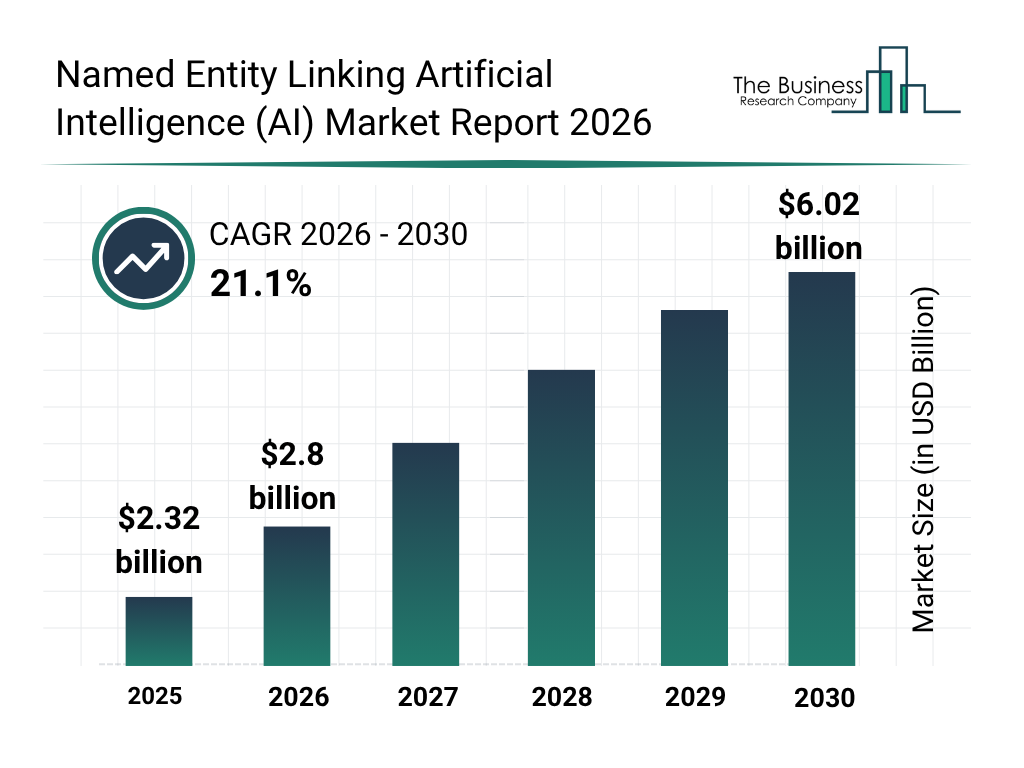
The named entity linking artificial intelligence (AI) market has seen substantial growth in its size over recent years. It is projected to expand from $2.32 billion in 2025 to $2.8 billion in 2026, achieving a compound annual growth rate (CAGR) of 20.9%. Historically, this expansion can be attributed to several factors including the surge in big data generation, the increasing adoption of natural language processing (NLP) technologies, a heightened demand for structured knowledge management, the expansion of AI research within enterprises, and the essential need for disambiguation within extensive text datasets.
The named entity linking artificial intelligence (AI) market is projected to experience substantial expansion over the coming years, reaching a valuation of $6.02 billion by 2030, demonstrating a compound annual growth rate (CAGR) of 21.1%. This anticipated growth during the forecast period stems from several factors, including the increasing embrace of hybrid AI models, the rise in cloud-based entity linking implementations, a greater need for automated content recommendations, the broadening scope of AI-driven knowledge graph development, and the incorporation of AI entity linking within the fintech and healthcare industries. Prominent trends for this period encompass the growing adoption of cloud-based entity linking platforms, the escalating integration of knowledge graphs with entity linking solutions, a surging requirement for real-time semantic processing and text analytics, the advancement of machine learning and deep learning-powered entity linking tools, and an intensified focus on cross-industry AI-driven information extraction.
Get A Free Sample Report With In-Depth Market Insights:
Named Entity Linking Artificial Intelligence (AI) Market Expansion Drivers: What’s Shaping Future Growth?
The expanding volume of data is projected to stimulate the growth of the named entity linking artificial intelligence (AI) market in the future. Data volume refers to the quantity of information existing or processed within a system. This volume is increasing due to the rapid proliferation of digital content as more users create and share information through social media, e-commerce, and connected devices. Named entity linking artificial intelligence (AI) assists in managing these growing data volumes by organizing and linking entities across large datasets, enabling faster extraction of meaningful insights from vast amounts of unstructured data. For instance, in March 2024, Edge Delta, a US-based software company, reported that the data generated worldwide reached around 120 zettabytes (ZB) in 2023, which equates to approximately 337,080 petabytes (PB) produced daily. Thus, the increasing data volume is a primary driver for the growth of the named entity linking artificial intelligence (AI) market.
Named Entity Linking Artificial Intelligence (AI) Market Segment Trends And Revenue Contributors
The named entity linking artificial intelligence (AI) market covered in this report is segmented –
1) By Component: Software, Services
2) By Technology Integration: Machine Learning-Based Entity Linking, Deep Learning-Based Entity Linking, Knowledge Graph-Driven Entity Linking, Hybrid Artificial Intelligence Models
3) By Deployment Mode: On-Premises, Cloud
4) By Application: Information Extraction, Content Recommendation, Knowledge Graph Construction, Sentiment Analysis, Other Applications
5) By End-User: Banking, Financial Services, And Insurance, Healthcare, Retail And E-Commerce, Media And Entertainment, Information And Telecommunications, Government, Other End-Users
Subsegments:
1) By Software: Cloud Based Entity Linking Platforms, On Premises Entity Linking Solutions, Application Programming Interface Based Entity Linking Tools, Knowledge Graph Integration Software, Text Analytics And Semantic Processing Software
2) By Services: Consulting And Advisory Services, System Integration Services, Deployment And Implementation Services, Training And Support Services, Maintenance And Managed Services
Named Entity Linking Artificial Intelligence (AI) Market Strategic Trends: What Defines The Next Growth Phase?
Leading companies within the named entity linking artificial intelligence market are concentrating on creating sophisticated solutions, like AI scanner technology, to autonomously identify, clarify, and connect entities within extensive datasets, thus enabling quicker and more precise data insights. AI scanner technology is defined as an AI system designed to automatically scan and analyze data, identifying, extracting, and linking entities to provide structured insights. As an example, in March 2025, InLinks Optimization Ltd., a software firm based in the UK, introduced Waikay, which is an innovative AI scanner technology. This new technology platform utilizes a patented method to query large language models like Google’s Gemini and ChatGPT, constructing a comprehensive understanding of their knowledge regarding any given brand. Its features encompass automated fact-checking, offering a workflow to check, flag, or delete information, detection of broken links in AI-generated citations, and ongoing comparisons with two competing brands. Additionally, it integrates scheduled reporting and a flexible pricing structure, including a free option, empowering businesses of varying sizes to track and enhance how their brand is portrayed in content generated by AI.
Named Entity Linking Artificial Intelligence (AI) Market Company Landscape And Competitive Strategy
Major companies operating in the named entity linking artificial intelligence (AI) market are Apple Inc., Microsoft Corporation, Meta Platforms Inc., Amazon Web Services Inc., IBM Corporation, Oracle Corporation, SAP SE, Hewlett Packard Enterprise (HPE), Thomson Reuters Corporation, SAS Institute Inc., Elastic N.V., Explosion AI GmbH, KNIME AG, Hugging Face Inc., Expert.ai S.p.A., Sinequa Corporation, Babel Street Inc., Lymba Corporation, Diffbot Technologies Corp., PoolParty Semantic Suite GmbH, TextRazor Ltd.
View The Full Named Entity Linking Artificial Intelligence (AI) Market Report:
Named Entity Linking Artificial Intelligence (AI) Market Largest Region: Which Geography Holds The Biggest Share?
North America was the largest region in the named entity linking artificial intelligence (AI) market in 2025. Asia-Pacific is expected to be the fastest-growing region in the forecast period. The regions covered in the named entity linking artificial intelligence (AI) market report are Asia-Pacific, South East Asia, Western Europe, Eastern Europe, North America, South America, Middle East, Africa.
Reach Out To Our Team:
The Business Research Company: https://www.thebusinessresearchcompany.com/
Americas: +1 310-496-7795
Asia: +44 7882 955267 & +91 8897263534
Europe: +44 7882 955267
Email us at: marketing@tbrc.info
Follow us on:
LinkedIn: https://in.linkedin.com/company/the-business-research-company
YouTube: https://www.youtube.com/channel/UC24_fI0rV8cR5DxlCpgmyFQ
Global Market Model: https://www.thebusinessresearchcompany.com/global-market-model

Wasay has over a decade of experience in market research, data modelling, and analytics, with prior experience at GlobalData and Decision Tree Consulting Services. At The Business Research Company , he leads research operations across syndicated studies, customized consulting engagements, and the Global Market Model platform. His professional experience includes supporting organizations such as Boston Consulting Group, KPMG, and Ernst & Young. Wasay holds a degree in Electronics and Communications Engineering, postgraduate management qualifications from International Management Institute Belgium and Indian School of Business and Entrepreneurship, and completed the Integrated Program in Business Analytics from Indian Institute of Management Indore.