
Delivering more actionable and strategically valuable research, The Business Research Company’s 2026 market reports feature market attractiveness analysis, total addressable market evaluation, company benchmarking matrices, interactive Excel dashboards, expanded supply chain intelligence, emerging startup coverage, and detailed product insights.
#Network Function Virtualization Market Value Analysis: What Growth Is Expected Over The Forecast Period?#_x000D_
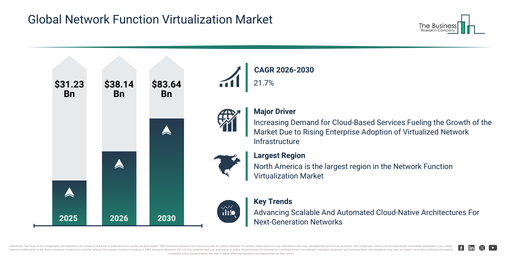
The network function virtualization market has seen substantial expansion in recent years. Its valuation is anticipated to climb from $31.23 billion in 2025 to $38.14 billion in 2026, indicating a compound annual growth rate (CAGR) of 22.1%. This historical expansion can be attributed to the spread of telecom network virtualization initiatives, a rising demand for flexible network architectures, the increasing adoption of cloud infrastructure, a growing necessity for cost-efficient network operations, and the availability of standard server hardware._x000D_
_x000D_
The size of the network function virtualization market is projected to experience substantial expansion over the upcoming years. This market is anticipated to reach $83.64 billion by 2030, exhibiting a compound annual growth rate (CAGR) of 21.7%. Factors contributing to this growth during the projected period include escalating investments in cloud-native core networks, the surging embrace of 5G network slicing, the broadening scope of automated network orchestration, an intensified focus on open network ecosystems, and the escalating need for agile service deployment. Key trends anticipated for the forecast period encompass a greater acceptance of virtualized network functions, an increase in the deployment of software-based network services, the progressing integration of nfv with sdn architectures, the expansion of cloud-native network platforms, and a heightened emphasis on network scalability and flexibility._x000D_
_x000D_
#Download A Free Sample Report For Comprehensive Market Insights:#_x000D_
_x000D_
#Network Function Virtualization Market Growth Factors: Which Forces Are Supporting Market Expansion?_x000D_
The growing demand for cloud-based services is projected to fuel the expansion of the network function virtualization (NFV) market moving forward. Cloud-based services involve servers, software, and data accessed over the Internet, allowing organizations to dynamically deploy and manage network operations without relying on dedicated hardware. The increase in cloud adoption is driven by enterprises seeking agility, scalability, and reduced infrastructure costs through virtualization. NFV plays a critical role in this transition by virtualizing key network functions such as routing, firewalling, and service chaining, which enables automated and efficient cloud deployments. For instance, in April 2025, according to the American Bar Association, a U.S.-based professional organization, approximately 75% of attorneys reported using cloud computing for work-related tasks, an increase from 69% in 2023 and about 70% in 2022. Therefore, the escalating demand for cloud-based services is a primary driver for the growth of the network function virtualization market._x000D_
_x000D_
#Network Function Virtualization Market Segmentation Trends And Revenue Drivers#_x000D_
The network function virtualization market covered in this report is segmented – _x000D_
_x000D_
1) By Component: Solutions, Orchestration And Automation, Services _x000D_
2) By Application: Virtual Appliance, Core Network _x000D_
3) By End User: Service Providers, Data Centers_x000D_
_x000D_
Subsegments:_x000D_
1) By Solutions: Virtualized Network Functions (VNFs), Virtual Routers, Virtual Firewalls, Load Balancers_x000D_
2) By Orchestration And Automation: Network Orchestration Tools, Service Orchestration Platforms, Automation Frameworks _x000D_
3) By Services: Consulting Services, Integration And Implementation Services, Support And Maintenance Services_x000D_
_x000D_
#Network Function Virtualization Market Transformation Trends: Which Innovations Are Driving Change?#_x000D_
Major companies within the network function virtualization market are dedicating efforts to developing inventive solutions, such as platform-oriented telco cloud frameworks. These solutions are designed to facilitate scalable, automated, and cloud-native telecom networks for 6G and beyond. A platform-oriented telco cloud framework defines a modular, cloud-native NFV architecture that integrates telecom functions with cloud infrastructure, thereby helping operators achieve automated orchestration, scalable deployments, and flexible, software-driven network management. For instance, in April 2025, the European Telecommunications Standards Institute (ETSI), a France-based not-for-profit organization, introduced a new NFV architecture, which included a platform-oriented Telco Cloud framework that enhances the traditional MANO (Management and Orchestration) model. This framework offers platform-level capabilities with modular services at various granularities, simplifies the integration of network functions with cloud infrastructure, and supports cloud-native principles such as AI-driven automation, digital twins, and declarative management APIs. It empowers telecom operators to efficiently manage virtualized RAN, industrial networks, and end-to-end 6G deployments while simultaneously improving scalability, flexibility, and operational sustainability when compared to conventional hardware-centric networks._x000D_
_x000D_
#Network Function Virtualization Market Industry Leaders: Which Organizations Are Driving Competition?_x000D_
Major companies operating in the network function virtualization market are Cisco Systems Inc.; Telefonaktiebolaget LM Ericsson; Huawei Technologies Co. Ltd.; Nokia Corporation; Juniper Networks Inc.; NEC Corporation; ZTE Corporation; Fujitsu Limited; Ciena Corporation; Mavenir Systems Inc.; Radisys Corporation; Amdocs Limited; Intel Corporation; Hewlett Packard Enterprise Company; Dell Technologies Inc.; Arista Networks Inc.; Broadcom Inc.; F5 Networks Inc.; Fortinet Inc.; Wind River Systems Inc. _x000D_
_x000D_
#Access The Complete Network Function Virtualization Market Report:#_x000D_
_x000D_
#Network Function Virtualization Market Regional Distribution: Which Areas Drive Market Expansion?#_x000D_
North America was the largest region in the network function virtualization market in 2025. Asia-Pacific is expected to be the fastest-growing region in the forecast period. The regions covered in the network function virtualization market report are Asia-Pacific, South East Asia, Western Europe, Eastern Europe, North America, South America, Middle East, Africa._x000D_
_x000D_
#Get in touch with us:#_x000D_
_x000D_
The Business Research Company: https://www.thebusinessresearchcompany.com/_x000D_
Americas: +1 310-496-7795_x000D_
Asia: +44 7882 955267 & +91 8897263534_x000D_
Europe: +44 7882 955267_x000D_
Email us at: marketing@tbrc.info_x000D_
_x000D_
#Follow us on:#_x000D_
_x000D_
LinkedIn: https://in.linkedin.com/company/the-business-research-company_x000D_
YouTube: https://www.youtube.com/channel/UC24_fI0rV8cR5DxlCpgmyFQ_x000D_
Global Market Model: https://www.thebusinessresearchcompany.com/global-market-model

Wasay has over a decade of experience in market research, data modelling, and analytics, with prior experience at GlobalData and Decision Tree Consulting Services. At The Business Research Company , he leads research operations across syndicated studies, customized consulting engagements, and the Global Market Model platform. His professional experience includes supporting organizations such as Boston Consulting Group, KPMG, and Ernst & Young. Wasay holds a degree in Electronics and Communications Engineering, postgraduate management qualifications from International Management Institute Belgium and Indian School of Business and Entrepreneurship, and completed the Integrated Program in Business Analytics from Indian Institute of Management Indore.