The Business Research Company’s 2026 market reports combine market attractiveness scoring, total addressable market sizing, company benchmarking matrices, interactive Excel dashboards, deeper supply chain intelligence, emerging startup tracking, and granular product-level insights to deliver research that is more actionable and strategically valuable.
Next-Gen Biometric Authentication Market Size Review: What Shaped Past Growth And What Will Drive Future Expansion?
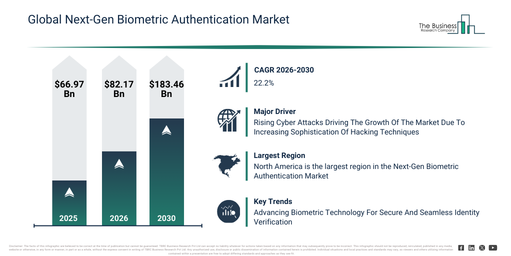
The next-gen biometric authentication market has experienced substantial growth in recent years. This market is projected to expand from $66.97 billion in 2025 to $82.17 billion in 2026, achieving a compound annual growth rate (CAGR) of 22.7%. Historically, this expansion has been driven by factors such as a rise in identity theft incidents, the early implementation of fingerprint systems, the proliferation of digital banking services, advancements in mobile device security, and a regulatory emphasis on secure authentication.
The market size for next-gen biometric authentication is projected for significant growth in the near future. This market is forecast to expand to $183.46 billion by 2030, achieving a compound annual growth rate (CAGR) of 22.2%. Key drivers for this growth include the wider adoption of passwordless security, the development of digital identity platforms, increased utilization of biometric MFA, innovations in AI-driven security analytics, and the broadening application of biometrics in public services. Noteworthy trends for the forecast period feature behavioral biometrics integration, continuous authentication models, advanced liveness detection techniques, multi-modal biometric verification, and adaptive risk-based authentication.
Access Free Sample Pages From The Next-Gen Biometric Authentication Market Report 2026:
Understanding The Main Driver Of The Next-Gen Biometric Authentication Market
An increasing frequency of cyber-attacks is anticipated to fuel the expansion of the next-gen biometric authentication market. These attacks involve hostile efforts by individuals or collectives to breach, harm, or illicitly access computer systems, networks, or data, typically aiming to steal data, disrupt services, or inflict damage. The surge in cyber-attacks stems from the growing complexity of hacking methods, as cybercriminals consistently create advanced malicious software capable of circumventing conventional security protocols and more efficiently exploiting system weaknesses. Next-gen biometric authentication strengthens cybersecurity through the use of sophisticated AI-powered multi-modal biometrics, blockchain integration, and ongoing authentication practices. This approach prevents identity theft, leading to a substantial decrease in cybercrimes across various digital platforms and essential infrastructure. For instance, as reported by the Department of Defence Australia in October 2025, during FY2024–25, ASD’s ACSC handled over 42,500 calls to the Australian Cyber Security Hotline, indicating a 16% increase from the previous year. Concurrently, ASD’s ACSC responded to more than 1,200 cyber security incidents, an 11% rise. Consequently, the increasing volume of cyber-attacks propels the next-gen biometric authentication market.
Next-Gen Biometric Authentication Market Segment Mapping For 2026 And Beyond
The next-gen biometric authentication market covered in this report is segmented –
1) By Authentication Type: Single Factor Authentication, Multi Factor Authentication
2) By Technology: Fingerprint Recognition, Iris Recognition, Palm Print Recognition, Face Recognition, Signature Recognition, Other Technologies
3) By End Users: Government And Defense, Banking, Financial Services, And Insurance (BFSI), Healthcare, Information Technology And Telecom, Retail, Travel And Hospitality, Other End Users
Subsegments:
1) By Single Factor Authentication Type: Fingerprint Recognition, Facial Recognition, Iris Recognition, Voice Recognition, Palm Vein Recognition
2) By Multi Factor Authentication Type: Biometric And PIN Combination, Biometric And Password Combination, Biometric And Token-Based Authentication, Biometric And Behavioral Authentication, Adaptive Biometric Authentication
What Key Trend Is Expected To Shape The Next-Gen Biometric Authentication Market Over The Forecast Period?
Leading companies in the next gen biometric authentication market are concentrating on developing advanced products, such as liveness-detection fingerprint scanners, to combat spoofing and build greater confidence in passwordless authentication. Liveness detection in biometrics serves as a security feature that verifies a fingerprint originates from a live finger, not a fake or replication, thereby preventing presentation attacks. For example, in October 2025, BIO key International, a U.S.-based provider of biometric identity and access management (IAM) solutions, launched its EcoID III USB Fingerprint Scanner. This device incorporates liveness detection and anti-spoofing technology to reject fraudulent fingerprints; it captures images very rapidly, supported by LED-guided 360° finger placement for an intuitive user experience; it facilitates encrypted device-to-host communication and application locking for comprehensive end-to-end security; and it adheres to strict standards such as FBI FAP 20, NIST PIV, and NIBSS certifications for high-assurance applications. By integrating robust biometric security with affordability and extensive interoperability, this scanner assists enterprises in adopting powerful, tokenless authentication solutions.
Next-Gen Biometric Authentication Market Major Players And Industry Competition Overview
Major companies operating in the next-gen biometric authentication market are Apple Inc., Samsung Electronics Co. Ltd., Siemens AG, Fujitsu Limited, NEC Corporation, Safron S.A, Thales Group, IDEMIA, Synaptics Inc., HID Global Corporation, ZKTeco Co. Ltd., Clear Secure Inc., Fingerprint Cards AB, Precise Biometrics, Suprema Inc., Aware Inc., IriTech Inc., BIO-key International Inc., BioID GmbH, Luxand Inc.
Full Next-Gen Biometric Authentication Market Report: Market Size, Trends, Segments And Key Players:
Next-Gen Biometric Authentication Market Geographic Segmentation: Regions Covered In The Report
North America was the largest region in the next-gen biometric authentication market in 2025. The regions covered in the next-gen biometric authentication market report are Asia-Pacific, South East Asia, Western Europe, Eastern Europe, North America, South America, Middle East, Africa.
Reach Out To Our Team:
The Business Research Company: https://www.thebusinessresearchcompany.com/
Americas: +1 310-496-7795
Asia: +44 7882 955267 & +91 8897263534
Europe: +44 7882 955267
Email us at: marketing@tbrc.info
Follow us on:
LinkedIn: https://in.linkedin.com/company/the-business-research-company
YouTube: https://www.youtube.com/channel/UC24_fI0rV8cR5DxlCpgmyFQ
Global Market Model: https://www.thebusinessresearchcompany.com/global-market-model

Wasay has over a decade of experience in market research, data modelling, and analytics, with prior experience at GlobalData and Decision Tree Consulting Services. At The Business Research Company , he leads research operations across syndicated studies, customized consulting engagements, and the Global Market Model platform. His professional experience includes supporting organizations such as Boston Consulting Group, KPMG, and Ernst & Young. Wasay holds a degree in Electronics and Communications Engineering, postgraduate management qualifications from International Management Institute Belgium and Indian School of Business and Entrepreneurship, and completed the Integrated Program in Business Analytics from Indian Institute of Management Indore.