Designed to make market research more actionable and strategically valuable, The Business Research Company’s 2026 market reports feature market attractiveness scoring, total addressable market sizing, company benchmarking matrices, interactive Excel dashboards, deeper supply chain intelligence, emerging startup tracking, and granular product-level insights.
How Big Is The Optical Artificial Intelligence Accelerator Market In 2026, And How Fast Will It Grow?
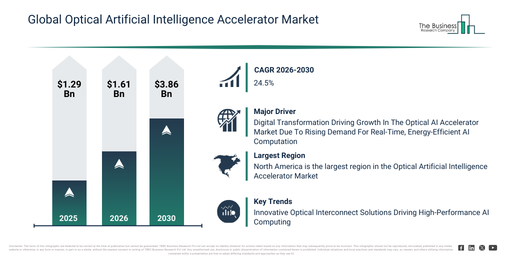
The market size for optical artificial intelligence accelerators has experienced exponential expansion in recent years. Projections indicate it will grow from $1.29 billion in 2025 to $1.61 billion in 2026, achieving a compound annual growth rate (CAGR) of 24.8%. This historical growth can be attributed to several factors, including the escalating demand for high-performance computing, the rise in AI research and development, the increasing adoption of data centers, the inherent limitations of electronic accelerators in terms of speed and energy efficiency, and substantial investments in silicon photonics startups.
The optical artificial intelligence accelerator market is projected to experience substantial growth in the coming years. It is expected to reach $3.86 billion in 2030, driven by a compound annual growth rate (CAGR) of 24.5%. This growth during the forecast period is attributed to the expansion of edge AI applications, the demand for low-latency AI inference, developments in autonomous vehicle AI processing, the integration of AI in healthcare imaging and genomics, and the creation of large-scale AI model training platforms. Major trends anticipated in this period include photonics-based high-speed AI computation, energy-efficient AI hardware solutions, hardware-software co-optimization for AI workloads, scalable AI model deployment, and the integration of optical accelerators in edge computing.
Download A Free Optical Artificial Intelligence Accelerator Market Sample Report With Size And Forecast Data:
Optical Artificial Intelligence Accelerator Market Growth Driver: The Key Factor Behind Rising Demand
The expansion of digital transformation is anticipated to drive the advancement of the optical artificial intelligence accelerator market moving ahead. This transformation involves embedding digital technologies throughout a business to optimize operations, elevate customer experiences, and foster innovation. The surge in digital transformation stems from an escalating need for improved customer interactions, as companies implement digital solutions to provide quicker, customized, and more accessible services, thereby satisfying changing consumer demands. Optical artificial intelligence (AI) accelerators support digital transformation by facilitating extremely fast, energy-efficient AI computations, which empowers businesses to handle vast data amounts instantaneously, streamline processes, and refine smart decision-making across their offerings. For example, a report released by the United States Census Bureau, a US-based federal statistical agency, in March 2024, highlighted the rapid growth in AI adoption, increasing from 3.7% of businesses in Fall 2023 to 5.4% in February 2024, with forecasts predicting a further jump to 6.6% by Fall 2024. Simultaneously, the employment-weighted usage rate indicates that roughly 12% of employees in companies are projected to be utilizing AI by then. Consequently, the expanding digital transformation is fueling the expansion of the optical artificial intelligence accelerator market.
Optical Artificial Intelligence Accelerator Market Segmentation: Key Segments And Subsegments Covered
The optical artificial intelligence accelerator market covered in this report is segmented –
1) By Component Type: Hardware, Software, Services
2) By Technology Type: Silicon Photonics, Photonic Integrated Circuits, Free-Space Optics, Other Technologies
3) By Application: Data Centers, Edge Computing, High-Performance Computing, Telecommunications, Autonomous Vehicles, Healthcare, Other Applications
4) By End-User: Information Technology And Telecommunications, Automotive, Healthcare, Banking, Financial Services And Insurance, Manufacturing, Other End Users
Subsegments:
1) By Hardware: Optical Chips, Photonic Integrated Circuits (PICs), Optical Interconnects
2) By Software: Optimization And Compiler Tools, Simulation And Modeling Software, Deployment And Runtime Software
3) By Services: Consulting And Integration Services, Training And Support Services, Managed Services
Optical Artificial Intelligence Accelerator Market Trends: Key Developments Shaping 2026 And Beyond
Leading companies in the optical artificial intelligence accelerator market are concentrating on developing innovative solutions, such as universal chiplet interconnect express (UCIe) optical chiplets, to improve high-speed data transfer, enhance energy efficiency, and accelerate AI computing performance. A universal chiplet interconnect express (UCIe) optical chiplet denotes a modular optical interconnect component that allows for high-speed, low-latency communication between heterogeneous chiplets in a multi-chip AI accelerator system, boosting data bandwidth and energy efficiency. For example, in March 2025, Ayar Labs Inc., a US-based semiconductor company, introduced TeraPHY, specifically engineered for AI scale-up architectures. It offers ultra-high bandwidth (8 Tbps) with remarkably low latency and power consumption, overcoming the limitations of traditional electrical interconnects. This enables seamless, scalable communication between GPUs and accelerators over flexible distances, thereby forming efficient large AI computing fabrics. TeraPHY supports multi-vendor interoperability via the UCIe standard, fostering an open ecosystem for cost-effective, high-performance AI infrastructure.
Leading Companies Operating In The Optical Artificial Intelligence Accelerator Market
Major companies operating in the optical artificial intelligence accelerator market are Microsoft Corporation, Huawei Technologies Co. Ltd., IBM Corporation, Intel Corporation, Broadcom, STMicroelectronics N.V., Marvell Technology Inc., Synopsy Inc., Lightmatter Inc., Q.ANT, Ayar Labs Inc., Xanadu Quantum Technologies Inc., Arago Semiconductor, Lightelligence Inc., LightOn, Luminous Computing, Neurophos, Etched.AI Inc., Lumai, Luminate Accelerator
Access The Full Optical Artificial Intelligence Accelerator Market Research Report:
Optical Artificial Intelligence Accelerator Market Regional Analysis: Largest Region And Key Geographies Covered
North America was the largest region in the optical artificial intelligence accelerator market in 2025. Asia-Pacific is expected to be the fastest-growing region in the forecast period. The regions covered in the optical artificial intelligence accelerator market report are Asia-Pacific, South East Asia, Western Europe, Eastern Europe, North America, South America, Middle East, Africa.
Reach Out To Our Team:
The Business Research Company: https://www.thebusinessresearchcompany.com/
Americas: +1 310-496-7795
Asia: +44 7882 955267 & +91 8897263534
Europe: +44 7882 955267
Email us at: marketing@tbrc.info
Follow us on:
LinkedIn: https://in.linkedin.com/company/the-business-research-company
YouTube: https://www.youtube.com/channel/UC24_fI0rV8cR5DxlCpgmyFQ
Global Market Model: https://www.thebusinessresearchcompany.com/global-market-model

Wasay has over a decade of experience in market research, data modelling, and analytics, with prior experience at GlobalData and Decision Tree Consulting Services. At The Business Research Company , he leads research operations across syndicated studies, customized consulting engagements, and the Global Market Model platform. His professional experience includes supporting organizations such as Boston Consulting Group, KPMG, and Ernst & Young. Wasay holds a degree in Electronics and Communications Engineering, postgraduate management qualifications from International Management Institute Belgium and Indian School of Business and Entrepreneurship, and completed the Integrated Program in Business Analytics from Indian Institute of Management Indore.