The Business Research Company’s 2026 market reports are designed to deliver research that is more actionable and strategically valuable. Key offerings include market attractiveness scoring, total addressable market sizing, company benchmarking matrices, interactive Excel dashboards, deeper supply chain intelligence, emerging startup tracking, and granular product-level insights.
Optical Networking Market Revenue Projected To Rise To $26.57 Billion By 2030
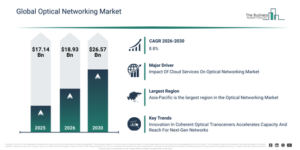
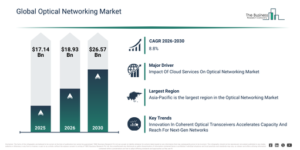
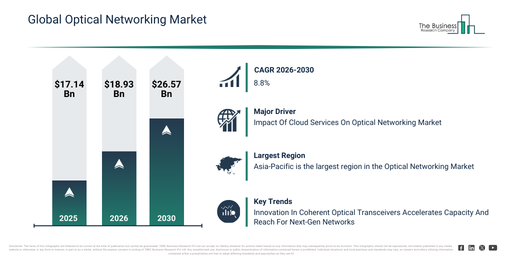
The optical networking market has experienced substantial growth in recent years. It is projected to expand from $17.14 billion in 2025 to $18.93 billion in 2026, achieving a compound annual growth rate (CAGR) of 10.5%. The historical increase can be attributed to several factors, including the expansion of national broadband initiatives, a rise in enterprise data traffic, growing investments in optical backbone infrastructure, the early adoption of SONET and WDM technologies, and an increasing demand for carrier-grade networks.
The optical networking market is set for substantial growth over the coming years. Its size is anticipated to expand to $26.57 billion by 2030, demonstrating a compound annual growth rate (CAGR) of 8.8%. This projected increase is largely due to factors such as the expansion of 5G transport networks, a rise in investments for data center interconnects, the increasing adoption of cloud-native networking solutions, the growing demand for ultra-low latency services, and advancements in programmable optical networks. Significant developments expected during this period include the increased uptake of dense WDM systems, the rising deployment of optical switching technologies, a growing need for scalable fiber networks, the broader implementation of software-defined optical networking, and an enhanced focus on network reliability and resilience.
Want Deeper Optical Networking Market Insights? Get A Free Sample Report:
Primary Growth Driver Shaping The Optical Networking Market Outlook
The future expansion of the optical networking market is anticipated to be fueled by the rising adoption of cloud technologies. These technologies offer scalable computing, storage, and analytics via remote infrastructure, which empowers national statistical offices (NSOs) to handle extensive datasets, conduct sophisticated analyses, and update their statistical production methodologies. NSOs are increasingly embracing cloud solutions due to a growing demand for high-performance computing, secure data management, and real-time analytical capabilities to cope with increasing digital workloads. Optical networking plays a crucial role in this shift, offering the high-capacity, low-latency connections necessary for efficient transfer and processing of vast amounts of statistical data. For instance, the cloud-awards, a US-based international program, reported that the market reached approximately $833 billion in 2025, increasing from $735.45 billion in 2024 and surpassing an earlier $690 billion estimate. Consequently, the expanding use of cloud technologies is a key factor propelling the optical networking market’s growth.
Optical Networking Market Structure: A Detailed Look At Segments And Subsegments
The optical networking market covered in this report is segmented –
1) By Component: Optical Fibers, Optical Switches, Optical Amplifiers, Optical Splitters, Optical Transceivers, Optical Circulators
2) By Service: Network Design, Data Centre Network Maintenance And Support
3) By Technology: Synchronous Optical Networking, Wavelength Division Multiplexing, Coarse Wavelength Division Multiplexing, Dense Wavelength Division Multiplexing, Reconfigurable Optical Add-Drop Multiplexer, Fiber Channels
4) By End User: Military And Defense, Banking, Financial Services, And Insurance, Information Technology And Telecommunications, Government, Other End Users
Subsegments:
1) By Optical Fibers: Single-Mode Optical Fibers, Multi-Mode Optical Fibers, Specialty Optical Fibers (Erbium-Doped, Photonic Crystal Fibers)
2) By Optical Switches: Mechanical Optical Switches, Solid-State Optical Switches, Mems (Micro-Electro-Mechanical Systems) Optical Switches, Optical Cross-connect (Oxc) Switches
3) By Optical Amplifiers: Erbium-Doped Fiber Amplifiers (Edfa), Raman Amplifiers, Semiconductor Optical Amplifiers (Soa), Fiber Bragg Grating (Fbg) Amplifiers
4) By Optical Splitters: Fused Biconical Taper (Fbt) Splitters, Planar Lightwave Circuit (Plc) Splitters, 1×2, 1×4, 1×8 Splitters, Wavelength Division Multiplexing (Wdm) Splitters
5) By Optical Transceivers: Sfp (Small Form-Factor Pluggable) Transceivers, Qsfp (Quad Small Form-Factor Pluggable) Transceivers, Cfp (C Form-Factor Pluggable) Transceivers, Xfp (10 Gigabit Small Form-Factor Pluggable) Transceivers
6) By Optical Circulators: 3-Port Optical Circulators, 4-Port Optical Circulators, Fiber Optic Circulators For Amplifiers And Network Protection
Optical Networking Market Innovation And Strategy Trends Among Leading Companies
Companies operating in the optical networking market are prioritizing the development of advanced solutions, such as next-generation optical transceiver modules, to enhance network performance, increase data throughput, and meet the growing bandwidth demands of cloud, telecom, and data center operations. Optical transceiver modules are crucial components that enable high-speed data transmission, superior signal integrity, and extended optical reach, supporting scalable and reliable fiber-optic connectivity. For instance, in October 2023, Coherent, a U.S.-based optical component company, announced that the Optical Internetworking Forum (OIF), a global nonprofit organization focused on advancing optical networking standards, approved the 800ZR Coherent Optics Implementation Agreement, an important standard enabling interoperable 800-gigabit coherent optical modules for long-reach data center interconnect applications. This standards advancement accelerates the development of high-capacity optical modules, improves cross-vendor interoperability, and supports the widespread adoption of next-generation optical networking technologies.
Top Companies Competing In The Optical Networking Market
Major companies operating in the optical networking market are Huawei Technologies Co., Cisco Systems Inc., Broadcom Inc., Mitsubishi Electric Corporation, Ericsson, NEC Corporation, Nokia Corporation, Fujitsu Optical Components, ZTE Corporation, Sumitomo Electric Industries Ltd., Corning Inc., Fujikura Ltd., Juniper Networks, Ciena Corporation, II-VI Incorporated, Lumentum Holdings Inc., Infinera Corporation, Adtran Inc., Viavi Solutions Inc., ECI Telecom Ltd., Ribbon Communications Inc., ADVA Optical Networking SE, Oclaro Inc., Finisar Corporation, Applied Optoelectronics Inc.
View The Complete Optical Networking Market Study With Segment And Regional Data:
Optical Networking Market Regional Outlook Across Major Geographies
Asia-Pacific was the largest region in the optical networking market in 2025. The regions covered in the optical networking market report are Asia-Pacific, South East Asia, Western Europe, Eastern Europe, North America, South America, Middle East, Africa.
Reach Out To Our Team:
The Business Research Company: https://www.thebusinessresearchcompany.com/
Americas: +1 310-496-7795
Asia: +44 7882 955267 & +91 8897263534
Europe: +44 7882 955267
Email us at: marketing@tbrc.info
Follow us on:
LinkedIn: https://in.linkedin.com/company/the-business-research-company
YouTube: https://www.youtube.com/channel/UC24_fI0rV8cR5DxlCpgmyFQ
Global Market Model: https://www.thebusinessresearchcompany.com/global-market-model

Wasay has over a decade of experience in market research, data modelling, and analytics, with prior experience at GlobalData and Decision Tree Consulting Services. At The Business Research Company , he leads research operations across syndicated studies, customized consulting engagements, and the Global Market Model platform. His professional experience includes supporting organizations such as Boston Consulting Group, KPMG, and Ernst & Young. Wasay holds a degree in Electronics and Communications Engineering, postgraduate management qualifications from International Management Institute Belgium and Indian School of Business and Entrepreneurship, and completed the Integrated Program in Business Analytics from Indian Institute of Management Indore.