
Backed by market attractiveness analysis, total addressable market sizing, company benchmarking matrices, interactive Excel dashboards, wider supply chain intelligence, emerging startup coverage, and detailed product-level insights, The Business Research Company’s 2026 market reports are designed to offer research that is more actionable and strategically valuable than ever.
Optical Wireless Communication For Data Centers Market Expansion Outlook: What Revenue Opportunities Are Ahead?
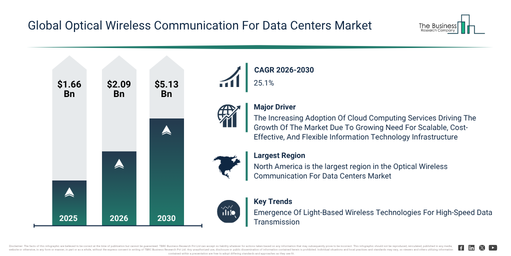
The optical wireless communication for data centers market size has experienced substantial expansion in recent years. This market is set to expand from $1.66 billion in 2025 to $2.09 billion in 2026, achieving a compound annual growth rate (CAGR) of 25.8%. Historically, this growth can be ascribed to several factors, including the escalating deployment of hyperscale data centers, the rising need for high bandwidth data transmission, increasing investments in cloud infrastructure, the expansion of edge data center facilities, and the growing adoption of high-speed optical networking technologies.
The optical wireless communication for data centers market is projected to experience substantial expansion in the coming years. This market is predicted to reach $5.13 billion by 2030, showing a compound annual growth rate (CAGR) of 25.1%. This expansion during the projection period stems from a surging need for scalable, cable-free data center designs, the increasing implementation of AI-powered computing setups, greater funding in low-latency communication infrastructures, a wider embrace of energy-saving data center networking options, and a heightened requirement for adaptable inter-rack connections. Key developments anticipated during this forecast include the broader acceptance of cable-free data center interconnections, the growing use of low-latency optical wireless connections, the increasing incorporation of high-bandwidth optical communication systems, the enlargement of adaptable rack-to-rack optical links, and the accelerating creation of redundant optical wireless network setups.
Get A Free Sample Report With In-Depth Market Insights:
Optical Wireless Communication For Data Centers Market Growth Factors: What’s Supporting Expansion?
The rising use of cloud computing services is anticipated to drive the expansion of the Optical wireless communication for data centers market in the future. Cloud computing services entail the provision of computing assets such as storage, processing power, networking, and software over the internet, delivered on a scalable and on-demand basis. This increased adoption primarily stems from a growing requirement for IT infrastructure that is scalable, cost-effective, and adaptable, enabling businesses to store, process, and access data efficiently while backing digital transformation efforts. The wider embrace of cloud computing services boosts the need for optical wireless communication in data centers by requiring interconnect solutions that offer high speed, low latency, and scalability to efficiently manage increasing data traffic and dynamic workloads. For instance, in January 2026, Eurostat, a Luxembourg-based official European Union statistical office, reported that in 2025, 52.74% of EU enterprises utilized paid cloud computing services, mainly for email, office applications, and file storage, which marked an increase from 2023. Consequently, the expanding adoption of cloud computing services is anticipated to further the growth of the wireless communication for data centers market. The growing acceptance of artificial intelligence is projected to stimulate the expansion of the optical wireless communication for data centers market moving forward. Artificial Intelligence (AI) is a field of computer science focused on developing machines and software that can execute tasks normally needing human intellect, including learning, logical thinking, issue resolution, making choices, sensory understanding, and language comprehension. The rise in AI adoption largely stems from its capacity to boost operational efficiency through the automation of routine tasks, streamlining workflows, refining decision-making processes, and lowering expenses across diverse sectors. The increasing use of artificial intelligence fuels the need for optical wireless communication (OWC) in data centers, as it demands interconnect solutions with ultra-high speed, minimal latency, and scalability to effectively manage the rising volume of AI-generated data processing and workload traffic. As an illustration, in October 2025, Netguru S.A., a software development company located in Poland, reported that in 2024, generative AI adoption hit 71%, a substantial increase from 33% in 2023, indicating businesses’ rapid growth in trust and dependence on these cutting-edge technologies. Consequently, the growing integration of artificial intelligence is anticipated to stimulate the expansion of the wireless communication for data centers market.
Optical Wireless Communication For Data Centers Market Segmentation: How Does The Market Break Down By Category?
The optical wireless communication for data centers market covered in this report is segmented –
1) By Technology Type: Free Space Optics, Infrared Optical Wireless Communication, Visible Light Communication, Light Fidelity, Hybrid Optical Wireless Systems
2) By Data Center Type: Hyperscale Data Centers, Colocation Data Centers, Enterprise Data Centers, Edge Data Centers
3) By Application Type: Rack To Rack Communication, Server To Server Communication, Top Of Rack Switching, Inter Rack Connectivity, Inter Pod Connectivity, Backup And Redundancy Links
4) By End User: Cloud Service Providers, Telecommunications Companies, Healthcare, Banking, Financial Services And Insurance, Government And Defense, Other End Users
Subsegments:
1) By Free Space Optics: Line Of Sight Optical Links, High Capacity Point To Point Links, Redundant Optical Backhaul Links, Temporary Network Extension Links, Disaster Recovery Links
2) By Infrared Optical Wireless Communication: Indoor Line Of Sight Links, Diffuse Infrared Communication Links, Point To Multipoint Infrared Links, Short Range Device Interconnects, Secure Room Level Communication Links
3) By Visible Light Communication: Light Emitting Diode Based Data Transmission Links, Indoor Positioning Enabled Communication Links, High Density Office Networking Links, Secure Line Of Sight Illumination Based Networks, Sensor Integrated Lighting Communication Networks
4) By Light Fidelity: Downlink Data Transmission Systems, Uplink Optical Communication Systems, Bidirectional Light Based Networking Systems, High Speed Indoor Connectivity Systems, Integrated Smart Lighting Networking Systems
5) By Hybrid Optical Wireless Systems: Hybrid Fiber Optical Wireless Integration Links, Multi Band Optical Wireless Networking Systems, Redundant Hybrid Communication Systems, Adaptive Switching Optical Communication Links, High Reliability Enterprise Connectivity Systems
Optical Wireless Communication For Data Centers Market Industry Trends: What’s Reshaping Demand?
Major companies operating in the optical wireless communication for data centers market are prioritizing the development of sophisticated solutions, including optical wireless LiFi technologies. These efforts aim to improve high-speed data transmission, lessen network congestion, optimize energy efficiency, and enable scalable, low-latency connectivity within next-generation AI and cloud data centers. LiFi, standing for Light Fidelity, is an optical wireless communication technology that transmits data through visible, infrared, or near-infrared light waves, contrasting with conventional radio frequency (RF)-based Wi-Fi systems. For example, in June 2024, LUMEOVA Inc, a US-based optical wireless technology company, unveiled WiRays. This pioneering optical wireless communication technology is capable of achieving wireless data speeds up to 100 gigabits per second (Gbps). WiRays harnesses the extensive optical spectrum to provide fiber-like transmission speeds without the necessity of physical fiber connections, and it is engineered for minimal power consumption and high spectral efficiency. The technology facilitates ultra-fast, secure, and interference-free communication, making it highly suitable for demanding environments such as AI clusters, cloud computing infrastructures, and next-generation data centers. Its semiconductor-based architecture supports high-volume manufacturing and scalable deployment, simultaneously reducing cabling complexity and allowing for flexible data center network configurations.
Optical Wireless Communication For Data Centers Market Competitive Landscape: Which Companies Lead The Industry?
Major companies operating in the optical wireless communication for data centers market are Nokia Corporation, NEC Corporation, L3Harris Technologies Inc., Lumentum Holdings Inc., Signify N.V., Viasat Inc., Hamamatsu Photonics K.K., Lucibel SA, Plaintree Systems Inc., fSONA Networks Corp., Transcelestial Technologies Pte. Ltd., Oledcomm SAS, pureLiFi Ltd, LightPointe Communications Inc., Wireless Excellence Limited, JSC Mostcom, VLNComm Inc., Lumeova Inc.
View The Full Optical Wireless Communication For Data Centers Market Report:
Optical Wireless Communication For Data Centers Market Regional Breakdown: Where Is Demand Concentrated?
North America was the largest region in the optical wireless communication for data centers market in 2025. Asia-Pacific is expected to be the fastest-growing region in the forecast period. The regions covered in the optical wireless communication for data centers market report are Asia-Pacific, South East Asia, Western Europe, Eastern Europe, North America, South America, Middle East, Africa.
Reach Out To Our Team:
The Business Research Company: https://www.thebusinessresearchcompany.com/
Americas: +1 310-496-7795
Asia: +44 7882 955267 & +91 8897263534
Europe: +44 7882 955267
Email us at: marketing@tbrc.info
Follow us on:
LinkedIn: https://in.linkedin.com/company/the-business-research-company
YouTube: https://www.youtube.com/channel/UC24_fI0rV8cR5DxlCpgmyFQ
Global Market Model: https://www.thebusinessresearchcompany.com/global-market-model

Wasay has over a decade of experience in market research, data modelling, and analytics, with prior experience at GlobalData and Decision Tree Consulting Services. At The Business Research Company , he leads research operations across syndicated studies, customized consulting engagements, and the Global Market Model platform. His professional experience includes supporting organizations such as Boston Consulting Group, KPMG, and Ernst & Young. Wasay holds a degree in Electronics and Communications Engineering, postgraduate management qualifications from International Management Institute Belgium and Indian School of Business and Entrepreneurship, and completed the Integrated Program in Business Analytics from Indian Institute of Management Indore.