Backed by market attractiveness analysis, total addressable market sizing, company benchmarking matrices, interactive Excel dashboards, wider supply chain intelligence, emerging startup coverage, and detailed product-level insights, The Business Research Company’s 2026 market reports are designed to offer research that is more actionable and strategically valuable than ever.
Parallel Computing Market Size Outlook: How Quickly Will Revenue Expand Through 2030?
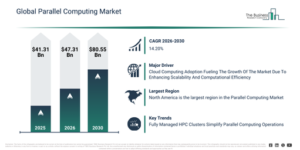
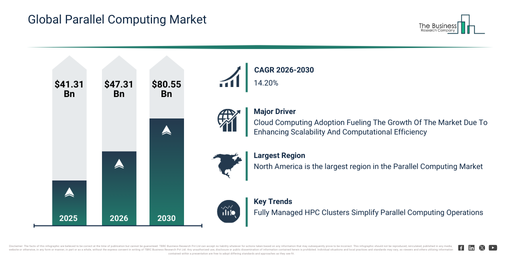
The parallel computing market size has experienced significant expansion in recent years. It is projected to grow from $41.31 billion in 2025 to $47.31 billion in 2026 at a compound annual growth rate (CAGR) of 14.5%. This historical growth can be linked to the increasing adoption of multi-core processors, a rising demand for scientific simulations, the expanding use of graphics processing units (GPUs)-accelerated computing, evolving big data processing requirements, and a greater reliance on high-performance computing in research.
The parallel computing market is anticipated to experience substantial expansion over the forthcoming years. Its size is projected to reach $80.55 billion in 2030, exhibiting a compound annual growth rate (CAGR) of 14.2%. This expansion during the projected period stems from several factors, including the expanding implementation of cloud-based high-performance computing (HPC) solutions, the heightened requirement for parallel processing within artificial intelligence workloads, the increasing necessity for real-time analytics across diverse sectors, the broader application of digital twins and industrial simulations, and the growing uptake of heterogeneous computing architectures. Key trends anticipated in the forecast timeframe encompass technological improvements in graphics processing units (GPUs) and accelerator designs, new breakthroughs in parallel programming frameworks, progress in cloud-native high-performance computing (HPC) platforms, ongoing research and development in quantum-parallel hybrid computing, and significant strides in distributed computing alongside edge-integrated parallel processing.
Get A Free Sample Report With In-Depth Market Insights:
Parallel Computing Market Opportunity Drivers: What’s Unlocking New Revenue Potential?
The expanding uptake of cloud computing is projected to fuel the growth of the parallel computing market in the future. Cloud computing encompasses the provision of computing assets such as servers, storage, databases, networking, software, and analytics over the internet to foster quicker innovation, adaptable resources, and economies of scale. Its adoption is primarily driven by scalability, allowing businesses to easily adjust computing resources based on demand and reduce infrastructure costs. Parallel computing significantly enhances cloud computing by enabling the simultaneous processing of extensive datasets across multiple processors, thereby improving the computational speed, scalability, and overall efficiency of cloud-based applications and services. For instance, in December 2023, Eurostat, a Luxembourg-based government organization, reported that 45.2% of enterprises across the European Union purchased cloud computing services, with 77.6% of large enterprises, 59% of medium-sized enterprises, and 41.7% of small businesses specifically adopting these services. Therefore, the increasing adoption of cloud computing is a key driver for the growth of the parallel computing market.
Parallel Computing Market Segment Analysis: What Are The Core Market Categories?
The parallel computing market covered in this report is segmented –
1) By Component: Hardware, Software, Services
2) By Deployment Mode: On-Premises, Cloud
3) By Enterprise Size: Small And Medium Enterprises, Large Enterprises
4) By Application: Scientific Research And Modeling, Artificial Intelligence And Machine Learning, High-Performance Data Analytics (HPDA), Engineering And Simulation (CAE), Media, Entertainment, And Rendering, Other Applications
5) By End-User: Information Technology (IT) And Telecommunications, Banking, Financial Services, And Insurance (BFSI), Healthcare, Manufacturing, Government, Other End-Users
Subsegments:
1) By Hardware: Processing Units, Memory Units, Storage Systems, Interconnect Networks, Accelerators
2) By Software: Parallel Programming Tools, Middleware, System Management Software, Operating Systems, Performance Optimization Tools
Parallel Computing Market Innovation Trends Shaping Future Development
Companies operating within the parallel computing market are concentrating on developing advanced managed services, like fully managed high-performance computing (HPC) clusters. This initiative aims to enhance efficiency, simplify operations, and minimize management overhead associated with scientific and engineering workloads. High-performance computing (HPC) clusters are collections of interconnected computers designed to work in unison, performing complex computations simultaneously by distributing tasks across multiple nodes to accelerate processing. As an illustration, in August 2024, Amazon Web Services, a cloud services company based in the USA, unveiled AWS Parallel Computing Service (AWS PCS). This new managed service empowers users to build scalable HPC clusters and effectively run and scale HPC workloads on AWS. It features a fully managed Slurm workload scheduler, complete with integrated technical support and diverse customization options, enabling the smooth execution of scientific models and simulations without requiring deep infrastructure expertise. Additionally, it includes unified APIs, a management console, and CLI tools for cluster provisioning and updates, thereby decreasing operational overhead and allowing engineers and researchers to devote more attention to their core work rather than infrastructure management.
Parallel Computing Market Competitive Landscape: Who Leads The Industry?
Major companies operating in the parallel computing market are Amazon Web Services Inc., Google LLC, Microsoft Corporation, Samsung Electronics Co. Ltd., Tencent Cloud Computing (Beijing) Co. Ltd., Dell Technologies Inc., International Business Machines Corporation (IBM), NVIDIA Corporation, Lenovo Group Limited, Intel Corporation, Oracle Corporation, Broadcom Inc., Qualcomm Incorporated, Hewlett Packard Enterprise Company, Fujitsu Limited, NEC Corporation, SK hynix Inc., Advanced Micro Devices Inc., Micron Technology Inc., Inspur Group Co. Ltd., Arm Limited, Alibaba Cloud Computing Ltd., Cerebras Systems Inc., Groq Inc.
View The Full Parallel Computing Market Report:
Parallel Computing Market Geographic Landscape: Which Region Dominates Industry Growth?
North America was the largest region in the parallel computing market in 2025. Asia-Pacific is expected to be the fastest-growing region in the forecast period. The regions covered in the parallel computing market report are Asia-Pacific, South East Asia, Western Europe, Eastern Europe, North America, South America, Middle East, Africa.
Reach Out To Our Team:
The Business Research Company: https://www.thebusinessresearchcompany.com/
Americas: +1 310-496-7795
Asia: +44 7882 955267 & +91 8897263534
Europe: +44 7882 955267
Email us at: marketing@tbrc.info
Follow us on:
LinkedIn: https://in.linkedin.com/company/the-business-research-company
YouTube: https://www.youtube.com/channel/UC24_fI0rV8cR5DxlCpgmyFQ
Global Market Model: https://www.thebusinessresearchcompany.com/global-market-model

Wasay has over a decade of experience in market research, data modelling, and analytics, with prior experience at GlobalData and Decision Tree Consulting Services. At The Business Research Company , he leads research operations across syndicated studies, customized consulting engagements, and the Global Market Model platform. His professional experience includes supporting organizations such as Boston Consulting Group, KPMG, and Ernst & Young. Wasay holds a degree in Electronics and Communications Engineering, postgraduate management qualifications from International Management Institute Belgium and Indian School of Business and Entrepreneurship, and completed the Integrated Program in Business Analytics from Indian Institute of Management Indore.