Through market attractiveness analysis, total addressable market evaluation, company benchmarking matrices, interactive Excel dashboards, expanded supply chain intelligence, emerging startup coverage, and detailed product insights, The Business Research Company’s 2026 market reports provide more actionable and strategically valuable research.
Passive Optical Network Equipment Market Value Analysis: What Growth Is Expected Over The Forecast Period?
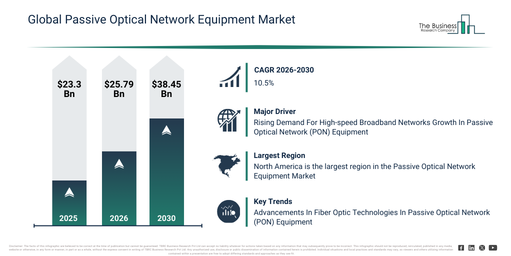
The passive optical network equipment market size has experienced rapid expansion over recent years. It is anticipated to expand from $23.3 billion in 2025 to $25.79 billion in 2026, exhibiting a compound annual growth rate (CAGR) of 10.7%. Historically, this growth has been fueled by factors such as inadequate broadband infrastructure, an escalating demand for high-speed internet, the initial implementation of fiber optic technologies, an increase in residential broadband usage, and the expanding need for commercial connectivity.
The passive optical network equipment market size is anticipated to experience significant expansion in the coming years. Its value is expected to reach $38.45 billion by 2030, exhibiting a compound annual growth rate (CAGR) of 10.5%. The projected growth within this forecast period stems from factors such as the expansion of FTTH and FTTB networks, the implementation of GPON and EPON solutions, the uptake of advanced wavelength division multiplexing, an increase in government and industrial fiber applications, and the rising demand for high-speed and reliable broadband. Prominent trends for this period involve the deployment of GPON and EPON OLTs, the integration of Optical Network Terminals (ONTs), widespread Fiber-to-the-Home (FTTH) implementation, the application of coarse and dense wavelength division multiplexers, and advanced optical power splitters and filters.
Download A Free Sample Report For Comprehensive Market Insights:
Passive Optical Network Equipment Market Expansion Supported By Key Demand Factors
The growing requirement for high-speed broadband networks is set to drive the expansion of the passive optical network (PON) equipment market in the coming period. High-speed broadband networks are defined as the infrastructure and technologies that enable quick and reliable internet access through the rapid transmission of large volumes of data. The increasing need for high-speed broadband arises from a greater reliance on digital services, the rise of remote work, online education, and an expanding number of connected devices across modern lifestyles. The PON equipment market supports this trend by providing effective fiber-optic infrastructure and components, which allow service providers to boost network capacity, extend coverage, and enhance data transmission speeds. For instance, in July 2023, according to the OECD, fixed broadband subscriptions reached 0.4965 billion across member countries by December 2023, with premium ultra-fast “Gigabit” offers tripling to account for 14% of fixed subscriptions, and mobile broadband subscriptions increasing to 1.86 billion by December 2023. Thus, the escalating demand for high-speed broadband networks is fueling the growth of the passive optical network equipment market.
Passive Optical Network Equipment Market Segment Analysis And Revenue Opportunities
The passive optical network equipment market covered in this report is segmented –
1) By Component: Wavelength Division Multiplexer And De-Multiplexer, Optical Filters, Optical Power Splitters, Optical Cables, Optical Line Terminal (OLT), Optical Network Terminal (ONT)
2) By Structure: Ethernet Passive Optical Network (EPON) Equipment, Gigabit Passive Optical Network (GPON) Equipment
3) By Application: Fiber To The Home (FTTH), Fiber To The Building (FTTB), Fiber To The Curb (FTTC), Other Applications
4) By End-use: Residential, Commercial, Industrial, Government And Education
Subsegments:
1) By Wavelength Division Multiplexer and De-Multiplexer: Coarse Wavelength Division Multiplexer (CWDM), Dense Wavelength Division Multiplexer (DWDM)
2) By Optical Filters: Bandpass Filters, Edge Filters, Gain Flattening Filters
3) By Optical Power Splitters: Fused Biconical Taper (FBT) Splitters, Planar Lightwave Circuit (PLC) Splitters
4) By Optical Cables: Single-Mode Fiber, Multi-Mode Fiber
5) By Optical Line Terminal (OLT): GPON OLT, EPON OLT, WDM-PON OLT
6) By Optical Network Terminal (ONT): GPON ONT, EPON ONT, XGS-PON ONT
#Passive Optical Network Equipment Market Trends Influencing Long-Term Demand
Leading companies operating in the passive optical network equipment market are dedicated to developing innovative network solutions, such as XGS-PON (10 gigabit symmetrical passive optical network), to enhance performance, expand bandwidth capacity, and achieve a competitive edge. XGS-PON is an advanced passive optical network standard that enables symmetrical data transmission at speeds of 10 gigabits per second (Gbps), supporting high-speed connectivity for residential, commercial, and wireless backhaul applications. For instance, in February 2024, Precision Optical Technologies Inc., a US-based system engineering and integration company specializing in optical networking products, announced the availability of Open Path, a turnkey solution designed to support a more open and interoperable passive optical network (PON) ecosystem. Open Path simplifies and accelerates PON deployments for multiple system operators (MSOs), service providers, and access network operators by providing a flexible, future-ready platform that supports XGS-PON technologies. The solution facilitates the convergence of residential, commercial, and wireless services onto a single infrastructure while allowing operators to reuse existing optical distribution network (ODN) resources, thereby reducing deployment complexity and overall costs.
Passive Optical Network Equipment Market Leading Players Shaping Industry Direction
Major companies operating in the passive optical network equipment market are Verizon Communications Inc.; AT & T Inc.; Huawei Technologies Co. Ltd.; Intel Corporation; Cisco Systems Inc.; Qualcomm Incorporated; Mitsubishi Electric Corporation; Broadcom Ltd.; Fujitsu Limited; Telefonaktiebolaget LM Ericsson; Nokia Corporation; NEC Corp.; ZTE Corp.; NXP Semiconductors; Motorola Solutions; Marvell Technology Group; FiberHome Telecommunication Technologies Co. Ltd.; Realtek Semiconductor Corp.; Molex LLC; Tellabs Inc.; Zyxel Communications Corp.; Adtran Inc.; Calix Inc.; Dasan Zhone Solutions; Allied Telesis Inc; Ubiquoss Inc; Alphion India Pvt. Ltd
Access The Complete Passive Optical Network Equipment Market Report:
Passive Optical Network Equipment Market Regional Analysis: Which Region Leads By Revenue?
North America was the largest region in the passive optical network equipment market in 2025. Asia-Pacific is expected to be the fastest-growing region in the forecast period. The regions covered in the passive optical network equipment market report are Asia-Pacific, South East Asia, Western Europe, Eastern Europe, North America, South America, Middle East, Africa.
Get in touch with us:
The Business Research Company: https://www.thebusinessresearchcompany.com/
Americas: +1 310-496-7795
Asia: +44 7882 955267 & +91 8897263534
Europe: +44 7882 955267
Email us at: marketing@tbrc.info
Follow us on:
LinkedIn: https://in.linkedin.com/company/the-business-research-company
YouTube: https://www.youtube.com/channel/UC24_fI0rV8cR5DxlCpgmyFQ
Global Market Model: https://www.thebusinessresearchcompany.com/global-market-model

Wasay has over a decade of experience in market research, data modelling, and analytics, with prior experience at GlobalData and Decision Tree Consulting Services. At The Business Research Company , he leads research operations across syndicated studies, customized consulting engagements, and the Global Market Model platform. His professional experience includes supporting organizations such as Boston Consulting Group, KPMG, and Ernst & Young. Wasay holds a degree in Electronics and Communications Engineering, postgraduate management qualifications from International Management Institute Belgium and Indian School of Business and Entrepreneurship, and completed the Integrated Program in Business Analytics from Indian Institute of Management Indore.