
Backed by market attractiveness analysis, total addressable market sizing, company benchmarking matrices, interactive Excel dashboards, wider supply chain intelligence, emerging startup coverage, and detailed product-level insights, The Business Research Company’s 2026 market reports are designed to offer research that is more actionable and strategically valuable than ever.
Patch Prioritization Artificial Intelligence (AI) Market Forecast: Value Set To Climb From $2.43 Billion To $6.56 Billion
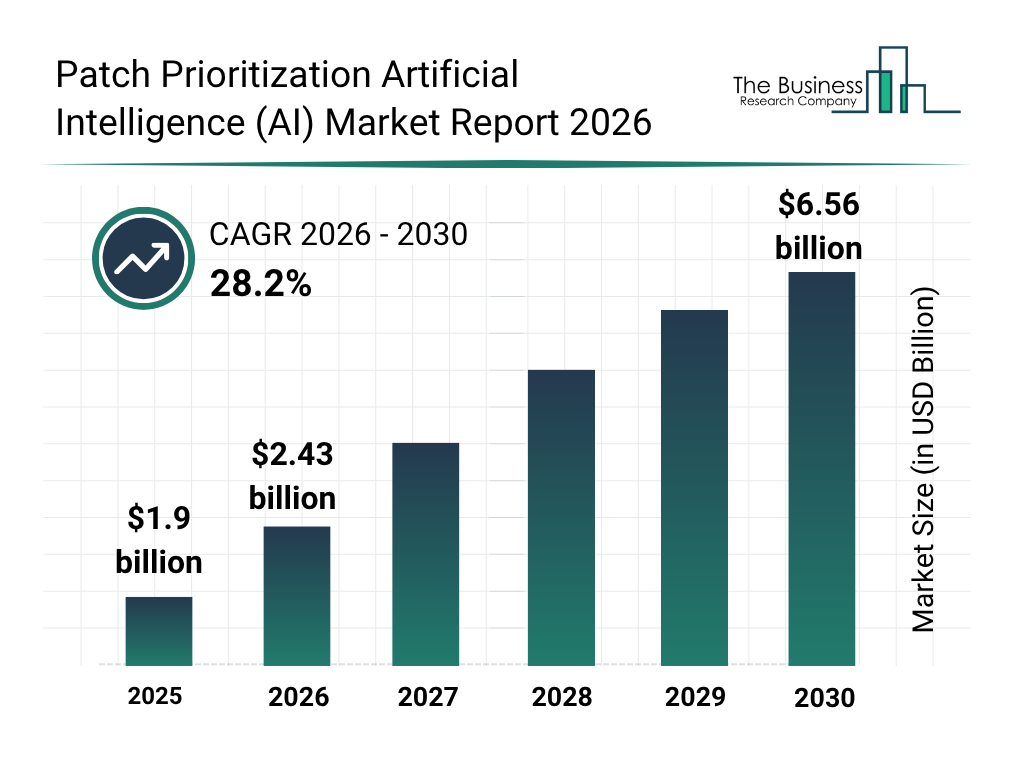
The patch prioritization artificial intelligence (AI) market has experienced significant expansion in recent years. Its valuation is anticipated to climb from $1.9 billion in 2025 to $2.43 billion in 2026, demonstrating a compound annual growth rate (CAGR) of 28.0%. This historical growth can be attributed to several factors, including the escalating frequency of cyberattacks, the growing complexity of enterprise IT environments, the adoption of traditional vulnerability management tools, the enforcement of regulatory compliance mandates, and a limited IT security workforce.
The patch prioritization artificial intelligence (AI) market is projected to undergo significant expansion in the coming years, reaching $6.56 billion by 2030 at a compound annual growth rate (CAGR) of 28.2%. This growth during the forecast period is fueled by several factors, including the increasing adoption of AI-driven patch prioritization platforms, the incorporation of machine learning into threat analytics, the expansion of cloud-based IT infrastructures, heightened investment in cybersecurity automation, and the proliferation of cross-industry digital transformation initiatives. Notable trends anticipated in this period include automated risk-based patch prioritization, deeper integration with IT operations and security platforms, sophisticated real-time threat scoring and analytics, a stronger focus on compliance in patch management, and the widening availability of cloud-based patch management solutions.
Get A Free Sample Report With In-Depth Market Insights:
Patch Prioritization Artificial Intelligence (AI) Market Demand Drivers: What’s Powering Industry Growth?
The escalating cybersecurity threats are projected to drive the expansion of the patch prioritization artificial intelligence market moving forward. Cybersecurity threats encompass dangers arising from harmful activities or system vulnerabilities that could compromise computers, networks, or confidential data. These threats are increasing due to the rapid embrace of digitalization across businesses and personal spheres, which broadens the number of online devices, applications, and data, subsequently creating more targets for attackers to exploit weaknesses. Patch prioritization artificial intelligence assists in mitigating cybersecurity threats by automatically evaluating and ranking software vulnerabilities according to their risk level, likelihood of exploitation, and operational impact, thereby enabling organizations to apply vital security patches faster and lessen their exposure to potential attacks. For instance, in October 2025, the Australian Signals Directorate, an Australia-based government agency, reported that its Australian Cyber Security Centre (ACSC) received over 42,500 calls to the Australian Cyber Security Hotline in 2024-25, marking a 16% rise compared to 2023-2024. Therefore, the growing incidence of cybersecurity threats is propelling the growth of the patch prioritization artificial intelligence market.
Patch Prioritization Artificial Intelligence (AI) Market Segmentation And Category Overview
The patch prioritization artificial intelligence (AI) market covered in this report is segmented –
1) By Component: Software, Services
2) By Deployment Mode: On-Premises, Cloud
3) By Organization Size: Small And Medium Enterprises, Large Enterprises
4) By Application: Vulnerability Management, Compliance Management, Risk Assessment, Information Technology Operations, Other Applications
5) By End-User: Banking, Financial Services, And Insurance, Healthcare, Information Technology And Telecommunications, Government, Retail, Manufacturing, Other End-Users
Subsegments:
1) By Software: Risk Based Vulnerability Prioritization Platforms, Automated Patch Intelligence Solutions, Machine Learning Driven Threat Scoring Tools, Cloud Based Patch Management Software, On Premises Patch Analytics Software
2) By Services: Professional Implementation And Integration Services, Managed Patch Prioritization Services, Consulting And Advisory Services, Training And Support Services, Continuous Monitoring And Optimization Services
Patch Prioritization Artificial Intelligence (AI) Market Innovation Trends: What Developments Are Reshaping The Industry?
Leading entities within the patch prioritization artificial intelligence market are concentrating on creating cutting-edge solutions, like autonomous risk management, designed for automated assessment, prioritization, and remediation of software vulnerabilities throughout intricate IT landscapes. This autonomous risk management denotes an AI system capable of automatically identifying, assessing, and alleviating risks without needing human involvement. An example is in August 2025, Qualys Inc., a US-based cloud security and compliance company, introduced numerous new Agentic AI functionalities on its Qualys platform. This novel methodology presents a marketplace featuring Cyber Risk AI Agents, which autonomously manage all stages of Cyber Risk Operations. It provides real-time risk intelligence across all potential attack vectors, ordered by their business impact, and decreases both risk and operational expenditures through swift, scalable, and accurate autonomous remediation. Consequently, this fosters a more intelligent and streamlined Risk Operations Center (ROC) by removing manual obstacles and facilitating autonomous, risk-centric workflows that empower teams and expedite protective measures.
Patch Prioritization Artificial Intelligence (AI) Market Competitive Analysis Of Leading Industry Participants
Major companies operating in the patch prioritization artificial intelligence (AI) market are Microsoft Corporation, International Business Machines Corporation, Cisco Systems Inc., Broadcom Inc., HCL Technologies Limited, ServiceNow Inc., Palo Alto Networks Inc., Fortinet Inc., CrowdStrike Holdings Inc., Check Point Software Technologies Ltd., BMC Software Inc., Kaseya Limited, Tenable Holdings Inc., Rapid7 Inc., Ivanti Inc., Qualys Inc., Tanium Inc., Automox Inc., Syxsense Inc., SecPod Technologies Private Limited.
View The Full Patch Prioritization Artificial Intelligence (AI) Market Report:
Patch Prioritization Artificial Intelligence (AI) Market Geographic Spread And Regional Opportunities
North America was the largest region in thepatch prioritization artificial intelligence (AI) market in 2025. Asia-Pacific is expected to be the fastest-growing region in the forecast period. The regions covered in the patch prioritization artificial intelligence (AI) market report are Asia-Pacific, South East Asia, Western Europe, Eastern Europe, North America, South America, Middle East, Africa.
Reach Out To Our Team:
The Business Research Company: https://www.thebusinessresearchcompany.com/
Americas: +1 310-496-7795
Asia: +44 7882 955267 & +91 8897263534
Europe: +44 7882 955267
Email us at: marketing@tbrc.info
Follow us on:
LinkedIn: https://in.linkedin.com/company/the-business-research-company
YouTube: https://www.youtube.com/channel/UC24_fI0rV8cR5DxlCpgmyFQ
Global Market Model: https://www.thebusinessresearchcompany.com/global-market-model

Wasay has over a decade of experience in market research, data modelling, and analytics, with prior experience at GlobalData and Decision Tree Consulting Services. At The Business Research Company , he leads research operations across syndicated studies, customized consulting engagements, and the Global Market Model platform. His professional experience includes supporting organizations such as Boston Consulting Group, KPMG, and Ernst & Young. Wasay holds a degree in Electronics and Communications Engineering, postgraduate management qualifications from International Management Institute Belgium and Indian School of Business and Entrepreneurship, and completed the Integrated Program in Business Analytics from Indian Institute of Management Indore.