Featuring market attractiveness scoring, total addressable market sizing, company benchmarking matrices, interactive Excel dashboards, deeper supply chain intelligence, emerging startup tracking, and granular product-level insights, The Business Research Company’s 2026 market reports are built to deliver research that is both more actionable and more strategically valuable.
Pay TV Market CAGR Outlook And Future Development
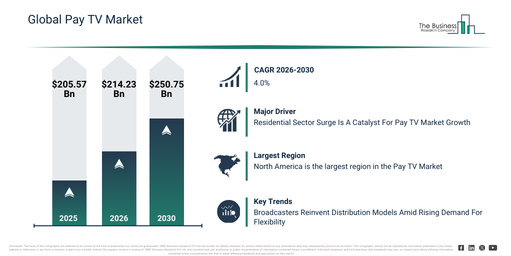
The pay tv market has experienced consistent expansion over recent years. It is anticipated to expand from $205.57 billion in 2025 to $214.23 billion in 2026, achieving a compound annual growth rate (CAGR) of 4.2%. This historical growth can be attributed to several factors, including the development of cable and satellite infrastructure, increased household television adoption, the proliferation of premium content options, growing demand for live sports broadcasting, and the availability of proprietary set-top boxes.
The pay tv market is anticipated to experience consistent growth over the coming years. By 2030, it is projected to reach a valuation of $250.75 billion, exhibiting a compound annual growth rate (CAGR) of 4.0%. This expansion in the forecast period is primarily driven by factors such as the increasing integration of pay tv and streaming services, heightened investments in interactive television platforms, the wider availability of high-speed broadband connectivity, a growing consumer demand for flexible subscription models, and an intensified focus on content services that provide added value. Significant trends anticipated during this period include a rise in the adoption of bundled content services, an increasing demand for IPTV-based pay tv platforms, greater incorporation of personalized content delivery, the broadening of multi-screen viewing experiences, and an enhanced strategic emphasis on customer retention.
Get A Free Sample Report With In-Depth Market Insights:
Pay TV Market Growth Catalysts And Demand Drivers
The increasing demand from residential applications is projected to fuel the expansion of the pay TV market moving forward. The residential sector pertains to real estate primarily designated for living purposes. Pay TV services furnish households with an extensive array of channels, premium content, additional features, ad-free viewing options, and enhanced signal stability and reliability. These services bolster residential applications by offering homes a broad spectrum of top-tier entertainment choices, dependable signal delivery, access to exclusive content, and convenient functionalities that elevate the overall in-home viewing experience. For instance, in March 2025, the U.S. Census Bureau, a US-based government department, reported that privately owned housing starts advanced to 1,501,000 units on a seasonally adjusted annual basis, marking an approximately 11.2% increase from the preceding month. Thus, the rising residential demand is propelling the growth of the pay TV market.
Pay TV Market Segments: Where Is Growth Concentrated?
The pay tv market covered in this report is segmented –
1) By Type: Postpaid, Prepaid
2) By Technology: Cable TV, Satellite TV, Internet Protocol TV (IPTV)
3) By Application: Residential, Commercial
Subsegments:
1) By Postpaid: Subscription-Based Packages, Bundled Services
2) By Prepaid: Pay-As-You-Go Packages, Short-Term Subscription Plans
Pay TV Market Trends Shaping Long-Term Demand
Major companies in the pay TV market are increasingly channeling investments into advanced direct-to-consumer (D2C) platforms and integrated streaming services. This strategy aims to broaden viewer reach, reduce reliance on traditional cable models, and boost user engagement. In October 2025, CNN, a US-based American media company, launched All Access, its updated subscription streaming tier. The service provides subscribers with live and on-demand video content, an extensive catalog of CNN Originals, and complete access to articles on CNN.com and its mobile app. This launch signifies the industry’s transition toward more adaptable, digitally powered content delivery strategies.
Pay TV Market Key Participants And Competitive Landscape
Major companies operating in the pay tv market are Bharti Airtel Limited; DirecTV LLC; Foxtel; Dish TV; Comcast Corporation; Rostelecom PJSC; Fetch TV Pty Limited; Tata Play Limited; Tricolor TV; Videocon d2h Limited; Charter Communications Inc.; Verizon Communications Inc.; Altice USA Inc.; DISH Network Corporation; Canal+ Group; Sky Limited; Liberty Global Inc.; Shaw Communications Inc.; Rogers Communications Inc.; Bell Canada Inc.; Telus Corporation; SKY Brasil; Televisa S.A.B. de C.V.; Optimum; Sling TV
View The Full Pay TV Market Report:
Pay TV Market Largest Region: Which Geography Holds The Biggest Share?
North America was the largest region in the pay TV market in 2025. The regions covered in the pay tv market report are Asia-Pacific, South East Asia, Western Europe, Eastern Europe, North America, South America, Middle East, Africa.
Reach Out To Our Team:
The Business Research Company: https://www.thebusinessresearchcompany.com/
Americas: +1 310-496-7795
Asia: +44 7882 955267 & +91 8897263534
Europe: +44 7882 955267
Email us at: marketing@tbrc.info
Follow us on:
LinkedIn: https://in.linkedin.com/company/the-business-research-company
YouTube: https://www.youtube.com/channel/UC24_fI0rV8cR5DxlCpgmyFQ
Global Market Model: https://www.thebusinessresearchcompany.com/global-market-model

Wasay has over a decade of experience in market research, data modelling, and analytics, with prior experience at GlobalData and Decision Tree Consulting Services. At The Business Research Company , he leads research operations across syndicated studies, customized consulting engagements, and the Global Market Model platform. His professional experience includes supporting organizations such as Boston Consulting Group, KPMG, and Ernst & Young. Wasay holds a degree in Electronics and Communications Engineering, postgraduate management qualifications from International Management Institute Belgium and Indian School of Business and Entrepreneurship, and completed the Integrated Program in Business Analytics from Indian Institute of Management Indore.