
Built to provide research that’s more actionable and strategically valuable, The Business Research Company’s 2026 market reports include market attractiveness analysis, total addressable market sizing, company benchmarking matrices, interactive Excel dashboards, broader supply chain intelligence, emerging startup tracking, and in-depth product insights.
Post‑Quantum Crypto For Internet of Things (IoT) Market Growth Potential: How Will Market Size Shift Through 2030?
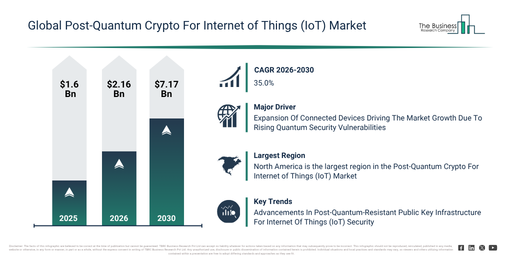
The market size for post-quantum crypto for internet of things (IoT) has experienced rapid expansion in recent times. Projections indicate it will expand from $1.6 billion in 2025 to $2.16 billion in 2026, exhibiting a compound annual growth rate (CAGR) of 34.8%. This historical growth is attributable to factors such as increased IoT device deployments, escalating cybersecurity threats, the use of conventional encryption protocols, a stronger regulatory focus on data protection, and the proliferation of smart home and industrial IoT applications.
The post-quantum crypto for internet of things (IoT) market size is projected to experience substantial expansion over the upcoming years, reaching $7.17 billion by 2030, demonstrating a compound annual growth rate (CAGR) of 35.0%. This anticipated growth is primarily driven by factors such as the wider adoption of post-quantum cryptography, a surging demand for quantum-safe IoT devices, the incorporation of AI for enhanced automated security, the proliferation of smart city and industrial IoT networks, the advancement of edge computing, and the necessity for secure firmware updates. Prominent trends expected within this forecast period involve the development of lightweight cryptographic algorithms suitable for IoT devices, the implementation of quantum-resistant key management solutions, the deployment of edge-based post-quantum encryption, seamless integration with existing IoT device management platforms, and robust secure firmware and authentication updates.
Get A Free Sample Report With In-Depth Market Insights:
Post‑Quantum Crypto For Internet of Things (IoT) Market Growth Catalysts And Demand Drivers
The future growth of the post-quantum crypto for the Internet of Things (IoT) market is anticipated to be fueled by the increasing number of connected devices. These are physical objects equipped with internet capabilities, designed to communicate and share data across networks. This proliferation of connected devices primarily stems from the rapid digitalization observed across various industries. Sectors like healthcare, manufacturing, and smart infrastructure are widely adopting internet-connected devices to facilitate automation and real-time data exchange, thereby considerably expanding the IoT ecosystem. The surging number of connected devices underscores an urgent necessity for quantum-resistant encryption. Each new device added to the network potentially introduces a vulnerability that traditional cryptographic methods might not adequately safeguard against future quantum computing threats. An illustration of this trend is provided by Scania, a commercial vehicle manufacturer based in Sweden. As reported in February 2025, Scania had around 638,000 connected vehicles by the close of 2024, a number that continues to climb swiftly. Consequently, the increasing prevalence of connected devices is a significant catalyst for the expansion of the post-quantum crypto for the Internet of Things (IoT) market.
Post‑Quantum Crypto For Internet of Things (IoT) Market Segment Landscape: Which Areas Lead Development?
The post‑quantum crypto for internet of things (IoT) market covered in this report is segmented –
1) By Component: Hardware, Software, Services
2) By Deployment Mode: On Premises, Cloud Based, Hybrid
3) By Organization Size: Small And Medium Enterprises, Large Enterprises
4) By Application: Smart Home, Industrial Internet of Things (IoT), Healthcare Internet of Things (IoT), Automotive, Smart Cities, Other Applications
5) By End-User: Manufacturing, Healthcare, Automotive, Energy And Utilities, Consumer Electronics, Other End-Users
Subsegments:
1) By Hardware: Cryptographic Processors, Secure Microcontrollers, Quantum Random Number Generators, Trusted Platform Modules, Hardware Security Modules
2) By Software: Post Quantum Cryptography Libraries, Encryption Software, Key Management Software, Authentication Software, Firmware Security Software
3) By Services: Consulting Services, Implementation Services, Managed Security Services, Training Services, Support And Maintenance Services
Post‑Quantum Crypto For Internet of Things (IoT) Market Trends Shaping Long-Term Demand
Leading companies in the post-quantum crypto for the internet of things (IoT) market are prioritizing technological advancements like post-quantum-resistant public key infrastructure (PKI) solutions. These efforts aim to secure IoT devices against future quantum computing threats while simultaneously ensuring scalability and compatibility within resource-constrained environments. Post-quantum-resistant PKI refers to cryptographic infrastructures that integrate NIST-aligned post-quantum algorithms, enabling device authentication, secure key exchange, lifecycle management, and long-term data protection within IoT ecosystems. For instance, in December 2024, SEALSQ Corp, a Switzerland-based semiconductor company, introduced INeS PKI, a post-quantum-resistant IoT security solution. This solution integrates quantum-resistant algorithms such as Crystals-Kyber and Crystals-Dilithium to protect IoT devices from quantum attacks. It facilitates secure device identity, zero-touch provisioning, and scalable key management across embedded, cloud, and on-premise deployments. INeS PKI provides high-performance and future-proof IoT security for applications including smart cities, industrial IoT, healthcare IoT, and connected vehicles.
Post‑Quantum Crypto For Internet of Things (IoT) Market Competitive Landscape: Who Leads The Industry?
Major companies operating in the post‑quantum crypto for internet of things (IoT) market are Alphabet Inc., Microsoft Corporation, Samsung Electronics Co. Ltd., Huawei Technologies Co Ltd, International Business Machines Corporation, Thales S A, Infineon Technologies AG, Rambus Inc, Kudelski SA, QNu Labs Private Limited, PQShield Limited, ISARA Corporation, QuintessenceLabs Pty Ltd, Qrypt Inc, Securosys SA, Post Quantum Limited, CryptoNext Security, EvolutionQ Inc, QuSecure Inc, Crypto Quantique Limited, ExeQuantum, Xiphera Ltd, Crypto4A Technologies Inc, Arqit Quantum Inc, and ResQuant Ltd.
View The Full Post‑Quantum Crypto For Internet of Things (IoT) Market Report:
Post‑Quantum Crypto For Internet of Things (IoT) Market Geographic Landscape: Which Region Leads Industry Growth?
North America was the largest region in the post-quantum crypto for the Internet of Things (IoT) market in 2025. Asia-Pacific is expected to be the fastest-growing region in the forecast period. The regions covered in the post‑quantum crypto for internet of things (IoT) market report are Asia-Pacific, South East Asia, Western Europe, Eastern Europe, North America, South America, Middle East, Africa.
Reach Out To Our Team:
The Business Research Company: https://www.thebusinessresearchcompany.com/
Americas: +1 310-496-7795
Asia: +44 7882 955267 & +91 8897263534
Europe: +44 7882 955267
Email us at: marketing@tbrc.info
Follow us on:
LinkedIn: https://in.linkedin.com/company/the-business-research-company
YouTube: https://www.youtube.com/channel/UC24_fI0rV8cR5DxlCpgmyFQ
Global Market Model: https://www.thebusinessresearchcompany.com/global-market-model

Wasay has over a decade of experience in market research, data modelling, and analytics, with prior experience at GlobalData and Decision Tree Consulting Services. At The Business Research Company , he leads research operations across syndicated studies, customized consulting engagements, and the Global Market Model platform. His professional experience includes supporting organizations such as Boston Consulting Group, KPMG, and Ernst & Young. Wasay holds a degree in Electronics and Communications Engineering, postgraduate management qualifications from International Management Institute Belgium and Indian School of Business and Entrepreneurship, and completed the Integrated Program in Business Analytics from Indian Institute of Management Indore.