
nan
Cancel For Any Reason (CFAR) Travel Insurance Market Forecast Highlighting Growth From $6.07 Billion To $8.35 Billion
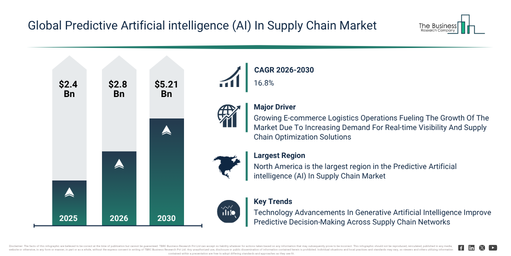
The market size for predictive artificial intelligence (AI) in supply chains has observed rapid expansion in recent years. This market is expected to increase from $2.4 billion in 2025 to $2.8 billion in 2026, achieving a compound annual growth rate (CAGR) of 16.6%. The historical growth in this sector can be ascribed to elements like manual demand forecasting procedures, disjointed supply chain data systems, over-reliance on past sales information for strategic planning, restricted integration of analytics in procurement, and notable inventory inefficiencies and stock imbalances.
The predictive artificial intelligence (AI) in supply chain market size is expected to undergo significant expansion over the next few years. It is forecast to grow to $5.21 billion in 2030, achieving a compound annual growth rate (CAGR) of 16.8%. This projected growth during the forecast period can be attributed to factors such as the increasing adoption of AI and machine learning in supply chain planning, the expansion of real-time data integration across logistics networks, the growth of cloud-based supply chain platforms, escalating volatility in global trade and disruptions, and a rising demand for end-to-end supply chain visibility. Prominent trends anticipated in this period include the wider adoption of AI-powered supply chain control towers, an increasing use of predictive analytics for inventory and warehouse optimization, the expansion of digital twin models for supply chain simulation, the growing integration of predictive risk management into procurement strategies, and the deployment of intelligent logistics optimization systems aimed at cost reduction.
Download A Free Sample Report For Comprehensive Market Insights:
Predictive Artificial intelligence (AI) In Supply Chain Market Development Factors: Which Trends Are Supporting Demand?
The expanding e-commerce logistics activities are anticipated to propel the growth of the predictive artificial intelligence (AI) in supply chain market moving forward. E-commerce logistics operations involve transportation, warehousing, inventory management, order fulfillment, and delivery tasks that facilitate online retail and digital commerce transactions. The increase in e-commerce logistics operations is driven by consumers’ rising preference for online shopping and faster delivery services across domestic and international markets. Predictive artificial intelligence (AI) in supply chain supports these growing e-commerce logistics operations by enhancing demand forecasting, optimizing inventory allocation, reducing transportation inefficiencies, and improving real-time supply chain visibility across fulfillment networks. For instance, in February 2026, according to the Census Bureau, a US-based government agency, U.S. retail e-commerce sales reached $326.7 billion in the first quarter of 2026, indicating a 2.7% increase (±0.5%) compared to the fourth quarter of 2025. Therefore, the increasing e-commerce logistics operations are fueling the expansion of the predictive artificial intelligence (AI) in supply chain market.
Cancel For Any Reason (CFAR) Travel Insurance Market Segmentation Trends And Revenue Drivers
The predictive artificial intelligence (AI) in supply chain market covered in this report is segmented –
1) By Component: Software; Services
2) By Deployment Mode: On Premise; Cloud Based; Hybrid
3) By Enterprise Size: Large Enterprises; Small And Medium Enterprises
4) By Application: Demand Forecasting; Inventory Management; Procurement And Sourcing; Risk Management; Other Applications
5) By End Use Industry: Retail; Automotive; Manufacturing; Food And Beverages; Healthcare; Other End Use Industries
Subsegments:
1) By Software: Inventory Optimization Software; Supply Chain Planning Software; Transportation Management Software; Warehouse Management Software; Predictive Maintenance Software; Logistics Analytics Platforms; Real Time Visibility And Tracking Software
2) By Services: Consulting Services; System Integration Services; Artificial Intelligence Model Development Services; Training And Support Services; Maintenance And Upgrade Services; Data Analytics And Visualization Services; Supply Chain Optimization Services
Technology Advancements In Generative Artificial Intelligence Improve Predictive Decision-Making Across Supply Chain Networks
Major companies operating in the predictive artificial intelligence (AI) in supply chain market are focusing on developing advanced solutions, such as generative supply chain orchestration platforms, to improve forecasting accuracy, automate operational planning, and strengthen supply chain resilience. Generative supply chain orchestration platforms refer to artificial intelligence systems that use large language models, predictive analytics, and real-time operational data to generate optimized recommendations for inventory planning, transportation management, supplier coordination, and logistics execution. For instance, in October 2024, DHL Supply Chain, a Germany-based logistics company, implemented a suite of generative artificial intelligence applications to enhance data management, customer support, and proposal accuracy across its supply chain operations. The technology includes advanced data cleansing capabilities for logistics planning, automated analysis of customer request-for-quotation documents, and artificial intelligence-driven proposal generation tools that improve operational efficiency and accelerate customer response times. Additionally, the implementation enabled DHL Supply Chain to streamline internal decision-making processes by reducing manual effort in document interpretation and logistics data validation. The generative AI tools also supported faster and more accurate customer engagement by improving quotation turnaround times and enhancing the consistency of supply chain planning proposals.
Predictive Artificial intelligence (AI) In Supply Chain Market Leading Companies Driving Competitive Growth
Major companies operating in the predictive artificial intelligence (AI) in supply chain market are Amazon.com Inc.; Microsoft Corporation; Siemens AG; Deloitte Touche Tohmatsu Limited; International Business Machines Corporation; Oracle Corporation; Honeywell International Inc.; NVIDIA Corporation; SAP SE; Google LLC; Zebra Technologies Corporation; Manhattan Associates Inc.; E2open Parent Holdings Inc.; o9 Solutions Inc.; Kinaxis Inc.; RELEX Solutions; The Descartes Systems Group Inc.; C3.ai Inc.; LatentView Analytics Limited; ToolsGroup; StockIQ Technologies Inc.
Access The Complete Predictive Artificial intelligence (AI) In Supply Chain Market Report:
Predictive Artificial intelligence (AI) In Supply Chain Market Largest Region By Revenue And Market Share
North America was the largest region in the predictive artificial intelligence (AI) in supply chain market in 2025. Asia-Pacific is expected to be the fastest-growing region in the forecast period. The regions covered in the predictive artificial intelligence (AI) in supply chain market report are Asia-Pacific, South East Asia, Western Europe, Eastern Europe, North America, South America, Middle East, Africa.
Get in touch with us:
The Business Research Company: https://www.thebusinessresearchcompany.com/
Americas: +1 310-496-7795
Asia: +44 7882 955267 & +91 8897263534
Europe: +44 7882 955267
Email us at: marketing@tbrc.info
Follow us on:
LinkedIn: https://in.linkedin.com/company/the-business-research-company
YouTube: https://www.youtube.com/channel/UC24_fI0rV8cR5DxlCpgmyFQ
Global Market Model: https://www.thebusinessresearchcompany.com/global-market-model

Wasay has over a decade of experience in market research, data modelling, and analytics, with prior experience at GlobalData and Decision Tree Consulting Services. At The Business Research Company , he leads research operations across syndicated studies, customized consulting engagements, and the Global Market Model platform. His professional experience includes supporting organizations such as Boston Consulting Group, KPMG, and Ernst & Young. Wasay holds a degree in Electronics and Communications Engineering, postgraduate management qualifications from International Management Institute Belgium and Indian School of Business and Entrepreneurship, and completed the Integrated Program in Business Analytics from Indian Institute of Management Indore.