Through market attractiveness analysis, total addressable market evaluation, company benchmarking matrices, interactive Excel dashboards, expanded supply chain intelligence, emerging startup coverage, and detailed product insights, The Business Research Company’s 2026 market reports provide more actionable and strategically valuable research.
Product Recommendation Engine Market Value Analysis: What Growth Is Expected Over The Forecast Period?
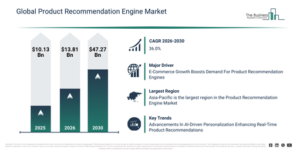
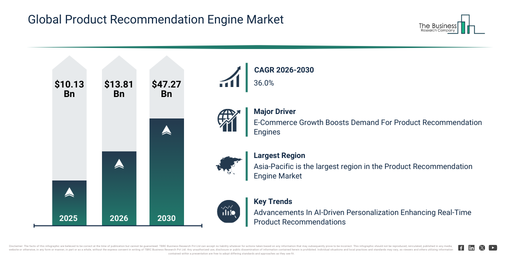
The product recommendation engine market size has experienced significant expansion in recent years. It is forecast to grow from $10.13 billion in 2025 to $13.81 billion in 2026, achieving a compound annual growth rate (CAGR) of 36.3%. This historical growth can be attributed to the proliferation of e-commerce platforms, the increasing volume of online consumer data, the early integration of recommendation algorithms, heightened digital marketing initiatives, and breakthroughs in machine learning techniques.
The product recommendation engine market is anticipated to experience substantial growth over the next few years. Its value is projected to reach $47.27 billion by 2030, exhibiting a robust compound annual growth rate (CAGR) of 36.0%. This expansion during the forecast period is largely attributable to the integration of artificial intelligence with customer experience, the ongoing expansion of omni-channel retail, the increasing growth in mobile commerce, the adoption of predictive analytics, and the rising demand for hyper-personalization. Key trends for the forecast period include personalized shopping experiences, recommendations derived from behavioral analytics, real-time product suggestions, optimized customer engagement, and comprehensive cross-platform recommendation systems.
Download A Free Sample Report For Comprehensive Market Insights:
#Product Recommendation Engine Market Growth Factors: Which Forces Are Supporting Market Expansion?
The expansion of e-commerce is anticipated to boost the product recommendation engine market moving ahead. E-commerce involves the online exchange of goods and services via digital channels. This surge in e-commerce is attributed to the ease of purchasing items anytime, anywhere, coupled with the proliferation of mobile devices, which facilitates easier entry to online platforms. Product recommendation engines provide value to e-commerce by customizing the shopping journey, proposing items based on customers’ prior actions and likes, and enhancing customer involvement. For instance, in September 2023, a report from the IAB Australia, an Australia-based non-profit organization, indicated that 73% of online shoppers bought non-grocery retail products online at least monthly, a percentage that has stayed constant since 2022. Consequently, the increasing prevalence of e-commerce is fueling the expansion of the product recommendation engine market. The increasing spread of internet access is anticipated to boost the product recommendation engine market, driven by wider online availability and a growing active user base. Internet penetration denotes the proportion of a population with internet access and regular usage, typically shown as a percentage of a country’s or region’s total inhabitants. This surge in internet penetration stems from the expanding availability of economical mobile data plans, which render online access more affordable for a greater segment of the population. Product recommendation engines gain from increasing internet penetration by allowing companies to provide tailored suggestions to an expanded and more continuously engaged online audience. For instance, in September 2025, the Government of Canada, a Canada-based federal government, projected that high-speed internet coverage would grow from 93.5% of the population in 2022 to 98% by 2026, ultimately achieving full 100% coverage by 2030. Thus, the growing internet penetration is propelling the expansion of the product recommendation engine market.
Product Recommendation Engine Market Segment Analysis: What Are The Major Market Categories?
The product recommendation engine market covered in this report is segmented –
1) By Type: Collaborative Filtering, Content-Based Filtering, Hybrid Recommendation Systems, Other Types
2) By Deployment Mode: On-Premise, Cloud
3) By End-User Industry: Information Technology And Telecommunication, Banking, Financial Services, And Insurance (BFSI), Retail, Media And Entertainment, Healthcare, Other End-User Industries
Subsegments:
1) By Collaborative Filtering: User-Based Collaborative Filtering, Item-Based Collaborative Filtering, Matrix Factorization Techniques
2) By Content-Based Filtering: Profile-Based Recommendations, Textual Content Analysis, Keyword-Based Recommendations
3) By Hybrid Recommendation Systems: Combining Collaborative and Content-Based Approaches, Weighted Hybrid Methods, Model-Based Hybrid Systems
4) By Other Types: Knowledge-Based Recommendation Systems, Demographic-Based Recommendations, Context-Aware Recommendation Systems
Product Recommendation Engine Market Trends: What Is Shaping Future Industry Growth?
Major companies operating within the product recommendation engine market are actively developing technologically advanced solutions, such as AI-driven intelligent product recommendation engines, to elevate user experience and facilitate personalized shopping journeys. AI-driven product recommendation engines represent sophisticated systems that leverage artificial intelligence and machine learning techniques to analyze user data and deliver customized product suggestions. For instance, in June 2023, SAP SE, a Germany-based software company, introduced a new AI-powered solution called SAP Intelligent Product Recommendation, designed to enhance the sales process and improve customer experiences. This tool employs machine learning and historical data to provide personalized product recommendations tailored to customer needs, thereby streamlining the quotation process for configurable products. This release aligns with SAP’s strategy to embed AI capabilities across its applications, empowering organizations to utilize advanced technologies for improved decision-making and operational efficiency.
Product Recommendation Engine Market Leading Companies Driving Competitive Growth
Major companies operating in the product recommendation engine market are Amazon.com Inc., Google plc, Microsoft Corporation, Alibaba Group Holding Limited, Intel Corporation, International Business Machines Corporation, Oracle Corporation, SAP SE, Salesforce Inc., Adobe Inc., Outbrain Inc., Cloudera Inc., Bloomreach Inc., Emarsys eMarketing Systems AG, Piano Software Inc., Coveo Solutions Inc., Dynamic Yield Ltd., Muvi LLC, Nosto Solutions Oy, Unbxd Inc., Certona Corporation, Recombee s.r.o.
Access The Complete Product Recommendation Engine Market Report:
Product Recommendation Engine Market Geographic Landscape: Which Region Dominates Industry Growth?
Asia-Pacific was the largest region in the product recommendation engine market in 2025. Asia-Pacific is expected to be the fastest-growing region in the forecast period. The regions covered in the product recommendation engine market report are Asia-Pacific, South East Asia, Western Europe, Eastern Europe, North America, South America, Middle East, Africa.
Get in touch with us:
The Business Research Company: https://www.thebusinessresearchcompany.com/
Americas: +1 310-496-7795
Asia: +44 7882 955267 & +91 8897263534
Europe: +44 7882 955267
Email us at: marketing@tbrc.info
Follow us on:
LinkedIn: https://in.linkedin.com/company/the-business-research-company
YouTube: https://www.youtube.com/channel/UC24_fI0rV8cR5DxlCpgmyFQ
Global Market Model: https://www.thebusinessresearchcompany.com/global-market-model

Wasay has over a decade of experience in market research, data modelling, and analytics, with prior experience at GlobalData and Decision Tree Consulting Services. At The Business Research Company , he leads research operations across syndicated studies, customized consulting engagements, and the Global Market Model platform. His professional experience includes supporting organizations such as Boston Consulting Group, KPMG, and Ernst & Young. Wasay holds a degree in Electronics and Communications Engineering, postgraduate management qualifications from International Management Institute Belgium and Indian School of Business and Entrepreneurship, and completed the Integrated Program in Business Analytics from Indian Institute of Management Indore.