Backed by market attractiveness analysis, total addressable market sizing, company benchmarking matrices, interactive Excel dashboards, wider supply chain intelligence, emerging startup coverage, and detailed product-level insights, The Business Research Company’s 2026 market reports are designed to offer research that is more actionable and strategically valuable than ever.
Protein–Ligand Binding Prediction Artificial Intelligence (AI) Market Size Outlook: How Quickly Will Revenue Expand Through 2030?
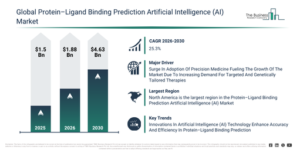
The protein–ligand binding prediction artificial intelligence (AI) market size has experienced remarkable growth in recent years. Its valuation is anticipated to rise from $1.5 billion in 2025 to $1.88 billion in 2026, demonstrating a compound annual growth rate (CAGR) of 25.1%. This historical expansion can be attributed to factors such as the development of computational chemistry, the uptake of traditional molecular docking tools, increased investment in pharmaceutical R&D, the progression of academic research in bioinformatics, and the accessibility of high-performance computing systems.
The protein–ligand binding prediction artificial intelligence (AI) market is anticipated to experience substantial growth over the next few years. It is forecast to expand to $4.63 billion in 2030, demonstrating a compound annual growth rate (CAGR) of 25.3%. This expansion during the forecast period is driven by the uptake of AI-powered protein-ligand prediction models, the expansion of cloud-based computational platforms, the integration of deep learning and graph neural networks, an increasing demand for faster drug discovery, and investment in predictive modeling and simulation software. Significant trends influencing the market include the integration of graph neural networks, AI-driven molecular docking optimization, the development of cloud-based drug discovery platforms, automated virtual screening pipelines, and predictive structure-activity relationship modeling.
Get A Free Sample Report With In-Depth Market Insights:
Protein–Ligand Binding Prediction Artificial Intelligence (AI) Market Opportunity Drivers: What’s Unlocking New Revenue Potential?
The increasing embrace of precision medicine is anticipated to fuel the expansion of the protein–ligand binding prediction artificial intelligence market in the future. This medical strategy involves tailoring disease prevention, diagnosis, and treatment according to an individual’s unique genetic makeup, environmental influences, and lifestyle attributes. The growing uptake of precision medicine stems from its enhanced treatment efficacy, where individualized therapies, aligned with a patient’s genetic profile, lead to better clinical results and fewer negative reactions. Protein–ligand binding prediction artificial intelligence aids precision medicine by precisely modeling molecular interactions specific to each patient, thus facilitating the creation of highly focused treatments that correspond with individual genetic and proteomic data. An illustrative example is seen in February 2024, when the US-based nonprofit advocacy organization, the Personalized Medicine Coalition, reported the approval of 16 novel personalized treatments for rare diseases, a rise from six approvals in 2022. Consequently, the increased acceptance of precision medicine is propelling the expansion of the protein–ligand binding prediction artificial intelligence market.
Protein–Ligand Binding Prediction Artificial Intelligence (AI) Market Segment Analysis: What Are The Core Market Categories?
The protein–ligand binding prediction artificial intelligence (AI) market covered in this report is segmented –
1) By Component: Software, Hardware, Services
2) By Technology: Machine Learning Algorithms, Deep Learning Models, Graph Neural Networks, Molecular Docking Tools, Quantitative Structure Activity Relationship Models
3) By Deployment Mode: On-Premises, Cloud
4) By Application: Drug Discovery, Molecular Docking, Virtual Screening, Structure-Based Drug Design, Other Applications
5) By End-User: Pharmaceutical And Biotechnology Companies, Academic And Research Institutes, Contract Research Organizations, Other End-Users
Subsegments:
1) By Software: Molecular Docking Software, Machine Learning Prediction Software, Data Analysis Software, Visualization Software, Simulation Software
2) By Hardware: High Performance Computing Systems, Graphics Processing Units, Cloud Computing Infrastructure, Workstations, Storage Systems
3) By Services: Model Development Services, Data Curation Services, Consulting Services, Integration Services, Support and Maintenance Services
Protein–Ligand Binding Prediction Artificial Intelligence (AI) Market Innovation Trends Shaping Future Development
Leading companies within the protein–ligand binding prediction artificial intelligence (AI) market are concentrating on creating sophisticated solutions, including structurally augmented AI datasets and predictive modeling platforms, with the aim of speeding up drug discovery and boosting pharmaceutical R&D efficiency. These structurally augmented protein–ligand binding AI platforms are machine learning systems that have been trained using high-quality, experimentally confirmed structural and binding affinity data, allowing them to precisely forecast molecular interactions and therapeutic effectiveness. An example of this is SandboxAQ, a US-based enterprise SaaS company, which introduced its Structurally Augmented IC50 Repository (SAIR) in June 2025. This new open dataset comprises protein–ligand structures along with experimentally determined binding affinities. The primary goal of this innovative solution is to offer an extensive, AI-compatible dataset that combines structural biology information with IC50 measurements, thereby assisting researchers in formulating more precise predictive models for how drugs interact with their targets. It utilizes vast curated structural datasets and advanced AI modeling methodologies. This platform facilitates better generalization capabilities, lowers experimental expenses, and accelerates the discovery of potential drug candidates. Designed to cater to the rigorous demands of pharmaceutical and biotechnology settings, it guarantees scalable, data-driven, and highly accurate performance for vital initiatives in drug discovery, molecular optimization, and therapeutic development.
Protein–Ligand Binding Prediction Artificial Intelligence (AI) Market Competitive Landscape: Who Leads The Industry?
Major companies operating in the protein–ligand binding prediction artificial intelligence (AI) market are AstraZeneca plc, Evotec SE, Schrödinger Inc, XtalPi Holdings Limited, Insilico Medicine Inc, Ardigen Spółka Akcyjna, AI-Driven Therapeutics GmbH, Relay Therapeutics Inc, BenevolentAI SA, Deep Genomics Inc, Anima Biotech Inc, Atomwise Inc, Arzeda Corp, Aqemia Ltd, Envisagenics Inc, PostEra Ltd, Genesis Therapeutics Inc, Cradle Bio B V, Cloud Pharmaceuticals Inc, BioSymetrics Inc, Peptone Ltd, PharmAI Ltd, Aigenpulse Limited, Molecular Forecaster Inc, and Menten AI Inc.
View The Full Protein–Ligand Binding Prediction Artificial Intelligence (AI) Market Report:
Protein–Ligand Binding Prediction Artificial Intelligence (AI) Market Geographic Landscape: Which Region Dominates Industry Growth?
North America was the largest region in the protein–ligand binding prediction artificial intelligence (AI) market in 2025. Asia-Pacific is expected to be the fastest-growing region in the forecast period. The regions covered in the protein–ligand binding prediction artificial intelligence (AI) market report are Asia-Pacific, South East Asia, Western Europe, Eastern Europe, North America, South America, Middle East, Africa.
Reach Out To Our Team:
The Business Research Company: https://www.thebusinessresearchcompany.com/
Americas: +1 310-496-7795
Asia: +44 7882 955267 & +91 8897263534
Europe: +44 7882 955267
Email us at: marketing@tbrc.info
Follow us on:
LinkedIn: https://in.linkedin.com/company/the-business-research-company
YouTube: https://www.youtube.com/channel/UC24_fI0rV8cR5DxlCpgmyFQ
Global Market Model: https://www.thebusinessresearchcompany.com/global-market-model

Wasay has over a decade of experience in market research, data modelling, and analytics, with prior experience at GlobalData and Decision Tree Consulting Services. At The Business Research Company , he leads research operations across syndicated studies, customized consulting engagements, and the Global Market Model platform. His professional experience includes supporting organizations such as Boston Consulting Group, KPMG, and Ernst & Young. Wasay holds a degree in Electronics and Communications Engineering, postgraduate management qualifications from International Management Institute Belgium and Indian School of Business and Entrepreneurship, and completed the Integrated Program in Business Analytics from Indian Institute of Management Indore.