Backed by market attractiveness analysis, total addressable market sizing, company benchmarking matrices, interactive Excel dashboards, wider supply chain intelligence, emerging startup coverage, and detailed product-level insights, The Business Research Company’s 2026 market reports are designed to offer research that is more actionable and strategically valuable than ever.
Pruning Tools For Artificial Intelligence (AI) Market Size, Value And Growth Trajectory Through 2030
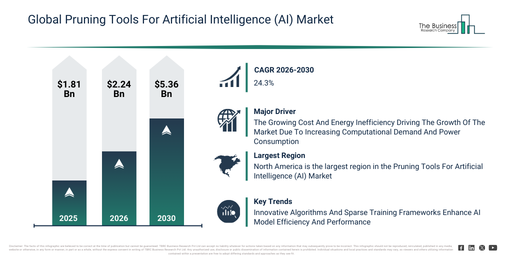
The market size for pruning tools in artificial intelligence (AI) has expanded significantly in recent years. This market is expected to grow from $1.81 billion in 2025 to $2.24 billion in 2026, exhibiting a compound annual growth rate (CAGR) of 24.1%. The growth observed in the past can be attributed to several factors, including the increasing sizes of deep learning models, rising concerns over computational costs, a heightened demand for faster inference speeds, the expansion of cloud AI infrastructure, and the early adoption of neural network optimization practices.
The market size for pruning tools utilized in artificial intelligence (AI) is projected to undergo significant expansion in the coming years. It will grow to $5.36 billion in 2030 at a compound annual growth rate (CAGR) of 24.3%. This growth during the forecast period is primarily driven by the increasing deployment of edge AI devices, a rising demand for energy-efficient AI processing, the expansion of real-time AI applications, a greater need for scalable AI deployment, and the growing adoption of automated machine learning. Major trends anticipated during this period include a rise in the uptake of automated model compression pipelines, the development of accuracy and efficiency evaluation platforms, an increasing demand for edge AI model optimization tools, the broadening of fine-tuning and retraining frameworks, and the integration of real-time performance monitoring modules.
Get A Free Sample Report With In-Depth Market Insights:
Pruning Tools For Artificial Intelligence (AI) Market Growth Backed By Core Demand Fundamentals
The increasing expenses and the push for greater energy efficiency are anticipated to drive the growth of the artificial intelligence (AI) pruning tools market moving forward. Cost and energy efficiency refers to the capacity to achieve desired outcomes or execute tasks while minimizing financial outlay and energy consumption. The escalation in costs and reduction in energy efficiency primarily stem from increased computational demands, as more powerful processors and larger AI models necessitate significantly more electricity and hardware resources to operate. Pruning tools for artificial intelligence (AI) enhance both cost and energy efficiency by reducing model size and computational requirements without significantly compromising performance. For instance, in 2024, the International Energy Agency (IEA), a France-based international energy institution, reported that global data center electricity use was approximately 415 terawatt-hours, and this figure is projected to rise to around 945 terawatt-hours by 2030, more than doubling due to expanding AI workloads and computational demand. Thus, the growing importance of cost and energy efficiency is fueling the demand for pruning tools within the artificial intelligence (AI) market.
Pruning Tools For Artificial Intelligence (AI) Market Segmentation: How Does The Market Break Down By Category?
The pruning tools for artificial intelligence (AI) market covered in this report is segmented –
1) By Product Type: Hardware Tools, Software Tools, Services
2) By Tool Type: Model Pruning Tools, Algorithmic Pruning Suites, Sparsity Optimization Libraries, Quantization And Compression Frameworks, Automated Pruning Pipelines
3) By Deployment Mode: On-Premises, Cloud-Based, Hybrid
4) By Application: Model Compression, Neural Network Optimization, Edge Artificial Intelligence (AI), Cloud Artificial Intelligence (AI), Other Applications
5) By End-User: Banking, Financial Services And Insurance, Healthcare, Retail, Automotive, Information Technologies And Telecommunications, Manufacturing, Other End-Users
Subsegments:
1) By Hardware Tools: Graphical Processing Units, Tensor Processing Units, Field Programmable Gate Arrays, Application Specific Integrated Circuits
2) By Software Tools: Model Pruning Libraries, Optimization Frameworks, Automation Tools, Performance Analysis Tools
3) By Services: Consulting Services, Implementation Services, Integration Services, Support Services, Training Services
Pruning Tools For Artificial Intelligence (AI) Market Growth Trends Reshaping The Competitive Landscape
Leading companies in the pruning tools for artificial intelligence (AI) market are concentrating on creating advanced solutions, including efficient pruning algorithms and sparse training frameworks, to enhance model performance and decrease computational expenses. Efficient pruning algorithms represent techniques that eliminate superfluous neural network weights to reduce model size and computational load without compromising accuracy, whereas sparse training frameworks are systems that train neural networks to have mostly zero values from the outset, conserving memory and compute during training. As an illustration, in May 2023, Google LLC, a US-based technology company, introduced JaxPruner, an open-source library tailored for the pruning and sparse training of neural networks within the JAX framework. This library assists researchers and engineers in reducing model size and computational requirements while maintaining high accuracy through the effective removal of non-essential parameters. It integrates seamlessly with established JAX workflows and offers a standardized API for evaluating different pruning strategies. By supporting both rapid prototyping and large-scale experiments, JaxPruner boosts the accessibility, efficiency, and reproducibility of sparse training across a variety of machine learning projects.
Pruning Tools For Artificial Intelligence (AI) Market Industry Leaders And Competitive Landscape
Major companies operating in the pruning tools for artificial intelligence (AI) market are Amazon Web Services Inc., Alphabet Inc., Microsoft Corporation, Meta Platforms Inc., Huawei Technologies Co. Ltd., International Business Machines Corporation, Intel Corporation, Qualcomm Technologies Inc., Advanced Micro Devices Inc., NVIDIA Corporation, Baidu Inc., OpenAI L.L.C., Renesas Electronics Corporation, Cerebras Systems Inc., Multiverse Computing S.L, Alibaba Cloud Computing Ltd., CLIKA Inc, Graphcore Limited, Pruna AI Inc., Nexa AI Inc.
View The Full Pruning Tools For Artificial Intelligence (AI) Market Report:
Pruning Tools For Artificial Intelligence (AI) Market Regional Analysis And Top Geography
North America was the largest region in the pruning tools for artificial intelligence (AI) market in 2025. Asia-Pacific is expected to be the fastest-growing region in the forecast period. The regions covered in the pruning tools for artificial intelligence (AI) market report are Asia-Pacific, South East Asia, Western Europe, Eastern Europe, North America, South America, Middle East, Africa.
Reach Out To Our Team:
The Business Research Company: https://www.thebusinessresearchcompany.com/
Americas: +1 310-496-7795
Asia: +44 7882 955267 & +91 8897263534
Europe: +44 7882 955267
Email us at: marketing@tbrc.info
Follow us on:
LinkedIn: https://in.linkedin.com/company/the-business-research-company
YouTube: https://www.youtube.com/channel/UC24_fI0rV8cR5DxlCpgmyFQ
Global Market Model: https://www.thebusinessresearchcompany.com/global-market-model

Wasay has over a decade of experience in market research, data modelling, and analytics, with prior experience at GlobalData and Decision Tree Consulting Services. At The Business Research Company , he leads research operations across syndicated studies, customized consulting engagements, and the Global Market Model platform. His professional experience includes supporting organizations such as Boston Consulting Group, KPMG, and Ernst & Young. Wasay holds a degree in Electronics and Communications Engineering, postgraduate management qualifications from International Management Institute Belgium and Indian School of Business and Entrepreneurship, and completed the Integrated Program in Business Analytics from Indian Institute of Management Indore.