The Business Research Company’s 2026 market reports are designed to deliver research that is more actionable and strategically valuable. Key offerings include market attractiveness scoring, total addressable market sizing, company benchmarking matrices, interactive Excel dashboards, deeper supply chain intelligence, emerging startup tracking, and granular product-level insights.
Physical Unclonable-Function (PUF) Display Market Size 2026: Valuation, Growth Rate And Forecast To 2030
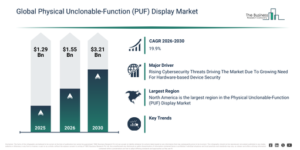
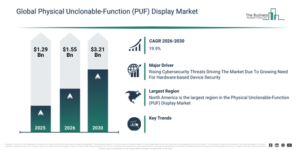
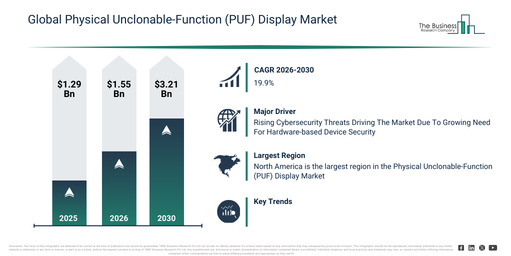
The physical unclonable-function (PUF) display market has experienced substantial growth in recent years. It is forecast to expand from $1.29 billion in 2025 to $1.55 billion in 2026, demonstrating a compound annual growth rate (CAGR) of 20.2%. The past growth can be attributed to factors such as rising incidents of device counterfeiting, a growing demand for hardware-based security, the limitations of software-only authentication, increased adoption of secure consumer electronics, and the necessity for trusted device identification.
The physical unclonable-function (puf) display market size is expected to experience significant expansion over the next few years. It is projected to reach $3.21 billion in 2030, exhibiting a compound annual growth rate (CAGR) of 19.9%. This growth during the forecast period is driven by the expansion of secure digital identity systems, the adoption of puf-based security in IoT devices, an increase in the demand for secure displays in financial applications, a heightened focus on zero-trust hardware architectures, and the integration of quantum-resistant security technologies. Prominent trends within the forecast period include display-level hardware authentication, anti-counterfeiting secure visual interfaces, the incorporation of pufs into advanced display panels, tamper-resistant display architectures, and the establishment of unique device identity through physical randomness.
Get A Free Sample Of The Physical Unclonable-Function (PUF) Display Market Report 2026:
What Is Driving The Growth Of The Physical Unclonable-Function (PUF) Display Market?
Increasing cybersecurity threats are anticipated to drive the expansion of the physical unclonable-function (PUF) display market. These threats involve potential harmful actions or weaknesses that could jeopardize the privacy, accuracy, or accessibility of digital infrastructure, networks, or information. The escalation of cybersecurity risks stems from the growing digitalization and interconnectedness of devices, which creates more opportunities for cybercriminals to exploit. Physical unclonable function (PUF) displays improve cybersecurity by offering a unique, hardware-based identity for devices, thus preventing unauthorized entry and the production of fake goods. For example, the World Economic Forum, a Switzerland-based non-profit, reported in January 2025 that 72% of individuals surveyed believed cyber risks had escalated in the preceding year (2024), pointing to a rise in cyber-enabled fraud, more phishing and social engineering attempts, and identity theft as the primary personal dangers. Consequently, the growing prevalence of cybersecurity threats is a key factor propelling the physical unclonable-function (PUF) display market. The increasing use of smartphones is forecast to boost the physical unclonable-function (PUF) display market. Smartphones are mobile gadgets that integrate communication features with sophisticated computing power, internet connectivity, and diverse applications. The surge in smartphone adoption is attributed to their greater affordability and widespread availability, which facilitates wider access to mobile networks and digital offerings. Within smartphones, the physical unclonable function (PUF) display serves to secure device verification and safeguard sensitive information by establishing a distinctive, tamper-proof hardware identity. As an illustration, the GSM Association (GSMA), a UK-based industry body representing mobile network operators and companies, indicated in February 2023 that smartphone penetration in sub-Saharan Africa is expected to grow substantially, reaching 87% by 2030, an increase from 51% in 2022. Thus, the expanding adoption of smartphones is a significant force behind the physical unclonable-function (PUF) display market.
How Is The Physical Unclonable-Function (PUF) Display Market Segmented?
The physical unclonable-function (puf) display market covered in this report is segmented –
1) By Type: Optical Physical Unclonable Function (PUF) Displays, Electronic Optical Physical Unclonable Function (PUF) Displays, Hybrid Optical Physical Unclonable Function (PUF) Displays
2) By Technology: Silicon-Based Physical Unclonable Function (PUF), Polymer-Based Physical Unclonable Function (PUF), Photonic Physical Unclonable Function (PUF), Other Technologies
3) By Application: Authentication, Anti-Counterfeiting, Secure Display Devices, Access Control, Other Applications
4) By End-User: Banking And Finance, Government, Consumer Electronics, Retail, Healthcare, Other End-Users
Subsegments:
1) By Physical Unclonable Function Displays: Reflective Physical Unclonable Function Displays, Transmissive Physical Unclonable Function Displays, Diffractive Physical Unclonable Function Displays
2) By Electronic Optical Physical Unclonable Function Displays: OLED-Based Electronic Optical Physical Unclonable Function Displays, LCD-Based Electronic Optical Physical Unclonable Function Displays, Micro-LED-Based Electronic Optical Physical Unclonable Function Displays
3) By Hybrid Optical Physical Unclonable Function Displays: Optical-Electronic Integrated Hybrid Physical Unclonable Function Displays, Photonic-Electronic Hybrid Physical Unclonable Function Displays, Quantum-Enhanced Hybrid Physical Unclonable Function Displays
Who Are The Key Players In The Physical Unclonable-Function (PUF) Display Market?
Major companies operating in the physical unclonable-function (puf) display market are Samsung Electronics Co. Ltd., Intel Corporation, Hewlett Packard Enterprise Company, Fujitsu Limited, Thales Group S.A., LG Display Co. Ltd., Infineon Technologies AG, NXP Semiconductors N.V., Analog Devices Inc., Renesas Electronics Corporation, Toppan Inc., Microchip Technology Inc., Synopsys Inc., Rambus Inc., eMemory Technology Inc., Promwad LLC, Infosecurity Inc., PUFsecurity Inc., Granite Mountain Technologies Inc., Enthentica S.A.S
Read The Complete Physical Unclonable-Function (PUF) Display Market Report 2026:
Which Region Is The Largest In The Physical Unclonable-Function (PUF) Display Market?
North America was the largest region in the physical unclonable-function (PUF) display market in 2025. Asia-Pacific is expected to be the fastest-growing region in the forecast period. The regions covered in the physical unclonable-function (puf) display market report are Asia-Pacific, South East Asia, Western Europe, Eastern Europe, North America, South America, Middle East, Africa.
Reach Out To Our Team:
The Business Research Company: https://www.thebusinessresearchcompany.com/
Americas: +1 310-496-7795
Asia: +44 7882 955267 & +91 8897263534
Europe: +44 7882 955267
Email us at: marketing@tbrc.info
Follow us on:
LinkedIn: https://in.linkedin.com/company/the-business-research-company
YouTube: https://www.youtube.com/channel/UC24_fI0rV8cR5DxlCpgmyFQ
Global Market Model: https://www.thebusinessresearchcompany.com/global-market-model

Wasay has over a decade of experience in market research, data modelling, and analytics, with prior experience at GlobalData and Decision Tree Consulting Services. At The Business Research Company , he leads research operations across syndicated studies, customized consulting engagements, and the Global Market Model platform. His professional experience includes supporting organizations such as Boston Consulting Group, KPMG, and Ernst & Young. Wasay holds a degree in Electronics and Communications Engineering, postgraduate management qualifications from International Management Institute Belgium and Indian School of Business and Entrepreneurship, and completed the Integrated Program in Business Analytics from Indian Institute of Management Indore.