Through market attractiveness analysis, total addressable market evaluation, company benchmarking matrices, interactive Excel dashboards, expanded supply chain intelligence, emerging startup coverage, and detailed product insights, The Business Research Company’s 2026 market reports provide more actionable and strategically valuable research.
Purchase Order Matching Artificial Intelligence Market Value Analysis: What Growth Is Expected Over The Forecast Period?
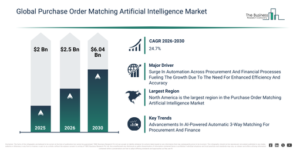
The purchase order matching artificial intelligence market size has shown substantial and swift expansion over recent years. It is anticipated to grow from $2 billion in 2025 to $2.5 billion in 2026, achieving a compound annual growth rate (CAGR) of 25.0%. The historical development of this market is linked to factors such as the expansion of enterprise procurement digitization, the significant manual workload in accounts payable, an increase in invoice fraud and duplicate payments, the adoption of ERP systems for procurement, and the demand for more rapid and accurate payment cycles.
The market for artificial intelligence in purchase order matching is anticipated to experience rapid expansion in the coming years. This market is projected to reach $6.04 billion by 2030, exhibiting a compound annual growth rate (CAGR) of 24.7%. Key drivers for this expansion during the forecast period include agentic accounts payable automation enabling end-to-end processing, real-time collaboration with suppliers and effective dispute resolution, AI-powered compliance checks for procurement policies, predictive capabilities for cash flow and payment scheduling, and increased adoption by small and medium-sized enterprises (SMEs) through cloud platforms. Significant trends anticipated in the forecast period encompass intelligent three-way matching for purchase orders (PO), invoices, and goods received notes (GRN), AI-driven exception handling and discrepancy resolution, the detection of fraud and duplicate payments within accounts payable (AP) workflows, touchless invoice processing leveraging Optical Character Recognition (OCR) and Natural Language Processing (NLP), and seamless integration with Enterprise Resource Planning (ERP) and procure-to-pay platforms.
Download A Free Sample Report For Comprehensive Market Insights:
Purchase Order Matching Artificial Intelligence Market Opportunity Drivers: What Is Creating New Revenue Potential?
The future expansion of the purchase order matching artificial intelligence market is anticipated due to the rising need for automation within procurement and financial operations. These processes encompass the structured activities for obtaining goods and services, handling relationships with suppliers, and managing financial dealings related to purchasing, budgeting, and payments. The escalating call for automation in these areas stems from the increasing requirement for both effectiveness and precision in processing substantial quantities of financial and procurement data, subsequently enabling organizations to conserve time and decrease operational expenses. Purchase order matching artificial intelligence assists procurement and financial processes by automating the validation of invoices against purchase orders and corresponding receipts, thereby minimizing manual errors, boosting accuracy, and speeding up payment cycles, leading to greater operational efficiency. For instance, a report from the Organization for Economic Co-operation and Development (OECD) in June 2025 highlighted the development of France-based, sector-specific CPBs, noting that 17 out of 35 OECD countries (49%) leverage them for health sector procurement and 12 out of 35 (34%) for ICT-related procurement. Therefore, the growing demand for automation across procurement and financial processes is projected to drive the growth of the purchase order matching artificial intelligence market.
Purchase Order Matching Artificial Intelligence Market Segmentation And Category Breakdown
The purchase order matching artificial intelligence market covered in this report is segmented –
1) By Component: Software, Services
2) By Deployment Mode: On-Premises, Cloud
3) By Enterprise Size: Small And Medium Enterprises, Large Enterprises
4) By Application: Invoice Processing, Fraud Detection, Compliance Management, Payment Reconciliation, Other Applications
5) By End User: Banking, Financial Services, and Insurance, Retail And E-commerce, Manufacturing, Healthcare, Logistics, Other End-User
Subsegments:
1) By Software: Cloud Based, On Premise
2) By Services: Implementation And Integration, Support And Maintenance, Consulting And Training
Purchase Order Matching Artificial Intelligence Market Transformation Trends: Which Innovations Are Driving Change?
Major companies within the purchase order matching artificial intelligence market are concentrating their efforts on technological advancements, such as automatic 3-way matching, to bolster efficiency, accuracy, and transparency throughout procurement and financial processes. Automatic 3-Way Matching refers to a system that autonomously verifies and reconciles purchase orders, goods receipts, and supplier invoices to guarantee precision, eliminate manual data entry, reduce inaccuracies, and streamline financial operations for swifter and more reliable payments. For example, in March 2024, Settle, a US-based cash-flow management platform, launched its Automatic 3-Way Matching feature for purchase orders, signifying a notable progression in procurement automation. This inventive solution simplifies the matching of purchase orders, invoices, and receipts, thereby minimizing manual errors and saving considerable time for finance and operations teams. It integrates advanced automation and validation functionalities, which enhance efficiency, transparency, and control within financial workflows. This feature underscores Settle’s dedication to simplifying cash flow management and modernizing procurement for fast-growing e-commerce and CPG brands.
Purchase Order Matching Artificial Intelligence Market Competitive Analysis Of Major Industry Participants
Major companies operating in the purchase order matching artificial intelligence market are International Business Machines Corporation, Oracle Corporation, SAP SE, GEP Worldwide LLC, QUADIENT S.A., Basware Corporation, Zycus Infotech Private Limited, Tipalti Inc., Tradeshift Holdings Inc., Ivalua Inc., Omnea Ltd., AppZen Inc., Rossum Ltd., Stampli Inc., Procurify Technologies Inc., SUTISOFT PRIVATE LIMITED, Traydstream Limited, Affinda Holdings Pty Ltd., Xelix Limited, Centime Inc., ProcureDesk
Access The Complete Purchase Order Matching Artificial Intelligence Market Report:
Purchase Order Matching Artificial Intelligence Market Regional Analysis And Leading Geography
North America was the largest region in the purchase order matching artificial intelligence market in 2025. Asia-Pacific is expected to be the fastest-growing region in the forecast period. The regions covered in the purchase order matching artificial intelligence market report are Asia-Pacific, South East Asia, Western Europe, Eastern Europe, North America, South America, Middle East, Africa.
Get in touch with us:
The Business Research Company: https://www.thebusinessresearchcompany.com/
Americas: +1 310-496-7795
Asia: +44 7882 955267 & +91 8897263534
Europe: +44 7882 955267
Email us at: marketing@tbrc.info
Follow us on:
LinkedIn: https://in.linkedin.com/company/the-business-research-company
YouTube: https://www.youtube.com/channel/UC24_fI0rV8cR5DxlCpgmyFQ
Global Market Model: https://www.thebusinessresearchcompany.com/global-market-model

Wasay has over a decade of experience in market research, data modelling, and analytics, with prior experience at GlobalData and Decision Tree Consulting Services. At The Business Research Company , he leads research operations across syndicated studies, customized consulting engagements, and the Global Market Model platform. His professional experience includes supporting organizations such as Boston Consulting Group, KPMG, and Ernst & Young. Wasay holds a degree in Electronics and Communications Engineering, postgraduate management qualifications from International Management Institute Belgium and Indian School of Business and Entrepreneurship, and completed the Integrated Program in Business Analytics from Indian Institute of Management Indore.