Delivering more actionable and strategically valuable research, The Business Research Company’s 2026 market reports feature market attractiveness analysis, total addressable market evaluation, company benchmarking matrices, interactive Excel dashboards, expanded supply chain intelligence, emerging startup coverage, and detailed product insights.
Quantum-Resistant Secure Firmware Loader Market Value Analysis: What Growth Is Expected Over The Forecast Period?
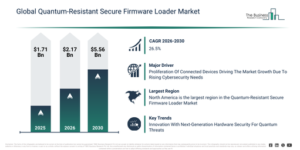
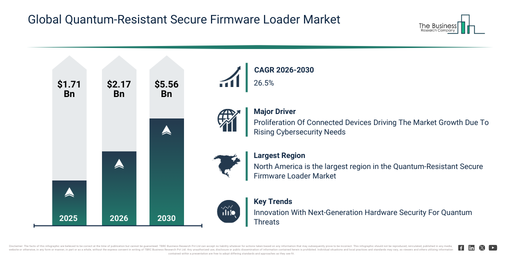
The quantum-resistant secure firmware loader market has experienced substantial growth in its size over recent years. It is projected to expand from $1.71 billion in 2025 to $2.17 billion in 2026, demonstrating a compound annual growth rate (CAGR) of 26.9%. The market’s historical growth can be primarily attributed to the increased deployment of IoT devices, incidents involving firmware security breaches, the ongoing expansion of industrial automation, a heightened awareness of vulnerabilities in connected devices, and the introduction of regulatory standards for device security.
The quantum-resistant secure firmware loader market is projected to experience rapid expansion over the coming years. This market is set to reach $5.56 billion by 2030, demonstrating a compound annual growth rate (CAGR) of 26.5%. Key factors driving this growth during the projected period include the rising demand for smart device security, the increasing adoption of post-quantum firmware protection, the expansion of autonomous system security, the growth in secure hardware module integration, and increased investment in embedded security. Significant trends anticipated within this forecast timeframe encompass post-quantum secure boot systems, quantum-safe firmware update mechanisms, platforms for device integrity verification, automated secure firmware deployment solutions, and the integration of embedded security modules.
Download A Free Sample Report For Comprehensive Market Insights:
Quantum-Resistant Secure Firmware Loader Market Growth Momentum: Which Factors Are Influencing Demand?
The increasing prevalence of connected devices is anticipated to drive the expansion of the quantum-resistant secure firmware loader market. Connected devices are defined as physical items embedded with sensors, software, and other technologies that enable them to connect and share data with other systems via the internet or communication networks. This rise in connected devices is primarily propelled by the swift growth of the Internet of Things (IoT), which allows everyday objects, from household appliances to industrial equipment, to collect, exchange, and analyze data, fostering smarter and more interconnected environments. Quantum-resistant secure firmware loaders are crucial for ensuring connected devices can securely receive, authenticate, and install updates, thereby protecting them from current and future quantum computing attacks, preventing unauthorized tampering, and maintaining the integrity, reliability, and long-term security of their operations in increasingly interconnected environments. As an illustration, in February 2023, BuildOps Inc., a US-based software-as-a-service (SaaS) company, noted that internet of things (IoT)-connected devices experienced a 28% increase from 2022 to 2023. Consequently, the proliferation of connected devices is fueling the growth of the quantum-resistant secure firmware loader market.
Quantum-Resistant Secure Firmware Loader Market Segment Breakdown: Which Categories Generate The Most Revenue?
The quantum-resistant secure firmware loader market covered in this report is segmented –
1) By Component: Hardware, Software, Services
2) By Security Type: Post-Quantum Cryptography, Hybrid Cryptography, Symmetric Key Algorithms, Other Security Types
3) By Deployment Mode: On-Premises, Cloud-Based
4) By End-User: Aerospace And Defence, Banking Financial Services And Insurance (BFSI), Healthcare, Manufacturing, Information Technology And Telecommunications, Other End-Users
Subsegments:
1) By Hardware: Secure Microcontrollers, Trusted Platform Modules (TPMs), Hardware Security Modules (HSMs), Physically Unclonable Functions (PUFs)
2) By Software: Firmware Encryption Tools, Quantum-Resistant Cryptographic Libraries, Secure Bootloaders, Key Management Software
3) By Services: Implementation And Integration Services, Consulting And Risk Assessment, Firmware Update And Maintenance Services, Security Auditing And Compliance Services
Quantum-Resistant Secure Firmware Loader Market Trends: What Is Shaping Future Industry Growth?
Leading companies in the quantum-resistant secure firmware loader market are concentrating on utilizing innovative technologies like endpoint security controller (ESC) chip technology to bolster hardware-level security, uphold firmware integrity, and shield sensitive data from emerging quantum computing threats. The endpoint security controller (ESC) chip is a specialized hardware component integrated into personal computers (PCs) that segregates security functions from the main processor and operating system. This assists in safeguarding firmware integrity, preventing unauthorized access, and protecting sensitive data against cyberattacks, including potential quantum computing threats. For example, in April 2024, HP Inc., a US-based information technology company, unveiled its HP business PCs featuring quantum-resistant firmware protection, which incorporates the 5th generation endpoint security controller (ESC) chip. This advancement offers hardware-level defense against quantum computer attacks by isolating critical security operations from the main processor and operating system, thereby ensuring the integrity of PC firmware. This measure prevents unauthorized access and secures sensitive data, as the ESC chip addresses new cybersecurity challenges presented by the potential development of cryptographically relevant quantum computers. The introduction of these products reflects a broader industry shift towards post-quantum cryptography, supporting organizations in proactively transitioning to quantum-resistant standards.
Quantum-Resistant Secure Firmware Loader Market Key Players And Strategic Industry Positioning
Major companies operating in the quantum-resistant secure firmware loader market are Microsoft Corporation, Intel Corporation, HP Inc., IBM Corporation, Qualcomm Incorporated, Honeywell International Inc., Thales S.A., STMicroelectronics N.V., Infineon Technologies AG, NXP Semiconductors N.V., Microchip Technology, Entrust Corporation, Kudelski S.A., Rambus Inc., Utimaco Management Services GmbH, ID Quantique (IDQ), Xiphera B.V., Quantropi Inc., KETS Quantum, Crypto Quantique
Access The Complete Quantum-Resistant Secure Firmware Loader Market Report:
Quantum-Resistant Secure Firmware Loader Market Regional Analysis: Which Region Leads By Revenue?
North America was the largest region in the quantum-resistant secure firmware loader market in 2025. Asia-Pacific is expected to be the fastest-growing region in the forecast period. The regions covered in the quantum-resistant secure firmware loader market report are Asia-Pacific, South East Asia, Western Europe, Eastern Europe, North America, South America, Middle East, Africa.
Get in touch with us:
The Business Research Company: https://www.thebusinessresearchcompany.com/
Americas: +1 310-496-7795
Asia: +44 7882 955267 & +91 8897263534
Europe: +44 7882 955267
Email us at: marketing@tbrc.info
Follow us on:
LinkedIn: https://in.linkedin.com/company/the-business-research-company
YouTube: https://www.youtube.com/channel/UC24_fI0rV8cR5DxlCpgmyFQ
Global Market Model: https://www.thebusinessresearchcompany.com/global-market-model

Wasay has over a decade of experience in market research, data modelling, and analytics, with prior experience at GlobalData and Decision Tree Consulting Services. At The Business Research Company , he leads research operations across syndicated studies, customized consulting engagements, and the Global Market Model platform. His professional experience includes supporting organizations such as Boston Consulting Group, KPMG, and Ernst & Young. Wasay holds a degree in Electronics and Communications Engineering, postgraduate management qualifications from International Management Institute Belgium and Indian School of Business and Entrepreneurship, and completed the Integrated Program in Business Analytics from Indian Institute of Management Indore.