The Business Research Company’s 2026 market reports are designed to deliver research that is more actionable and strategically valuable. Key offerings include market attractiveness scoring, total addressable market sizing, company benchmarking matrices, interactive Excel dashboards, deeper supply chain intelligence, emerging startup tracking, and granular product-level insights.
Quick Service Restaurant IT Market Revenue Projected To Rise To $40.23 Billion By 2030
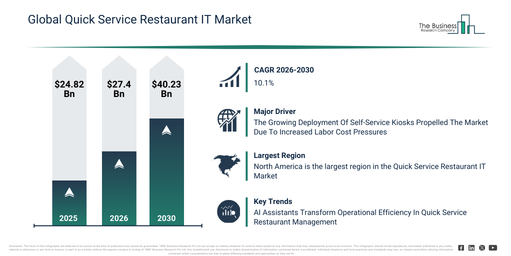
The quick service restaurant IT market has experienced significant expansion recently. This market is projected to expand from $24.82 billion in 2025 to $27.4 billion in 2026, demonstrating a compound annual growth rate (CAGR) of 10.4%. Historically, this growth has been driven by several factors, including the worldwide spread of fast food and QSR chains, increased consumer preference for speed and convenience, the uptake of digital payments and card acceptance, the requirement for improved inventory management and waste reduction, and the proliferation of online food delivery services.
The quick service restaurant IT market size is projected to experience substantial growth in the coming years. It is forecast to reach $40.23 billion in 2030, exhibiting a compound annual growth rate (CAGR) of 10.1%. This expansion during the forecast period is driven by factors such as the increasing adoption of self-service kiosks, AI-driven upselling and personalized ordering, enhanced integration with delivery aggregators, elevated investment in cybersecurity for payment systems, and the broadening of omnichannel customer engagement platforms. Key trends for the forecast period encompass cloud-based POS and order management, mobile ordering and loyalty program integration, kitchen display and workflow automation, the widespread adoption of contactless and digital payments, and real-time inventory and demand analytics.
Want Deeper Quick Service Restaurant IT Market Insights? Get A Free Sample Report:
Primary Growth Driver Shaping The Quick Service Restaurant IT Market Outlook
An increasing implementation of self-service kiosks significantly fueled the expansion of the quick service restaurant (QSR) IT market during past years. These automated self-service systems enable patrons to place orders and complete payments independently, bypassing direct staff interaction, which enhances the efficiency and precision of order processing. The escalating uptake of such kiosks is attributed to gains in operational efficiency, encompassing shorter wait times and optimized workflows, especially beneficial during busy service intervals. Quick service restaurant IT facilitates kiosk implementation through seamless integration with existing point-of-sale systems, inventory management tools, and data analytics platforms. A notable example is from June 2024, where Deliverect, a Belgium-based SaaS company, reported that 66% of American customers favor self-service kiosks compared to traditional manned checkout counters. Consequently, the expanding presence of self-service kiosks has been a key driver in boosting the quick service restaurant (QSR) IT market’s growth.
Quick Service Restaurant IT Market Structure: A Detailed Look At Segments And Subsegments
The quick service restaurant it market covered in this report is segmented –
1) By Component: Software, Hardware, Service
2) By Technology Adoption: Traditional Systems, Cloud-Based Solutions, Mobile Applications, Self-Service Kiosks, Point Of Sale Systems
3) By Deployment Mode: On-Premises, Cloud
4) By Application: Order Management, Inventory Management, Customer Relationship Management, Payment Processing, Other Applications
5) By End-User: Independent Quick Service Restaurant, Chain Quick Service Restaurant
Subsegments:
1) By Software: Point Of Sale Software, Inventory Management Software, Customer Relationship Management Software, Kitchen Display Software, Online Ordering Software, Employee Scheduling Software, Analytics And Reporting Software, Loyalty Program Software
2) By Hardware: Point Of Sale Terminals, Kitchen Display Screens, Self Service Kiosks, Payment Terminals, Printers, Barcode Scanners, Tablets, Networking Equipment
3) By Service: Installation Services, Maintenance Services, Cloud Hosting Services, Consulting Services, Training Services, Integration Services, Support And Helpdesk Services, Customization Services
Quick Service Restaurant IT Market Innovation And Strategy Trends Among Leading Companies
Leading firms in the quick service restaurant (QSR) IT market are concentrating on creating technological innovations, including AI-powered restaurant management assistants, to enhance operational precision, decision-making effectiveness, and employee output. Such an assistant is a smart digital platform that utilizes artificial intelligence and voice interaction to help restaurant managers supervise routine activities like scheduling, inventory management, and quality assurance, offering instant insights and automated suggestions. As an example, in June 2025, Yum China Holdings, Inc., a restaurant company based in China, introduced the Q-Smart assistant. This system incorporates artificial intelligence (AI) and natural language processing, facilitating hands-free communication via wearable technology, which enables managers to effectively handle scheduling, inventory, and quality duties. It delivers live insights, anticipatory alerts, and smart decision support, thereby boosting operational agility and streamlining restaurant management effectiveness.
Top Companies Competing In The Quick Service Restaurant IT Market
Major companies operating in the quick service restaurant it market are NCR Voyix Corporation, Toast Inc., Lightspeed Commerce Inc., Verifone Systems Inc., Shift4 Payments Inc., Panasonic Corporation, Fujitsu Limited, Zebra Technologies Corporation, PAX Technology Limited, Star Micronics Co. Ltd., SumUp Payments Limited, Heartland Payment Systems LLC, HM Electronics Inc., PAR Technology Corporation, Agilysys NV LLC, LG Corporation (LG Business Solutions), TouchBistro Inc., Clover Network LLC, Epos Now Limited, Wachter Inc., Shenzhen Xinguodu Payment Technology Co. Ltd, QSR Automations LLC, GoFrugal Technologies Pvt. Ltd., SZZT Electronics Co. Ltd., Diebold Nixdorf Inc., NEC Display Solutions of America Inc., Presto Automation Inc., Posist Technologies Pvt. Ltd., SilverWare POS Inc., Delphi Display Systems Inc., Abcom Pty Ltd, Restroworks, Restaurant Service Solutions Inc., Focus POS Systems LLC, Clear Solutions Inc., CAKE Corporation, and Chowly Inc.
View The Complete Quick Service Restaurant IT Market Study With Segment And Regional Data:
Quick Service Restaurant IT Market Regional Outlook Across Major Geographies
North America was the largest region in the quick service restaurant information technology (IT) market in 2025. Asia-Pacific is expected to be the fastest-growing region in the forecast period. The regions covered in the quick service restaurant it market report are Asia-Pacific, South East Asia, Western Europe, Eastern Europe, North America, South America, Middle East, Africa.
Reach Out To Our Team:
The Business Research Company: https://www.thebusinessresearchcompany.com/
Americas: +1 310-496-7795
Asia: +44 7882 955267 & +91 8897263534
Europe: +44 7882 955267
Email us at: marketing@tbrc.info
Follow us on:
LinkedIn: https://in.linkedin.com/company/the-business-research-company
YouTube: https://www.youtube.com/channel/UC24_fI0rV8cR5DxlCpgmyFQ
Global Market Model: https://www.thebusinessresearchcompany.com/global-market-model

Wasay has over a decade of experience in market research, data modelling, and analytics, with prior experience at GlobalData and Decision Tree Consulting Services. At The Business Research Company , he leads research operations across syndicated studies, customized consulting engagements, and the Global Market Model platform. His professional experience includes supporting organizations such as Boston Consulting Group, KPMG, and Ernst & Young. Wasay holds a degree in Electronics and Communications Engineering, postgraduate management qualifications from International Management Institute Belgium and Indian School of Business and Entrepreneurship, and completed the Integrated Program in Business Analytics from Indian Institute of Management Indore.