Backed by market attractiveness analysis, total addressable market sizing, company benchmarking matrices, interactive Excel dashboards, wider supply chain intelligence, emerging startup coverage, and detailed product-level insights, The Business Research Company’s 2026 market reports are designed to offer research that is more actionable and strategically valuable than ever.
Radiation Dose Optimisation Software Market Size, Value And Growth Trajectory Through 2030
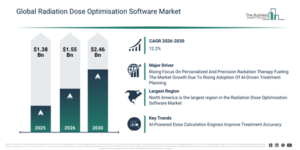
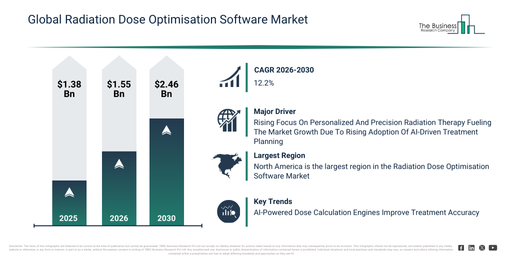
The radiation dose optimisation software market size has undergone rapid growth in recent years. It is forecast to expand from $1.38 billion in 2025 to $1.55 billion in 2026, at a compound annual growth rate (CAGR) of 12.5%. The historical market growth can be attributed to several factors including increasing demand for motion-adaptive radiation therapy, growing adoption of advanced imaging systems, a rising focus on minimizing treatment errors, expanding use of real-time patient monitoring, and an increasing preference for high-precision radiotherapy.
The radiation dose optimisation software market is anticipated to experience substantial expansion in the coming years. Its valuation is projected to attain $2.46 billion by 2030, registering a compound annual growth rate (CAGR) of 12.2%. This growth during the forecast period is driven by factors such as escalating investment in next-generation radiotherapy technologies, the rising adoption of 4D treatment systems, an increasing need for precise tumor-tracking solutions, the expanding integration of AI-enabled motion management, and a growing demand for personalized radiation therapy. Major trends anticipated in this period encompass technological enhancements in motion-synchronized radiotherapy systems, advancements in real-time imaging capabilities, the evolution of adaptive treatment delivery platforms, ongoing research and development in tumor-tracking technologies, and progress in imaging-guided radiotherapy solutions.
Get A Free Sample Report With In-Depth Market Insights:
Radiation Dose Optimisation Software Market Growth Catalysts And Demand Drivers
An increasing emphasis on personalized and precision radiation therapy is anticipated to boost the expansion of the radiation dose optimisation software market. This approach involves customizing the radiation dose, delivery methods, and overall treatment strategy to align precisely with each patient’s unique tumor attributes and anatomical structure. Clinicians are increasingly prioritizing personalized and precision radiation therapy to enhance tumor eradication and reduce harm to healthy tissues, achieved by adjusting dosage, targeting, and scheduling based on an individual’s specific tumor biology and anatomy. Radiation dose optimisation software plays a crucial role in facilitating this by precisely calculating and adapting radiation doses according to the patient’s distinct anatomy and tumor profile. This software enhances both the effectiveness and safety of treatment, ensuring optimal targeting of tumors while limiting radiation exposure to adjacent healthy tissues. A notable example occurred in May 2024, when, as reported by the Department for Health and Social Care, a UK government department, every National Health Service radiotherapy department in England received artificial intelligence technology. This was funded by £15.5 million in government allocation, enabling the technology to autonomously analyze scans and differentiate cancerous cells from healthy organs 2.5 times more quickly than prior techniques, thereby illustrating the increasing embrace of precision radiotherapy methods. Consequently, the heightened emphasis on personalized and precision radiation therapy is acting as a key driver for the expansion of the radiation dose optimisation software market.
Radiation Dose Optimisation Software Market Segmentation And Category Overview
The radiation dose optimisation software market covered in this report is segmented –
1) By Component: Software, Services
2) By Modality: X-Ray / DR, Fluoroscopy, CT, Mammography, Nuclear Medicine (PET/SPECT)
3) By Deployment: Cloud-Based, Hybrid, On-Premise
4) By Application: Diagnostic Imaging, Radiotherapy, Nuclear Medicine
5) By End-User: Hospitals, Diagnostic Centers, Ambulatory Surgical Centers, Research Institutes
Subsegments:
1) By Software: Dose Tracking Software, Dose Reporting Software, Protocol Management Software, Image Quality Analysis Software, Patient Safety Management Software
2) By Services: Installation And Implementation Services, Training And Education Services, Maintenance And Support Services, Consulting And Advisory Services, Audit And Compliance Services
Radiation Dose Optimisation Software Market Trends Shaping Long-Term Demand
Leading companies within the radiation dose optimisation software market are concentrating on acquiring regulatory approvals for advanced products, specifically AI-driven dose calculation engines, with the aim of boosting clinical effectiveness, enhancing treatment accuracy, and decreasing manual planning efforts and potential errors. AI-driven dose calculation engines denote sophisticated software algorithms that leverage artificial intelligence to automate and streamline the planning of radiation doses for cancer treatment. For example, in March 2025, DOSIsoft SA, a medical software company based in France, obtained Food and Drug Administration (FDA) clearance for its latest product, PLANET Onco Dose version 3.2. This is an extensive, cloud-native treatment planning system featuring a patented AI-powered dose engine that automates complex computations, substantially decreasing the time needed for plan generation. It incorporates automatic structure-guided optimization and auto-planning functions, facilitating effortless adaptation to various tumor geometries and patient anatomies with minimal intervention from physicists. Moreover, it integrates workflow automation tools and efficient resource management, thereby expanding clinical capacity and lowering operational expenditures for oncology departments.
Radiation Dose Optimisation Software Market Key Players Shaping Industry Direction
Major companies operating in the radiation dose optimisation software market are Bayer AG, Siemens Healthineers AG, Fujifilm Holdings Corporation, GE HealthCare Technologies Inc., Bracco Imaging S.p.A., Agfa-Gevaert Group, Carestream Health Inc., Guerbet SA, Sectra AB, Landauer Inc., Canon Medical Systems Corporation, Intelerad Medical Systems Inc., PTW Freiburg GmbH, Koninklijke Philips N.V., Ion Beam Applications S.A., PACSHealth LLC, QAELUM N.V., Virtual Phantoms Inc., Medsquare SAS, INFINITT Healthcare Co. Ltd.
View The Full Radiation Dose Optimisation Software Market Report:
Radiation Dose Optimisation Software Market Regional Analysis: Which Geography Leads On Revenue?
North America was the largest region in the radiation dose optimisation software market in 2025. Asia-Pacific is expected to be the fastest-growing region in the forecast period. The regions covered in the radiation dose optimisation software market report are Asia-Pacific, South East Asia, Western Europe, Eastern Europe, North America, South America, Middle East, Africa.
Reach Out To Our Team:
The Business Research Company: https://www.thebusinessresearchcompany.com/
Americas: +1 310-496-7795
Asia: +44 7882 955267 & +91 8897263534
Europe: +44 7882 955267
Email us at: marketing@tbrc.info
Follow us on:
LinkedIn: https://in.linkedin.com/company/the-business-research-company
YouTube: https://www.youtube.com/channel/UC24_fI0rV8cR5DxlCpgmyFQ
Global Market Model: https://www.thebusinessresearchcompany.com/global-market-model

Wasay has over a decade of experience in market research, data modelling, and analytics, with prior experience at GlobalData and Decision Tree Consulting Services. At The Business Research Company , he leads research operations across syndicated studies, customized consulting engagements, and the Global Market Model platform. His professional experience includes supporting organizations such as Boston Consulting Group, KPMG, and Ernst & Young. Wasay holds a degree in Electronics and Communications Engineering, postgraduate management qualifications from International Management Institute Belgium and Indian School of Business and Entrepreneurship, and completed the Integrated Program in Business Analytics from Indian Institute of Management Indore.