Built to provide research that’s more actionable and strategically valuable, The Business Research Company’s 2026 market reports include market attractiveness analysis, total addressable market sizing, company benchmarking matrices, interactive Excel dashboards, broader supply chain intelligence, emerging startup tracking, and in-depth product insights.
Radio Frequency (RF) Energy Harvesting Market Value Growth And Long-Term Outlook
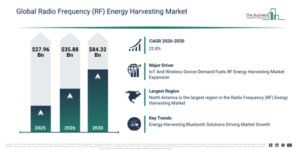
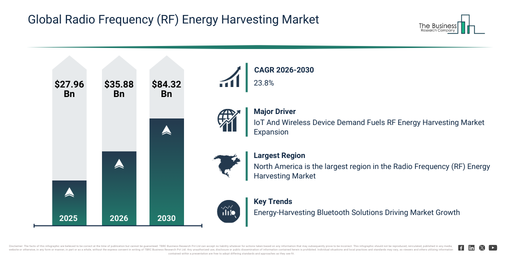
The radio frequency (rf) energy harvesting market has expanded dramatically in recent years. It is anticipated to increase from $27.96 billion in 2025 to $35.88 billion in 2026, registering a compound annual growth rate (CAGR) of 28.4%. This historical growth can be linked to several factors, including the development of low-power electronics, the early adoption of wireless sensor networks, the expansion of rf transmission infrastructure, advancements in semiconductor miniaturization, and increased research in ambient energy harvesting.
The radio frequency (rf) energy harvesting market is projected to experience substantial expansion over the upcoming years. The market is predicted to reach $84.32 billion by 2030, exhibiting a compound annual growth rate (CAGR) of 23.8%. This expansion during the forecast period is fueled by several factors, including the increasing implementation of massive IoT networks, a heightened demand for sensor systems requiring no maintenance, the broadening of smart city and industrial IoT applications, an intensified focus on sustainable power alternatives, and advancements in the efficiency of RF energy conversion technologies. Key trends expected over this period encompass the increased utilization of battery-free IoT devices, a greater uptake of RF-powered wireless sensors, the extended application of energy harvesting for asset tracking purposes, deeper integration with low-power communication protocols, and a stronger emphasis on smaller, miniaturized energy harvesting components.
Get A Free Sample Report With In-Depth Market Insights:
Radio Frequency (RF) Energy Harvesting Market Opportunity Drivers: What’s Unlocking New Revenue Potential?
The rising need for IoT and wireless devices is projected to stimulate the expansion of the radio frequency (RF) energy harvesting market in the future. IoT (Internet of Things) and wireless devices are defined as interconnected gadgets capable of wireless communication, facilitating data exchange and remote operation via the internet. This heightened demand for IoT and wireless devices stems from widespread internet connectivity, the uptake of IoT technology, and falling hardware component expenses. Radio frequency (RF) energy harvesting involves producing a small quantity of electrical power, which is then employed to power particular circuits within wireless communication electronic devices. For example, data from SmartTek Solutions, a US-based software company, indicated that in October 2023, global expenditure on IoT in 2022 amounted to $1 billion ($1 trillion), subsequently rising to $1,100 billion ($1.1 trillion). Consequently, the expanding need for IoT and wireless devices is fueling the advancement of the radio frequency (RF) energy harvesting market.
Radio Frequency (RF) Energy Harvesting Market Segment Analysis Spotlighting Growth Areas
The radio frequency (rf) energy harvesting market covered in this report is segmented –
1) By Component: Transducer, Thermoelectric And Radio Frequency (RF) Transducer, Power Management Integrated Circuit
2) By Frequency Range: Low Frequency (<1 GHz), Medium Frequency (1-10 GHz), High Frequency (>10 GHz)
3) By Application: Wireless Switching System, Wireless Heating, Ventilation, And Air Conditioning (HVAC) System, Wireless Sensing And Telematics System, Tire Pressure Monitoring System, Asset Tracking System, Remote Health Monitoring System, Regenerative Energy Harvesting System
4) By End-User Industry: Electronics, Healthcare, Defense And Aerospace, Automotive, Telecommunications, Other End-User Industries
Subsegments:
1) By Transducer: RF Transducers (Rectennas), Electromagnetic Transducers
2) By Thermoelectric And Radio Frequency (RF) Transducer: Thermoelectric Energy Harvesting Systems, RF Energy Harvesting Systems, Hybrid RF-Thermoelectric Systems
3) By Power Management Integrated Circuit (PMIC): Voltage Regulators, Power Converters, Energy Management Controllers
Radio Frequency (RF) Energy Harvesting Market Trends: What’s Defining The Industry’s Next Phase?
Companies operating within the radio frequency (RF) energy harvesting market are concentrating on advancements, such as energy-harvesting Bluetooth, to improve the efficiency and sustainability of wireless communication and IoT devices. Energy harvesting Bluetooth refers to the application of Bluetooth technology in devices powered by gathered energy from the surrounding environment, including solar, kinetic, or radio frequency sources, rather than conventional battery power. For instance, in October 2023, Globalscale Technologies Inc., a US-based IoT solutions provider, launched its energy harvesting Bluetooth LE 5.3 module, which utilizes the exceptionally low-power ATM33/e Series SoC from Atmosic Technologies. This module, known as the GTI-ATM3330e, incorporates a Bluetooth 5.3-compliant radio alongside an ARM Cortex M33F application processor, 128KB of RAM, 64KB of ROM, 512 KB of nonvolatile memory (NVM), ARM TrustZone-enabled security features, and sophisticated power management to facilitate maximum longevity in battery-operated devices.
Radio Frequency (RF) Energy Harvesting Market Leading Companies: Who Holds The Strongest Market Presence?
Major companies operating in the radio frequency (rf) energy harvesting market are Powercast Corp, Nikola Labs Inc., Everactive Inc, e-peas S.A., Wiliot Inc., Enocean GmbH, PowerFilm Inc., Texas Instruments Incorporated, NXP Semiconductors N.V., Microchip Technology Inc, Silicon Laboratories Inc., ON Semiconductor, ZF Friedrichshafen AG, ABB Limited, Fujitsu Limited, Telefonaktiebolaget LM Ericsson, Mide Technology Corp, Micropelt GmbH, Drayson Technologies Ltd, Sodaq B.V., ONiO
View The Full Radio Frequency (RF) Energy Harvesting Market Report:
Radio Frequency (RF) Energy Harvesting Market Top Region: Where Does Most Revenue Come From?
North America was the largest region in the radio frequency (RF) energy harvesting market in 2025. The regions covered in the radio frequency (rf) energy harvesting market report are Asia-Pacific, South East Asia, Western Europe, Eastern Europe, North America, South America, Middle East, Africa.
Reach Out To Our Team:
The Business Research Company: https://www.thebusinessresearchcompany.com/
Americas: +1 310-496-7795
Asia: +44 7882 955267 & +91 8897263534
Europe: +44 7882 955267
Email us at: marketing@tbrc.info
Follow us on:
LinkedIn: https://in.linkedin.com/company/the-business-research-company
YouTube: https://www.youtube.com/channel/UC24_fI0rV8cR5DxlCpgmyFQ
Global Market Model: https://www.thebusinessresearchcompany.com/global-market-model

Wasay has over a decade of experience in market research, data modelling, and analytics, with prior experience at GlobalData and Decision Tree Consulting Services. At The Business Research Company , he leads research operations across syndicated studies, customized consulting engagements, and the Global Market Model platform. His professional experience includes supporting organizations such as Boston Consulting Group, KPMG, and Ernst & Young. Wasay holds a degree in Electronics and Communications Engineering, postgraduate management qualifications from International Management Institute Belgium and Indian School of Business and Entrepreneurship, and completed the Integrated Program in Business Analytics from Indian Institute of Management Indore.