Built to provide research that’s more actionable and strategically valuable, The Business Research Company’s 2026 market reports include market attractiveness analysis, total addressable market sizing, company benchmarking matrices, interactive Excel dashboards, broader supply chain intelligence, emerging startup tracking, and in-depth product insights.
Robotics Process Automation Market CAGR Outlook And Future Development
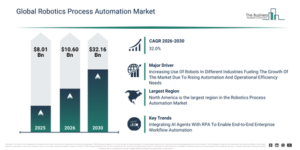
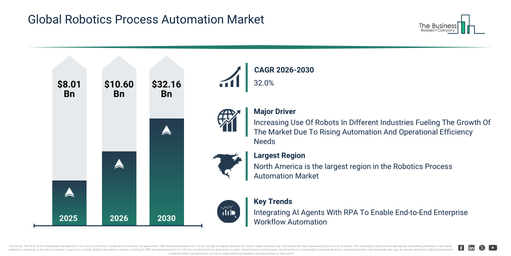
The robotics process automation market has experienced substantial growth in its scale over recent years. It is projected to expand from $8.01 billion in 2025 to reach $10.60 billion by 2026, demonstrating a compound annual growth rate (CAGR) of 32.3%. This historical expansion is linked to factors such as increased demand for operational efficiency, the broader uptake of digital transformation programs, greater incorporation of AI and machine learning, the increased deployment of cloud-based robotic process automation offerings, and a stronger emphasis on enhancing customer experience.
The robotics process automation market is projected to experience substantial expansion over the coming years. This market is forecast to reach a valuation of $32.16 billion by 2030, driven by a compound annual growth rate (CAGR) of 32.0%. This anticipated growth during the forecast period is fueled by factors such as the heightened embrace of hyperautomation, increased capital allocation towards robotics process automation services and consulting, the progressive integration of cognitive and intelligent robotics process automation solutions, the broader deployment of low-code or no-code platforms, and the expanding implementation across various industries by enterprises. Furthermore, significant developments expected in this timeframe encompass technological leaps in artificial intelligence (AI)-driven automation, novelties in cloud-native robotics process automation offerings, progress in process mining and task mining techniques, ongoing investigations into autonomous and self-healing bots, and enhancements in frameworks for governance, compliance, and security.
Get A Free Sample Report With In-Depth Market Insights:
Robotics Process Automation Market Growth Drivers: What’s Behind The Acceleration?
The widespread adoption of robots across various sectors is anticipated to stimulate the future growth of the robotics process automation market. Robots refer to programmable physical machines and software-based bots designed to execute repetitive, rule-based, and high-volume tasks with minimal human oversight. This rise in robot utilization is driven by the need for enhanced productivity and efficiency in performing recurring, hazardous, and precision tasks throughout industries, while also mitigating labor shortages and reducing operational costs. Robotics process automation facilitates the integration of robots in different industries by automating routine business processes, minimizing human errors, boosting overall productivity, and enabling employees to focus on higher-value activities. For instance, in September 2025, the International Federation of Robotics, a Germany-based non-profit organization, reported that 4,664,000 robotic units were operational in factories globally in 2024, indicating a 9% increase from 4,281,585 units in 2023. Furthermore, robot installations in the metal and machinery industry surged by 31% to a record 54,600 units in 2024 compared to 2023. Consequently, the increasing application of robots across diverse industries is a significant catalyst for the expansion of the robotics process automation market.
Robotics Process Automation Market Segment Landscape And Growth Outlook
The robotics process automation market covered in this report is segmented –
1) By Solution Component: Software, Services
2) By Deployment: On-Premise, Cloud Or SaaS
3) By Technology Type: Attended Robotics Process Automation (RPA), Unattended Robotics Process Automation (RPA), Intelligent Or Cognitive RPA
4) By Enterprise Size: Small And Medium Enterprises, Large Enterprises
5) By End-User Industry: Banking, Financial Services And Insurance, Information Technology And Telecom, Healthcare, Retail And Consumer Goods, Manufacturing, Logistics, Government And Public Sector, Other End-User Industries
Subsegments:
1) By Software: Process Design And Modeling, Automation Development And Deployment, Operations Management And Monitoring, Analytics And Reporting, Integration And Orchestration
2) By Services: Consulting Services, Implementation Services, Training And Support Services, Maintenance And Optimization Services, Managed Services
Robotics Process Automation Market Trends: What’s Defining The Industry’s Next Phase?
Key players in the robotics process automation market are focusing their efforts on creating technologically advanced platforms, such as enterprise-grade agentic automation platforms. These innovations are designed to autonomously manage complex end-to-end business processes, adjust to dynamic environments, and work alongside human teams. Enterprise-grade autonomic automation is defined by a platform’s capacity to integrate robotics process automation with artificial intelligence and decision-making abilities, enabling it to operate independently, manage unforeseen issues, and expand operations securely and reliably as business needs grow. For example, in April 2025, UiPath Inc., a US-based enterprise software company, unveiled the UiPath Platform for agentic automation. This platform seamlessly combines AI agents, RPA bots, and human interaction into one unified and scalable system. The solution offers low-code workflow design for quick implementation, intelligent coordination of AI and software bots across various systems, and improved security and compliance tools for large-scale enterprise automation. Ultimately, this platform supports comprehensive workflow automation, boosts process dependability, and helps organizations achieve superior efficiency and accelerated operational outcomes.
Robotics Process Automation Market Leading Players And Competitive Positioning
Major companies operating in the robotics process automation market are Microsoft Corporation, International Business Machines Corporation, Oracle Corporation, ServiceNow Inc., SS&C Technologies Holdings Inc., NICE Ltd., Pegasystems Inc., UiPath Inc., Appian Corporation, WorkFusion Inc., ElectroNeek Robotics Inc., OpenBots Inc., AntWorks Inc., Automation Anywhere Inc., EdgeVerve Systems Limited, Kofax Inc., Nintex Platform Group Inc., AutomationEdge Technologies Inc., Blue Prism Limited, Jacada Ltd.
View The Full Robotics Process Automation Market Report:
Robotics Process Automation Market Regional Split: Which Areas Are Fueling Growth?
North America was the largest region in the robotics process automation market in 2025. Asia-Pacific is expected to be the fastest-growing region in the forecast period. The regions covered in the robotics process automation market report are Asia-Pacific, South East Asia, Western Europe, Eastern Europe, North America, South America, Middle East, Africa.
Reach Out To Our Team:
The Business Research Company: https://www.thebusinessresearchcompany.com/
Americas: +1 310-496-7795
Asia: +44 7882 955267 & +91 8897263534
Europe: +44 7882 955267
Email us at: marketing@tbrc.info
Follow us on:
LinkedIn: https://in.linkedin.com/company/the-business-research-company
YouTube: https://www.youtube.com/channel/UC24_fI0rV8cR5DxlCpgmyFQ
Global Market Model: https://www.thebusinessresearchcompany.com/global-market-model

Wasay has over a decade of experience in market research, data modelling, and analytics, with prior experience at GlobalData and Decision Tree Consulting Services. At The Business Research Company , he leads research operations across syndicated studies, customized consulting engagements, and the Global Market Model platform. His professional experience includes supporting organizations such as Boston Consulting Group, KPMG, and Ernst & Young. Wasay holds a degree in Electronics and Communications Engineering, postgraduate management qualifications from International Management Institute Belgium and Indian School of Business and Entrepreneurship, and completed the Integrated Program in Business Analytics from Indian Institute of Management Indore.