
Built to provide research that’s more actionable and strategically valuable, The Business Research Company’s 2026 market reports include market attractiveness analysis, total addressable market sizing, company benchmarking matrices, interactive Excel dashboards, broader supply chain intelligence, emerging startup tracking, and in-depth product insights.
Satellite Constellations Market Size And Revenue Outlook Through 2030
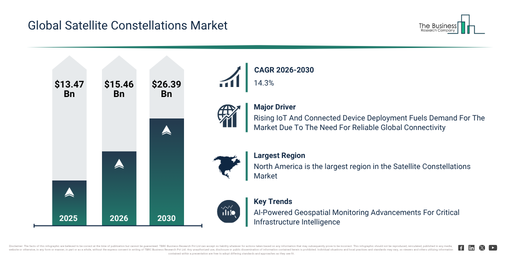
The satellite constellations market has experienced rapid growth in recent years. It is anticipated to expand from $13.47 billion in 2025 to $15.46 billion in 2026, exhibiting a compound annual growth rate (CAGR) of 14.7%. This historic growth can be attributed to several factors: increasing demand for global communication coverage, rising investments in the development of satellite infrastructure, the growing adoption of satellite-based navigation systems, an increase in government initiatives for space exploration, and the rising deployment of earth observation satellites.
The satellite constellations market is projected to experience substantial expansion in the coming years. This market is anticipated to reach $26.39 billion by 2030, demonstrating a compound annual growth rate (CAGR) of 14.3%. This projected growth during the forecast period is driven by several factors, including the increasing proliferation of commercial satellite constellations, a surging demand for high-speed satellite internet services, the ongoing advancement of sophisticated satellite networking technologies, wider adoption of satellite connectivity for remote uses, and expanding investments in cutting-edge space infrastructure. Key trends anticipated within this period encompass the escalating deployment of extensive low Earth orbit satellite constellations, the expanding creation of inter-satellite communication networks for improved coverage, the increasing uptake of reusable launch technologies for constellation placement, the growing integration of advanced satellite payload innovations, and a rising need for robust and uninterrupted global satellite connectivity solutions.
Get A Free Sample Report With In-Depth Market Insights:
Satellite Constellations Market Development Factors: What’s Supporting Demand?
The increasing proliferation of IoT and connected devices is projected to fuel the expansion of the satellite constellations market in the future. These technologies encompass physical items outfitted with sensors, software, and network capabilities, allowing them to gather, share, and exchange information with other systems and devices. Their adoption is rising progressively, driven by an escalating need for real-time oversight and automation, which enhances operational effectiveness and supports better decision-making. This surge in the integration of IoT and connected devices is consequently boosting the need for satellite constellations, as these constellations provide uninterrupted real-time connectivity, monitoring capabilities, and data exchange across distant and widely distributed areas. For example, data from Telefonaktiebolaget LM Ericsson, a telecommunications firm based in Sweden, indicated in April 2025 that worldwide IoT connections totaled 18.8 billion connections in 2024, with projections for this figure to climb to 43.0 billion connections by 2030. Consequently, the expansion of IoT and connected devices is a key factor driving the growth of the satellite constellations market.
Satellite Constellations Market Segment Analysis Spotlighting Growth Areas
The satellite constellations market covered in this report is segmented –
1) By Component: Satellite, Launch Vehicle, Ground Station, Service
2) By Orbit Type: Low Earth Orbit, Medium Earth Orbit, Geostationary Earth Orbit, Highly Elliptical Orbit
3) By Connectivity Type: Direct To Device, Satellite To Ground, Satellite To Satellite, Machine To Machine
4) By Application: Broadband Internet Services, Earth Observation And Remote Sensing, Navigation And Positioning, Internet Of Things Connectivity, Communications Services, Defense And Military Applications, Maritime Connectivity, Aviation Connectivity, Weather Monitoring
5) By End Use: Commercial, Government, Non Profit
Subsegments:
1) By Satellite: Communication Satellites, Earth Observation Satellites, Navigation Satellites, Meteorological Satellites, Scientific Research Satellites, Internet Connectivity Satellites, Data Relay Satellites
2) By Launch Vehicle: Small Satellite Launch Vehicles, Medium Lift Launch Vehicles, Heavy Lift Launch Vehicles, Reusable Launch Vehicles, Expendable Launch Vehicles, Air Launched Vehicles, Dedicated Launch Vehicles
3) By Ground Station: Gateway Ground Stations, Telemetry Tracking And Command Stations, Mission Control Centers, Data Processing Centers, Satellite Network Operation Centers, User Terminal Stations, Remote Ground Stations
4) By Service: Broadband Connectivity Services, Earth Observation Services, Navigation Services, Internet Of Things Connectivity Services, Satellite Communication Services, Data Analytics Services, Disaster Monitoring Services, Asset Tracking Services, Geospatial Intelligence Services, Weather Monitoring Services
Satellite Constellations Market Transformation Trends: What Innovations Are Driving Change?
Leading companies within the satellite constellations market are concentrating on developing innovative solutions, such as infrastructure monitoring platforms, to enhance asset visibility, bolster predictive maintenance capabilities, and facilitate real-time operational decision-making. These platforms constitute technology systems that gather, analyze, and visualize data from diverse sources for the continuous assessment of the condition and performance of critical infrastructure assets. For example, in January 2026, LiveEO GmbH, an AI and geospatial analytics company from Germany, introduced Twinspector, a satellite constellation. This system is specifically designed to monitor critical infrastructure like power lines, railways, pipelines, and vegetation corridors. It provides benefits such as high-frequency data collection, improved infrastructure risk detection, and refined operational decision-making. The constellation aims to support customers in strengthening their asset monitoring and maintenance planning, thereby promoting the expanding integration of satellite-enabled infrastructure management and digital asset monitoring technologies.
Satellite Constellations Market Leading Companies: Who Holds The Strongest Market Presence?
Major companies operating in the satellite constellations market are Airbus SE, Amazon.com Inc., AST SpaceMobile Inc., BlackSky Technology Inc., Eutelsat Group, Globalstar Inc., Iridium Communications Inc., Lockheed Martin Corporation, MDA Space Ltd., Mitsubishi Electric Corporation, NEC Corporation, Northrop Grumman Corporation, OHB SE, Planet Labs PBC, Rocket Lab USA Inc., SES S.A., SpaceX, Spire Global Inc., Telesat Corporation, Thales S.A., Tomorrow.io, Viasat Inc.
View The Full Satellite Constellations Market Report:
Satellite Constellations Market Regional Analysis: Which Geography Leads On Revenue?
North America was the largest region in the satellite constellations market in 2025. Asia-Pacific is expected to be the fastest-growing region in the forecast period. The regions covered in the satellite constellations market report are Asia-Pacific, South East Asia, Western Europe, Eastern Europe, North America, South America, Middle East, Africa.
Reach Out To Our Team:
The Business Research Company: https://www.thebusinessresearchcompany.com/
Americas: +1 310-496-7795
Asia: +44 7882 955267 & +91 8897263534
Europe: +44 7882 955267
Email us at: marketing@tbrc.info
Follow us on:
LinkedIn: https://in.linkedin.com/company/the-business-research-company
YouTube: https://www.youtube.com/channel/UC24_fI0rV8cR5DxlCpgmyFQ
Global Market Model: https://www.thebusinessresearchcompany.com/global-market-model

Wasay has over a decade of experience in market research, data modelling, and analytics, with prior experience at GlobalData and Decision Tree Consulting Services. At The Business Research Company , he leads research operations across syndicated studies, customized consulting engagements, and the Global Market Model platform. His professional experience includes supporting organizations such as Boston Consulting Group, KPMG, and Ernst & Young. Wasay holds a degree in Electronics and Communications Engineering, postgraduate management qualifications from International Management Institute Belgium and Indian School of Business and Entrepreneurship, and completed the Integrated Program in Business Analytics from Indian Institute of Management Indore.