
Backed by market attractiveness analysis, total addressable market sizing, company benchmarking matrices, interactive Excel dashboards, wider supply chain intelligence, emerging startup coverage, and detailed product-level insights, The Business Research Company’s 2026 market reports are designed to offer research that is more actionable and strategically valuable than ever.
Satellite Vessel Tracking Market Poised To Hit $1.74 Billion By 2030 With A 15.2% CAGR
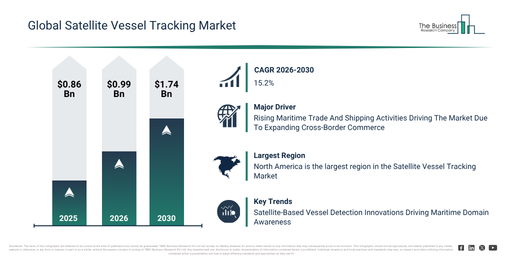
The satellite vessel tracking market has experienced swift expansion in its scale during recent years. Its value is projected to rise from $0.86 billion in 2025 to $0.99 billion in 2026, demonstrating a compound annual growth rate (CAGR) of 15.6%. Historically, the market’s development has been fueled by several key factors, including the increase in maritime trade and vessel traffic, a growing demand for uninterrupted monitoring of vessels across remote waters, evolving maritime safety and security imperatives, the wider adoption of satellite communication for maritime activities, and an expanding requirement for vessel identification and location visibility.
The satellite vessel tracking market is projected for significant expansion over the coming years. This sector is anticipated to reach a valuation of $1.74 billion by 2030, demonstrating a compound annual growth rate (CAGR) of 15.2%. This projected increase is driven by several factors, including the increasing need for real-time maritime situational awareness, the rising requirement for monitoring vessels in previously inaccessible sea areas, the growing call for automated analysis of vessel movements, the increasing use of satellite-powered fleet monitoring solutions, and the demand for improved maritime surveillance and safety measures. Key developments anticipated during this period encompass the wider implementation of continuous satellite-based vessel monitoring, the escalating need for tracking vessel location and movement in real-time, a developing preference for precise maritime positioning, an increased requirement for long-range vessel visibility across distant waters, and the expanded adoption of satellite-enabled maritime situational awareness technologies.
Get A Free Sample Report With In-Depth Market Insights:
Satellite Vessel Tracking Market Growth Momentum: What Factors Are Shaping Demand?
The expanding scope of maritime trade and shipping operations is anticipated to propel the growth of the satellite vessel tracking market. These activities involve the transportation of goods and commodities via commercial vessels across domestic and international waterways, facilitating global trade and supply chain connectivity. The increase in maritime trade and shipping activities is driven by the rise in global trade and cross-border commerce, which escalates the demand for efficient and cost-effective transportation of goods across international markets. This expansion directly contributes to the growth of satellite vessel tracking by boosting the need for continuous vessel visibility, effective navigation, and compliance with regulations across congested international shipping routes. For instance, in March 2025, the Naval Institute, a US-based non-profit organization, projected that maritime trade volume would rise by 2% in 2024, while container trade is expected to grow by 2.7%. Therefore, the growing maritime trade and shipping activities are a key driver for the satellite vessel tracking market.
Satellite Vessel Tracking Market Segment Performance And Emerging Opportunities
The satellite vessel tracking market covered in this report is segmented –
1) By Technology: Automatic Identification System, Long Range Identification And Tracking, Satellite Imagery, Internet Of Things
2) By Orbit Class: Geostationary Earth Orbit, Medium Earth Orbit, Low Earth Orbit
3) By Deployment: On-Premises, Cloud-Based
4) By Application: Commercial Shipping, Fishing Vessels, Military And Defense, Oil And Gas Exploration
5) By End Use: Transportation And Logistics, Government, Marine Research
Subsegments:
1) By Automatic Identification System: Class A Automatic Identification System, Class B Automatic Identification System, Terrestrial Automatic Identification System Integration, Satellite Automatic Identification System
2) By Long Range Identification And Tracking: Commercial Vessel Tracking, Government Vessel Tracking, Fleet Monitoring Services, Maritime Safety Monitoring
3) By Satellite Imagery: Optical Satellite Imagery, Synthetic Aperture Radar Satellite Imagery, Multispectral Satellite Imagery, High Resolution Satellite Imagery
4) By Internet Of Things: Connected Vessel Sensors, Asset Tracking Devices, Cargo Monitoring Systems, Remote Equipment Monitoring, Environmental Monitoring Sensors
Satellite Vessel Tracking Market Trends Redefining Industry Growth
Leading firms within the satellite vessel tracking sector are concentrating on creating advanced solutions, particularly satellite-based vessel detection platforms, to elevate maritime surveillance, better identify non-cooperative vessels, and bolster operational decision-making processes. These platforms are integrated systems that leverage satellite imagery and artificial intelligence to autonomously detect, identify, and track vessels across vast marine regions, even those not transmitting standard tracking signals. As an illustration, in July 2026, Space Data, a Japan-based technology firm, introduced Vessel Watch, a satellite-based vessel detection platform engineered to automatically spot vessels from optical satellite imagery and pinpoint suspected dark vessels by cross-referencing detections with Automatic Identification System (AIS) data. Its advantages include AI-driven vessel detection, the identification of dark vessels via AIS correlation, and highly reliable detection with fewer false positives. This introduction is intended to assist customers in enhancing their maritime situational awareness and streamlining surveillance operations, simultaneously fostering progress in satellite-enabled maritime security and monitoring capabilities.
Satellite Vessel Tracking Market Competitive Landscape: Which Companies Lead The Industry?
Major companies operating in the satellite vessel tracking market are Viasat Inc, MDA Space Ltd, Iridium Communications Inc, CLS Group, Planet Labs PBC, ICEYE Oy, ORBCOMM Inc, Capella Space Corporation, EarthDaily Analytics Corp, BlackSky Technology Inc, HawkEye 360 Inc, Pixxel Space Technologies Pvt. Ltd., Kongsberg Satellite Services AS, Synspective Inc, SRT Marine Systems plc, Satellogic Inc, SI Imaging Services Co. Ltd., Umbra Lab Inc, Unseenlabs SAS, Spire Global Inc, Thales Group, Globalstar Inc, KVH Industries Inc, Addvalue Technologies Ltd
View The Full Satellite Vessel Tracking Market Report:
Satellite Vessel Tracking Market Regional Breakdown: Where Is Demand Concentrated?
North America was the largest region in the satellite vessel tracking market in 2025. Asia-Pacific is expected to be the fastest-growing region in the forecast period. The regions covered in the satellite vessel tracking market report are Asia-Pacific, South East Asia, Western Europe, Eastern Europe, North America, South America, Middle East, Africa.
Reach Out To Our Team:
The Business Research Company: https://www.thebusinessresearchcompany.com/
Americas: +1 310-496-7795
Asia: +44 7882 955267 & +91 8897263534
Europe: +44 7882 955267
Email us at: marketing@tbrc.info
Follow us on:
LinkedIn: https://in.linkedin.com/company/the-business-research-company
YouTube: https://www.youtube.com/channel/UC24_fI0rV8cR5DxlCpgmyFQ
Global Market Model: https://www.thebusinessresearchcompany.com/global-market-model

Wasay has over a decade of experience in market research, data modelling, and analytics, with prior experience at GlobalData and Decision Tree Consulting Services. At The Business Research Company , he leads research operations across syndicated studies, customized consulting engagements, and the Global Market Model platform. His professional experience includes supporting organizations such as Boston Consulting Group, KPMG, and Ernst & Young. Wasay holds a degree in Electronics and Communications Engineering, postgraduate management qualifications from International Management Institute Belgium and Indian School of Business and Entrepreneurship, and completed the Integrated Program in Business Analytics from Indian Institute of Management Indore.