Delivering more actionable and strategically valuable research, The Business Research Company’s 2026 market reports feature market attractiveness analysis, total addressable market evaluation, company benchmarking matrices, interactive Excel dashboards, expanded supply chain intelligence, emerging startup coverage, and detailed product insights.
Virtualization Software Market Value Analysis: What Growth Is Expected Over The Forecast Period?
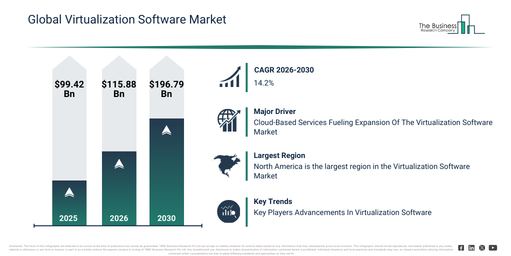
The virtualization software market has expanded considerably in recent years. Looking ahead, its size is projected to increase from $99.42 billion in 2025 to $115.88 billion in 2026, driven by a compound annual growth rate (CAGR) of 16.6%. Historically, this expansion has been driven by several key factors, including the increasing consolidation of data centers, the growth of enterprise server virtualization, the rising adoption of cloud computing models, a persistent demand for efficient IT resource utilization, and the ongoing expansion of enterprise software ecosystems.
The virtualization software market size is expected to experience rapid growth in the coming years, with projections indicating it will reach $196.79 billion by 2030, demonstrating a compound annual growth rate (CAGR) of 14.2%. This expansion during the forecast period is primarily fueled by the growing adoption of cloud-native architectures, the increasing demand for secure virtualization platforms, the expansion of edge computing deployments, rising investments in software-defined infrastructure, and a heightened focus on energy-efficient data centers. Furthermore, key trends in this period include the increasing adoption of containerization and microservices, a rising demand for hybrid and multi-cloud virtualization, the growing use of hypervisor-based security controls, an expansion of virtual desktop infrastructure deployments, and an enhanced focus on resource optimization.
Download A Free Sample Report For Comprehensive Market Insights:
Virtualization Software Market Demand Drivers: What Is Fueling Industry Growth?
The rising need for cloud-based services is anticipated to drive the expansion of the virtualization software market in the future. Cloud-based services are defined as computing resources, including storage, processing power, and software applications, that are accessed via the internet rather than being hosted on a user’s local device or network. This heightened demand for cloud-based services stems from their advantages in scalability, cost-effectiveness, improved collaboration, data security, and accessibility. Virtualization software facilitates efficient resource allocation and management, which in turn enables cloud-based services to optimize server utilization, streamline operational processes, and offer scalable computing resources as needed. For example, in December 2023, data from Eurostat, a Luxembourg-based intergovernmental organization, revealed that approximately 45.2% of European Union enterprises acquired cloud computing services for hosting email systems, storing electronic files, and performing various other functions. The acquisition of cloud computing services by EU enterprises saw an increase of 4.2 percentage points in 2023 when compared to 2021. Approximately 44% of traditional small businesses leverage cloud infrastructure or hosting services, whereas 66% of small tech companies and 74% of enterprises make use of cloud services. Consequently, the growing demand for cloud-based services is fueling the expansion of the virtualization software market.
Virtualization Software Market Segment Performance And Strategic Opportunities
The virtualization software market covered in this report is segmented –
1) By Type: Storage Virtualization, Application Virtualization, Network Virtualization, Hardware Virtualization, Server Virtualization, Operating System (OS) Virtualization, Other Types
2) By Platform: PC Virtualization, Mobile Virtualization
3) By Deployment: On-Premises Virtualization, Cloud-Based Virtualization
4) By Organization Size: Small And Medium-Sized Enterprises (SMEs), Large Enterprises
Subsegments:
1) By Storage Virtualization: Block-Level Storage Virtualization, File-Level Storage Virtualization, Object Storage Virtualization
2) By Application Virtualization: Desktop Virtualization, Virtualized Application Streaming, Application Delivery
3) By Network Virtualization: Software-Defined Networking (SDN), Network Function Virtualization (NFV), Virtual Network Infrastructure
4) By Hardware Virtualization: Full Virtualization, Paravirtualization, Hardware-Assisted Virtualization
5) By Server Virtualization: Virtual Machine (VM) Server Virtualization, Containerization (Docker, Kubernetes), Hypervisor-based Virtualization
6) By Operating System (OS) Virtualization: OS-Level Virtualization (Containers), Virtual Private Servers (VPS), Lightweight Virtualization
7) By Other Types: Storage Area Network (SAN) Virtualization, Data Virtualization, Cloud Virtualization
Virtualization Software Market Innovation Trends: Which Developments Are Transforming The Industry?
Leading firms within the virtualization software market are prioritizing sophisticated virtualization solutions, including single hybrid cloud data platforms, to effectively meet a variety of enterprise requirements. Such a platform within virtualization software unifies and oversees data across both public and private cloud environments, ensuring uninterrupted functionality. An example is Hitachi Ltd., a Japan-based manufacturer of electrical equipment, which introduced Hitachi Virtual Storage Platform One, a single hybrid cloud data platform, in October 2023. This platform provides a simplified approach for managing significant mission-critical tasks, incorporating a consolidated architecture designed to proficiently tackle issues via a singular control plane, data fabric, and data plane, covering block, file, object, cloud, mainframe, and software-defined storage workloads. This extensive data platform serves various environments and is governed by a unified AI-powered software stack.
Virtualization Software Market Key Players: Which Companies Shape Industry Competition?
Major companies operating in the virtualization software market are Amazon.com Inc., Google LLC, Microsoft Corporation, Huawei Technologies Co. Ltd., International Business Machines Corporation, Oracle Corporation, Citrix Systems Inc., Nutanix Inc., Scale Computing Inc., NComputing Co. Ltd., Lynx Software Technologies Inc., TenAsys Corporation, OpenStack Foundation, VMware Inc., Red Hat Inc., Proxmox Server Solutions GmbH, SUSE LLC, Virtuozzo International GmbH, Xen Project, QEMU Project, VDIworks Inc., Inuvika OVD Enterprise, VergeIO, Liquidware Labs
Access The Complete Virtualization Software Market Report:
Virtualization Software Market Regional Distribution: Which Areas Drive Market Expansion?
North America was the largest region in the virtualization software market in 2025. Asia-Pacific is expected to be the fastest-growing region in the forecast period. The regions covered in the virtualization software market report are Asia-Pacific, South East Asia, Western Europe, Eastern Europe, North America, South America, Middle East, Africa.
Get in touch with us:
The Business Research Company: https://www.thebusinessresearchcompany.com/
Americas: +1 310-496-7795
Asia: +44 7882 955267 & +91 8897263534
Europe: +44 7882 955267
Email us at: marketing@tbrc.info
Follow us on:
LinkedIn: https://in.linkedin.com/company/the-business-research-company
YouTube: https://www.youtube.com/channel/UC24_fI0rV8cR5DxlCpgmyFQ
Global Market Model: https://www.thebusinessresearchcompany.com/global-market-model

Wasay has over a decade of experience in market research, data modelling, and analytics, with prior experience at GlobalData and Decision Tree Consulting Services. At The Business Research Company , he leads research operations across syndicated studies, customized consulting engagements, and the Global Market Model platform. His professional experience includes supporting organizations such as Boston Consulting Group, KPMG, and Ernst & Young. Wasay holds a degree in Electronics and Communications Engineering, postgraduate management qualifications from International Management Institute Belgium and Indian School of Business and Entrepreneurship, and completed the Integrated Program in Business Analytics from Indian Institute of Management Indore.