Featuring market attractiveness scoring, total addressable market sizing, company benchmarking matrices, interactive Excel dashboards, deeper supply chain intelligence, emerging startup tracking, and granular product-level insights, The Business Research Company’s 2026 market reports are built to deliver research that is both more actionable and more strategically valuable.
Service Robotics Market Forecast: What Value Will The Market Reach By 2030?
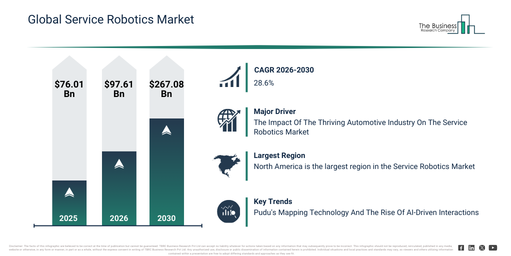
The service robotics market has experienced substantial expansion recently. It is projected to increase from $76.01 billion in 2025 to $97.61 billion in 2026, achieving a compound annual growth rate (CAGR) of 28.4%. This historical development is attributable to factors such as growing labor deficits in service sectors, the initial implementation of robotic assistance systems, the rise of automation in healthcare, the broadening of logistics automation, and enhancements in robotic hardware capabilities.
The service robotics market is projected to experience substantial expansion over the coming years. This market is anticipated to reach $267.08 billion by 2030, exhibiting a compound annual growth rate (CAGR) of 28.6%. This surge is primarily driven by increased investments in smart service automation, the broader use of robots in household and individual settings, an increasing need for touchless service options, improvements in sensor and vision technologies, and a greater integration of robots into everyday life. Key trends expected during this period involve the wider implementation of autonomous service robots, a greater embrace of AI-powered human-robot interactions, the expanding role of robots in healthcare and logistics sectors, the development of cloud-integrated robotic systems, and a heightened emphasis on standards for safety and dependability.
Get A Free Sample Report With In-Depth Market Insights:
Service Robotics Market Expansion Drivers: What’s Shaping Future Growth?
The expanding automotive sector is anticipated to drive the advancement of the service robotics market in the future. This industry encompasses various companies, organizations, and operations engaged in the creation, production, promotion, and sale of motor vehicles. Incorporating service robotics into the automotive sector provides numerous advantages, such as boosting production efficiency, improving product quality, enhancing employee safety, and facilitating adaptation to evolving industry trends. An example of this growth is evident from data released by the Government of Canada, a federal administration situated in Canada, in August 2025. This data indicated that in 2023, manufacturing revenues for automobiles and light-duty motor vehicles reached $60.0 billion, a significant rise from $45.0 billion in 2022, representing a 33.2% increase. Consequently, the expansion of the automotive industry is fueling the growth within the service robotics market.
Service Robotics Market Segment Landscape: Which Areas Lead Development?
The service robotics market covered in this report is segmented –
1) By Type: Professional, Personal, Domestic
2) By Component: Hardware, Software
3) By Environment: Aerial, Ground, Marine
4) By End-User: Healthcare, Defense, Electronics, Automotive, Transportation, Construction, Other End Users
Subsegments:
1) By Professional: Healthcare Robots, Logistics Robots, Agriculture Robots, Security And Surveillance Robots, Cleaning Robots, Construction Robots
2) By Personal: Companion Robots, Entertainment Robots, Educational Robots, Assistance Robots
3) By Domestic: Vacuum Cleaning Robots, Lawn Mowing Robots, Pool Cleaning Robots, Window Cleaning Robots, Home Security Robots
Service Robotics Market Strategic Trends: What Defines The Next Growth Phase?
Major companies operating in the service robotics market are focusing on developing new technological solutions, such as Pudu’s proprietary mapping technology, to improve operational efficiency, enhance customer interactions, and expand the applications for service robots across various industries. Pudu’s proprietary mapping technology enables their service robots to achieve precise navigation and obstacle avoidance in dynamic environments. For instance, in April 2024, a China-based technology company launched BellaBot Pro. BellaBot Pro leverages artificial intelligence to offer personalized greetings and interactions with customers, including enhanced dish identification capabilities that improve the dining experience by accurately recognizing menu items.
Service Robotics Market Industry Leaders And Competitive Landscape
Major companies operating in the service robotics market are Parrot SA; Aethon Inc.; Honda Motor Co. Ltd.; Panasonic Holdings Corporation; Yujin Robot Co. Ltd.; iRobot Corporation; Kongsberg Maritime; SoftBank Group Corp.; Boston Dynamics Inc.; Clearpath Robotics Inc.; Fetch Robotics Inc.; Locus Robotics; Sarcos Robotics; Knightscope Inc.; Seegrid Corporation; Simbe Robotics Inc.; Samsung Group; Robert Bosch GmbH; Omron Corporation; Universal Robots A/S; Sanbot Qihan Technology Co. Ltd.; 1X Technologies; Moley Robotics; Ecovacs Robotics; Starship Technologies; Neato Robotics; Cyberdyne Inc.
View The Full Service Robotics Market Report:
Service Robotics Market Geographic Analysis: Where Is Demand Rising Fastest?
North America was the largest region in the service robotics market in 2025. Asia-Pacific is expected to be the fastest-growing region in the forecast period. The regions covered in the service robotics market report are Asia-Pacific, South East Asia, Western Europe, Eastern Europe, North America, South America, Middle East, Africa.
Reach Out To Our Team:
The Business Research Company: https://www.thebusinessresearchcompany.com/
Americas: +1 310-496-7795
Asia: +44 7882 955267 & +91 8897263534
Europe: +44 7882 955267
Email us at: marketing@tbrc.info
Follow us on:
LinkedIn: https://in.linkedin.com/company/the-business-research-company
YouTube: https://www.youtube.com/channel/UC24_fI0rV8cR5DxlCpgmyFQ
Global Market Model: https://www.thebusinessresearchcompany.com/global-market-model

Wasay has over a decade of experience in market research, data modelling, and analytics, with prior experience at GlobalData and Decision Tree Consulting Services. At The Business Research Company , he leads research operations across syndicated studies, customized consulting engagements, and the Global Market Model platform. His professional experience includes supporting organizations such as Boston Consulting Group, KPMG, and Ernst & Young. Wasay holds a degree in Electronics and Communications Engineering, postgraduate management qualifications from International Management Institute Belgium and Indian School of Business and Entrepreneurship, and completed the Integrated Program in Business Analytics from Indian Institute of Management Indore.