Delivering more actionable and strategically valuable research, The Business Research Company’s 2026 market reports feature market attractiveness analysis, total addressable market evaluation, company benchmarking matrices, interactive Excel dashboards, expanded supply chain intelligence, emerging startup coverage, and detailed product insights.
Simulation Software Market Growth Potential: How Will Market Size Change Through 2030?
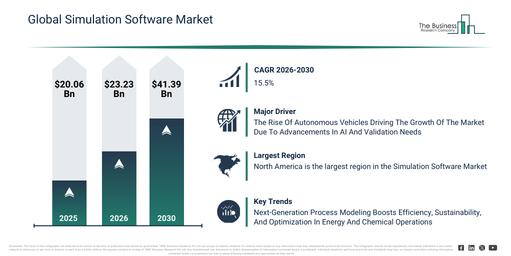
The simulation software market has experienced rapid expansion in recent years. It is anticipated to increase from $20.06 billion in 2025 to $23.23 billion in 2026, demonstrating a compound annual growth rate (CAGR) of 15.8%. The historical growth can be attributed to factors such as the increased adoption in automotive and aerospace industries, a rising demand for product optimization, the expansion of research and development and engineering projects, the early implementation of modeling and analysis tools, and government initiatives supporting digital engineering.
The simulation software market size is set for substantial growth over the next few years. It is expected to expand to $41.39 billion by 2030, achieving a compound annual growth rate (CAGR) of 15.5%. This growth during the forecast period can be attributed to several factors including the expansion of cloud-based simulation, its integration with AI and machine learning, the development of digital twin technologies, increasing demand across education and research fields, and rising investment in advanced analytics and visualization. Major trends expected in this period include real-time simulation and predictive modeling, the emergence of cloud-based simulation platforms, gamified training and learning modules, integration with IoT-enabled systems, and the deployment of advanced visualization and analytics tools.
Download A Free Sample Report For Comprehensive Market Insights:
Simulation Software Market Growth Drivers: What Factors Are Accelerating Expansion?
The future expansion of the simulation software market is anticipated to be propelled by the advancement of autonomous vehicles. Such a vehicle possesses the capability to detect its environment and operate independently of human input. The primary catalyst for autonomous vehicle development stems from progress in artificial intelligence, allowing these vehicles to interpret their surroundings, make operational choices, and maneuver securely sans human involvement. Simulation software plays a crucial role in building autonomous vehicles by assisting with the validation, design, and refinement of various products and solutions. An example of this commitment is seen in 2023, when the General Office of ShanghAI Municipal People’s Government unveiled a strategy to boost its funding and progress in autonomous driving. Their intention is to elevate investments in self-driving cars, based on the expectation that this sector will reach a valuation of $72 billion by 2025. Consequently, the evolution of autonomous vehicles serves as a significant impetus for the expansion of the simulation software market.
Simulation Software Market Segmentation: How Is The Market Structured Across Key Categories?
The simulation software market covered in this report is segmented –
1) By Component: Software, Services
2) By Application: Product Engineering, Research And Development, Gamification
3) By Deployment: On-Premises, Cloud
4) By End-user Industry: Automotive, IT And Telecommunication, Aerospace And Defense, Energy And Mining, Education And Research, Electrical And Electronics, Other End-User Industries
Subsegments:
1) By Software: Simulation Platforms, Modeling Tools, Analysis And Visualization Software
2) By Services: Consulting Services, Integration And Deployment, Support And Maintenance
Simulation Software Market Trends Reshaping Industry Growth
Leading companies within the simulation software market are prioritizing the development of innovative solutions, such as advanced process modeling, to boost operational efficiency, decrease costs, and foster sustainable practices. Advanced process modeling involves using sophisticated computer simulations to represent, predict, and optimize complex industrial processes, including chemical reactions, refining, or manufacturing operations, ultimately improving efficiency and reducing risks. For example, in August 2025, KBC Process Technology Limited, a UK-based technology firm, unveiled Petro-SIM 7.6, the latest iteration of its process simulation platform, specifically designed for the upstream and downstream oil and gas sectors, encompassing refining, petrochemicals, polymers, and sustainable aviation fuel (SAF) production. This platform integrates AI and machine learning with physics-based process simulation, enhancing prediction accuracy, optimization speed, and real-time decision-making. Notable enhancements feature a new Fischer-Tropsch reactor model for SAF production, a NOMAD solver for complex optimization, and advanced polymer process modeling aimed at minimizing downtime and off-spec production. The release also presents significant advancements in renewable feedstock kinetic modeling and bio-oil co-processing, supporting more efficient, lower-emission operations across both traditional and emerging energy processes.
Simulation Software Market Competitive Landscape And Leading Companies
Major companies operating in the simulation software market are Microsoft Corporation; Siemens AG; International Business Machines Corporation; Rockwell Automation Inc.; Dassault Systèmes SE; Keysight Technologies Inc.; Autodesk Inc.; DNV GL AS; Ansys Inc.; PTC Inc.; Unity Technologies Inc.; AVEVA Group plc; MathWorks Inc.; Bentley Systems Incorporated; Altair Engineering Inc.; Lanner Group Ltd.; MSC Software Corporation; ESI Group SA; COMSOL Inc.; Simulations Plus Inc.; GSE Systems Inc.; AnyLogic North America LLC; Cybernet Systems Corporation; Tecplot Inc.; Simul8 Corporation; OpenFOAM Foundation
Access The Complete Simulation Software Market Report:
Simulation Software Market Regional Analysis: Which Region Leads By Revenue?
North America was the largest region in the simulation software market in 2025. The regions covered in the simulation software market report are Asia-Pacific, South East Asia, Western Europe, Eastern Europe, North America, South America, Middle East, Africa.
Get in touch with us:
The Business Research Company: https://www.thebusinessresearchcompany.com/
Americas: +1 310-496-7795
Asia: +44 7882 955267 & +91 8897263534
Europe: +44 7882 955267
Email us at: marketing@tbrc.info
Follow us on:
LinkedIn: https://in.linkedin.com/company/the-business-research-company
YouTube: https://www.youtube.com/channel/UC24_fI0rV8cR5DxlCpgmyFQ
Global Market Model: https://www.thebusinessresearchcompany.com/global-market-model

Wasay has over a decade of experience in market research, data modelling, and analytics, with prior experience at GlobalData and Decision Tree Consulting Services. At The Business Research Company , he leads research operations across syndicated studies, customized consulting engagements, and the Global Market Model platform. His professional experience includes supporting organizations such as Boston Consulting Group, KPMG, and Ernst & Young. Wasay holds a degree in Electronics and Communications Engineering, postgraduate management qualifications from International Management Institute Belgium and Indian School of Business and Entrepreneurship, and completed the Integrated Program in Business Analytics from Indian Institute of Management Indore.