The Business Research Company’s 2026 market reports combine market attractiveness scoring, total addressable market sizing, company benchmarking matrices, interactive Excel dashboards, deeper supply chain intelligence, emerging startup tracking, and granular product-level insights to deliver research that is more actionable and strategically valuable.
Smart Connected Assets And Operations Market Value Projected To Grow At A 12.5% Compound Annual Growth Rate Through 2030
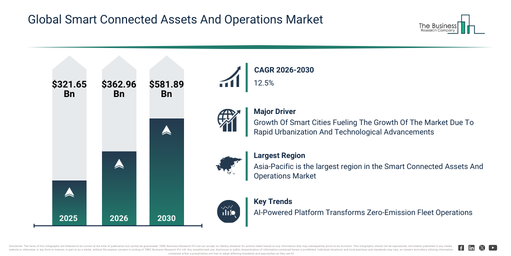
The smart connected assets and operations market has experienced rapid expansion in recent years. It is anticipated to increase from $321.65 billion in 2025 to $362.96 billion in 2026, at a compound annual growth rate (CAGR) of 12.8%. The historical growth of this market can be attributed to several factors, including the increasing deployment of IoT sensors in industry, the necessity to decrease unplanned equipment downtime, the rising adoption of asset performance management, various digital transformation initiatives in operations, and the escalating costs of maintenance and spare parts.
The smart connected assets and operations market size is anticipated to experience substantial expansion over the next few years, projected to reach $581.89 billion by 2030 with a compound annual growth rate (CAGR) of 12.5%. This growth during the forecast period is propelled by factors such as AI-driven prescriptive maintenance recommendations, edge analytics enabling low latency decision-making, the integration of digital twins for comprehensive operations planning, robust cybersecurity hardening for connected assets, and sustainability-focused energy and asset efficiency programs. Significant trends expected in this period include predictive maintenance for connected industrial assets, real-time operations monitoring via IoT dashboards, asset performance management platforms designed to reduce downtime, the automation of field service workflows using mobile tools, and enhanced connected supply chain visibility coupled with logistics optimization.
Evaluate The Smart Connected Assets And Operations Market Report Before You Buy With A Free Sample:
Smart Connected Assets And Operations Market Growth Driver Analysis For The 2026–2030 Forecast Period
An increasing focus on smart cities is anticipated to boost the expansion of the smart connected assets and operations market in the future. These are urban environments employing digital technologies, data, and intelligent infrastructure to elevate living standards, improve service delivery, and foster sustainability. This heightened focus stems from rapid urbanization, prompting urban centers to seek creative methods for effective management of infrastructure, resources, and growing populations. By integrating digital technologies into urban infrastructure, smart connected assets and operations improve both the efficiency and sustainability of smart cities. Examples of these assets include intelligent street lighting, smart waste management systems, and connected transportation, which facilitate real-time data gathering and automated decisions. For instance, in April 2023, the International Institute for Management Development, a Switzerland-based academic institution, reported that the count of smart cities hit 141 in 2023, marking an increase from prior years. Consequently, the increasing importance placed on smart cities is a key factor propelling the expansion of the smart connected assets and operations market.
Smart Connected Assets And Operations Market Segmentation Breakdown: Primary And Secondary Categories
The smart connected assets and operations market covered in this report is segmented –
1) By Solution Type: Asset Management, Operations Management, Field Service Management, Supply Chain Management
2) By Technology Type: Internet of Things, Artificial Intelligence, Blockchain, Big Data Analytics
3) By Module: Hardware, (APM) Asset Performance Management Software And Platform, Services
4) By Deployment Type: On-Premises, Cloud-Based, Hybrid
5) By End Use Industry Type: Manufacturing, Healthcare, Transportation and Logistics, Energy And Utilities
Subsegments:
1) By Asset Management: Inventory Tracking, Equipment Monitoring, Lifecycle Management, Predictive Maintenance
2) By Operations Management: Workflow Automation, Performance Monitoring, Resource Allocation, Process Optimization
3) By Field Service Management: Service Scheduling, Work Order Management, Mobile Workforce Management, Remote Assistance
4) By Supply Chain Management: Demand Planning, Logistics Optimization, Supplier Collaboration, Order Fulfillment
Smart Connected Assets And Operations Market Industry Trends: New Developments From Leading Companies
Leading companies within the sustainability and asset management sector are focusing on developing advanced digital platforms, such as those for zero-emission asset management, to boost operational efficiency, enhance regulatory compliance, and reduce their carbon footprint. Zero-emission asset management platforms are defined as integrated software solutions that enable businesses to monitor, manage, and report on the sustainability and environmental impact of their assets, thereby facilitating their transition to net-zero goals. For instance, in November 2024, Aion-Tech Solutions, an India-based digital technology company, launched ROQIT—a zero-emission, AI-powered asset management platform—through its subsidiary ROQIT Greenfleet Digital Solutions, designed to transform sustainable fleet operations. ROQIT is a cloud-native Software-as-a-Service (SaaS) solution that provides real-time monitoring, predictive maintenance, and emissions tracking across various asset types, including four-wheelers, buses, trucks, and railway vehicles. The platform integrates artificial intelligence (AI), the Internet of Things (IoT), and data analytics to optimize route planning, improve operational efficiency, and support organizations in achieving carbon-neutral mobility and long-term sustainability objectives.
Who Are The Top Competitors In The Smart Connected Assets And Operations Market?
Major companies operating in the smart connected assets and operations market are Microsoft Corporation, Alibaba Group Holding Limited, Amazon Web Services Inc., Siemens AG, NVIDIA Corporation, Rockwell Automation Inc., Dassault Systèmes SE, Hexagon AB, Autodesk Inc., Trimble Inc., ANSYS Inc., Unity Software Inc., Bentley Systems Incorporated, DeepMind Technologies Limited, General Electric Company, Schneider Electric SE, Honeywell International Inc., ABB Ltd., Hitachi Ltd., Bosch Group
Access The Smart Connected Assets And Operations Market Report For Complete Segment-Level Analysis:
Which Region Leads The Smart Connected Assets And Operations Market, And Which Regions Are Covered?
Asia-Pacific was the largest region in the smart connected assets and operations market in 2025. Asia-Pacific is expected to be the fastest-growing region in the forecast period. The regions covered in the smart connected assets and operations market report are Asia-Pacific, South East Asia, Western Europe, Eastern Europe, North America, South America, Middle East, Africa.
Reach Out To Our Team:
The Business Research Company: https://www.thebusinessresearchcompany.com/
Americas: +1 310-496-7795
Asia: +44 7882 955267 & +91 8897263534
Europe: +44 7882 955267
Email us at: marketing@tbrc.info
Follow us on:
LinkedIn: https://in.linkedin.com/company/the-business-research-company
YouTube: https://www.youtube.com/channel/UC24_fI0rV8cR5DxlCpgmyFQ
Global Market Model: https://www.thebusinessresearchcompany.com/global-market-model

Wasay has over a decade of experience in market research, data modelling, and analytics, with prior experience at GlobalData and Decision Tree Consulting Services. At The Business Research Company , he leads research operations across syndicated studies, customized consulting engagements, and the Global Market Model platform. His professional experience includes supporting organizations such as Boston Consulting Group, KPMG, and Ernst & Young. Wasay holds a degree in Electronics and Communications Engineering, postgraduate management qualifications from International Management Institute Belgium and Indian School of Business and Entrepreneurship, and completed the Integrated Program in Business Analytics from Indian Institute of Management Indore.