Backed by market attractiveness analysis, total addressable market sizing, company benchmarking matrices, interactive Excel dashboards, wider supply chain intelligence, emerging startup coverage, and detailed product-level insights, The Business Research Company’s 2026 market reports are designed to offer research that is more actionable and strategically valuable than ever.
Smart Mobility Market Revenue Growth On Track For A 17% CAGR Through 2030
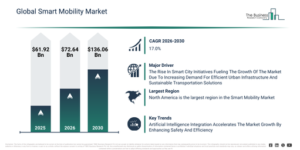
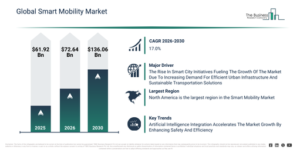
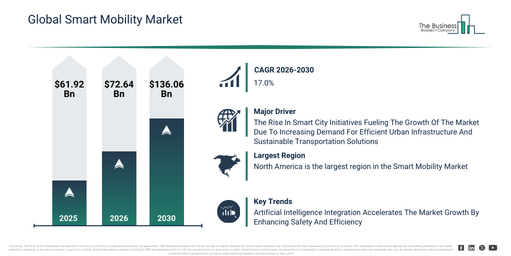
The smart mobility market has experienced significant expansion recently. Projections indicate its expansion from $61.92 billion in 2025 to $72.64 billion in 2026, demonstrating a compound annual growth rate (CAGR) of 17.3%. Historically, this expansion is linked to factors such as urban congestion challenges, the broadening of public transport systems, the emergence of intelligent traffic systems, the rise of shared mobility services, and regulations concerning fuel efficiency.
The smart mobility market is poised for significant expansion in the foreseeable future. It is projected to achieve a valuation of $136.06 billion by 2030, exhibiting a compound annual growth rate (CAGR) of 17.0%. The expansion during the forecast period can be linked to the increased adoption of autonomous vehicles, the development of electric vehicle infrastructure, investments in smart city transport, data-driven approaches to mobility planning, and the demand for low emission transport solutions. Major developments expected in this period include integrated mobility platforms, connected vehicle ecosystems, AI-driven traffic management, mobility as a service models, and sustainable urban transportation.
Get A Free Sample Report With In-Depth Market Insights:
Smart Mobility Market Growth Drivers: What’s Behind The Acceleration?
The increasing number of smart city initiatives is anticipated to fuel the expansion of the smart mobility market in the future. A smart city is defined as an urban area employing digital technology and data-driven methods to elevate residents’ quality of life, enhance municipal services, and foster sustainable growth. These initiatives are growing due to rapid urbanization and the imperative for sustainable urban development. With more individuals relocating to cities, infrastructure, resources, and public services like transportation, energy, and waste management face escalating demands. Within smart cities, smart mobility employs technology to streamline transportation, mitigate congestion, and encourage sustainability. This encompasses smart traffic management, electric vehicles, shared mobility services, and autonomous vehicles, all geared towards making urban transport more efficient, interconnected, and environmentally sound. For example, in June 2023, as reported by the Cities Today, a UK-based magazine, the German federal government pledged to more actively advance smart cities and smart regions, committing a total of €820 million ($918.4 million) to this objective. The smart cities model projects (Modellprojekte Smart Cities) currently support 73 projects, establishing best practices for 11,000 municipalities throughout Germany. Consequently, the proliferation of smart city initiatives is a driving force for the smart mobility market.
Smart Mobility Market Segment Outlook: Which Categories Are Growing Fastest?
The smart mobility market covered in this report is segmented –
1) By Type: Integrated Mobility Platforms, Smart Transportation Solutions, Connected Vehicle Solutions, Mobility As A Service, Traffic Management Systems
2) By Technology: Internet Of Things, Artificial Intelligence, Blockchain, Big Data Analytics, Cloud Computing
3) By Transport Mode: Public Transport, Private Transport, Shared Mobility, Electric Vehicles, Rail Transport
4) By End-User: Government, Transportation Service Providers, Fleet Operators, Corporate, Individuals
Subsegments:
1) By Integrated Mobility Platforms: Multimodal Trip Planning, Real-Time Transit Information, Payment And Ticketing Integration, Mobility Aggregator Apps
2) By Smart Transportation Solutions: Intelligent Public Transport, Smart Parking Systems, Dynamic Traffic Signal Control, Electric Vehicle Charging Infrastructure
3) By Connected Vehicle Solutions: Vehicle-to-Vehicle (V2V) Communication, Vehicle-to-Infrastructure (V2I) Communication, Telematics And Infotainment Systems, Advanced Driver Assistance Systems (ADAS)
4) By Mobility As A Service (MaaS): Ride-Hailing Services, Car-Sharing Services, Bike And Scooter Sharing, Subscription-Based Mobility Plans
5) By Traffic Management Systems: Adaptive Traffic Control Systems, Incident Detection Systems, Traffic Data Analytics, Electronic Toll Collection Systems
Smart Mobility Market Trends: What’s Defining The Industry’s Next Phase?
Leading companies in the smart mobility market are increasingly adopting artificial intelligence (AI) to bolster transportation efficiency, safety, and sustainability. The integration of artificial intelligence into smart mobility solutions aids in optimizing traffic flow and alleviating congestion through the analysis of real-time data. Furthermore, it improves capabilities in predictive maintenance and route planning, thereby enhancing both efficiency and safety within transportation systems. For example, in September 2023, Hyundai Motor Company, a US-based automotive manufacturer, released the Venue and Venue N Line in India, which are equipped with advanced driver assistance systems (ADAS), establishing them as the most economical sports utility vehicles (SUVs) with this technology in the sub-4m segment. The introduction of ADAS aims to improve road safety and address the rising consumer demand for advanced features in compact SUVs. Hyundai’s strategic focus on affordability and technological innovation positions the Venue as a strong competitive choice against models such as Tata Nexon and Maruti Suzuki Brezza.
Smart Mobility Market Leading Companies And Competitive Benchmarking
Major companies operating in the smart mobility market are Volkswagen AG, Toyota Motor Corporation, Ford Motor Company, General Motors, Bayerische Motoren Werke AG, HyundAI Motor Company, Robert Bosch GmbH, Siemens AG, Intel Corporation, Cisco Systems Inc., Škoda Auto AS, Uber Technologies Inc., Lyft Inc., TomTom International BV, Waymo LLC, Lime Electric Scooter Sharing Company, Gett Inc, Mindteck, QuaLiX Information System LLP, Excelfore Corporation, Innoviz Technologies Ltd.
View The Full Smart Mobility Market Report:
Smart Mobility Market Top Region By Revenue And Market Share
North America was the largest region in the smart mobility market in 2025. Asia-Pacific is expected to be the fastest-growing region in the forecast period. The regions covered in the smart mobility market report are Asia-Pacific, South East Asia, Western Europe, Eastern Europe, North America, South America, Middle East, Africa.
Reach Out To Our Team:
The Business Research Company: https://www.thebusinessresearchcompany.com/
Americas: +1 310-496-7795
Asia: +44 7882 955267 & +91 8897263534
Europe: +44 7882 955267
Email us at: marketing@tbrc.info
Follow us on:
LinkedIn: https://in.linkedin.com/company/the-business-research-company
YouTube: https://www.youtube.com/channel/UC24_fI0rV8cR5DxlCpgmyFQ
Global Market Model: https://www.thebusinessresearchcompany.com/global-market-model

Wasay has over a decade of experience in market research, data modelling, and analytics, with prior experience at GlobalData and Decision Tree Consulting Services. At The Business Research Company , he leads research operations across syndicated studies, customized consulting engagements, and the Global Market Model platform. His professional experience includes supporting organizations such as Boston Consulting Group, KPMG, and Ernst & Young. Wasay holds a degree in Electronics and Communications Engineering, postgraduate management qualifications from International Management Institute Belgium and Indian School of Business and Entrepreneurship, and completed the Integrated Program in Business Analytics from Indian Institute of Management Indore.