Built to provide research that’s more actionable and strategically valuable, The Business Research Company’s 2026 market reports include market attractiveness analysis, total addressable market sizing, company benchmarking matrices, interactive Excel dashboards, broader supply chain intelligence, emerging startup tracking, and in-depth product insights.
Software Defined Radio Market Value Analysis: What Growth Lies Ahead Over The Forecast Period?
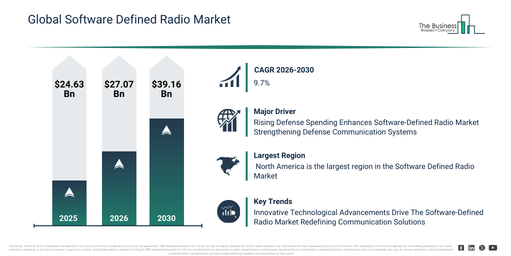
The software defined radio market has demonstrated significant expansion in recent years. Looking ahead, it is projected to grow from $24.63 billion in 2025 to $27.07 billion in 2026, achieving a compound annual growth rate (CAGR) of 9.9%. Historically, this market’s development has been fueled by factors including the increasing number of military communication modernization programs, the widening of public safety communication networks, a growing demand for spectrum-efficient radio systems, the adoption of reconfigurable communication hardware, and the surge in multi-standard wireless devices.
The software defined radio market is projected to experience robust expansion over the coming years. Its valuation is set to reach $39.16 billion in 2030, exhibiting a compound annual growth rate (CAGR) of 9.7%. This anticipated growth during the forecast timeframe is attributable to factors such as the expanding implementation of 5G and future communication systems, heightened capital expenditure in software-driven defense radio technologies, an escalating need for dynamic spectrum management, the broadening of satellite communication infrastructures, and a sharpened emphasis on cybersecurity for radio systems. Key trends anticipated within this period encompass the increasing embrace of multi-band programmable radios, the wider rollout of cognitive radio systems, the escalating incorporation of software-defined waveforms, the extension of secure and encrypted communication networks, and a heightened emphasis on radio architectures that promote interoperability.
Get A Free Sample Report With In-Depth Market Insights:
Software Defined Radio Market Opportunity Drivers: What’s Unlocking New Revenue Potential?
The software-defined radio market is expected to grow, driven by increased defense spending on upgrading communication systems. The defense sector provides soldiers with technological benefits, enabling them to operate effectively in wartime through enhanced data transmission, voice clarity, and data accuracy systems. These advanced communication systems are vital for protecting sensitive information across the defense sector. Moreover, the increasing prevalence of cross-border disputes and terrorism is leading to higher investments in defense communication. These factors are likely to boost the deployment of advanced communication systems for improved security and safety. For instance, in May 2024, the UK Parliament, UK-based government, indicated that the UK’s defense spending stood at £54.2 billion in the 2023-24 financial year. This amount is forecast to rise to £57.1 billion in 2024-25, representing a 4.5% increase in real terms. Thus, the rise in defense expenditure on communication systems will propel the software-defined radio market growth.
Software Defined Radio Market Segments: Where Is Growth Concentrated?
The software defined radio market covered in this report is segmented –
1) By Type: Joint Tactical Radio System (JTRS), Cognitive Radio, General Purpose Radio, Terrestrial Trunked Radio (TETRA)
2) By Component: Hardware, Software, Service
3) By Platform: Airborne, Naval, Land, Space
4) By Frequency Band: High Frequency (HF), Very High Frequency (VHF), Ultra-High Frequency (UHF), Other Bands
5) By End-Users: Aerospace And Defense, Telecommunication, Public Safety, Commercial, Other End-Users
Subsegments:
1) By Joint Tactical Radio System (JTRS): Handheld Radios, Vehicular Radios, Base Station Radios
2) By Cognitive Radio: Spectrum Sensing, Dynamic Spectrum Access, Network Management
3) By General Purpose Radio: VHF Radio, UHF Radio, HF Radio
4) By Terrestrial Trunked Radio (TETRA): Mobile TETRA Radios, Portable TETRA Radios, Infrastructure Equipment
Software Defined Radio Market Innovation Trends Shaping Future Development
Leading companies in the software-defined radio (SDR) market are strategically focusing on deploying advanced products, such as sophisticated multi-band modular software-defined radios, to bolster interoperability, enhance mission flexibility, and comply with evolving communication standards across defense and commercial sectors. These advanced multi-band modular software-defined radios are reconfigurable communication systems that leverage software to switch between various frequencies and waveforms. This capability helps users adapt swiftly to different missions, improves overall interoperability, and lessens the reliance on multiple dedicated hardware radios. For instance, in March 2023, Elta Systems, an Israel-based aerospace and defense company, introduced the ARC 840 SDR – Network Centric Operations (SDR-NCO) airborne communication system. This system is compliant with the latest SCA 4.1 standard from the US Joint Tactical Networking Centre. The ARC 840 software-defined radio facilitates voice, video, and data communications. Operating across very high frequency (VHF), ultra-high frequency (UHF), and L-band ranges, the ARC 840 ensures compatibility with diverse military and commercial radios, thereby enabling communication among air, ground, and sea forces. Its modular architecture includes two user-swappable radio frequency (RF) modules, allowing for customization to meet varied mission requirements. The system also integrates transmission and communication security features, such as frequency hopping and low probability of intercept (LPI) techniques, to ensure secure exchanges.
Software Defined Radio Market Key Participants And Competitive Landscape
Major companies operating in the software defined radio market are Elbit Systems Ltd.; L3Harris Technologies Inc.; BAE Systems plc; General Dynamics Corporation; Leonardo S.p.A.; Aselsan A.S.; Bharat Electronics Limited; Thales Group; Raytheon Technologies Corporation; Rafael Advanced Defense Systems Ltd.; Rohde & Schwarz GmbH & Co. KG; Israel Aerospace Industries Ltd.; Indra Sistemas S.A.; LIG Nex1 Co. Ltd.; ViaSat Inc.; Ultra Electronics Holdings; Curtiss-Wright Corporation; Silvus Technologies Inc.; FlexRadio Systems; Epiq Solutions; Giga-tronics Inc.; SDRplay Limited
View The Full Software Defined Radio Market Report:
Software Defined Radio Market Largest Region: Which Geography Holds The Biggest Share?
North America was the largest region in the modular data center market in 2025. Asia-Pacific is expected to be the fastest-growing region in the forecast period. The regions covered in the software defined radio market report are Asia-Pacific, South East Asia, Western Europe, Eastern Europe, North America, South America, Middle East, Africa.
Reach Out To Our Team:
The Business Research Company: https://www.thebusinessresearchcompany.com/
Americas: +1 310-496-7795
Asia: +44 7882 955267 & +91 8897263534
Europe: +44 7882 955267
Email us at: marketing@tbrc.info
Follow us on:
LinkedIn: https://in.linkedin.com/company/the-business-research-company
YouTube: https://www.youtube.com/channel/UC24_fI0rV8cR5DxlCpgmyFQ
Global Market Model: https://www.thebusinessresearchcompany.com/global-market-model

Wasay has over a decade of experience in market research, data modelling, and analytics, with prior experience at GlobalData and Decision Tree Consulting Services. At The Business Research Company , he leads research operations across syndicated studies, customized consulting engagements, and the Global Market Model platform. His professional experience includes supporting organizations such as Boston Consulting Group, KPMG, and Ernst & Young. Wasay holds a degree in Electronics and Communications Engineering, postgraduate management qualifications from International Management Institute Belgium and Indian School of Business and Entrepreneurship, and completed the Integrated Program in Business Analytics from Indian Institute of Management Indore.