The Business Research Company’s 2026 market reports are designed to deliver research that is more actionable and strategically valuable. Key offerings include market attractiveness scoring, total addressable market sizing, company benchmarking matrices, interactive Excel dashboards, deeper supply chain intelligence, emerging startup tracking, and granular product-level insights.
Spatial Computing Market Revenue Projected To Rise To $448.95 Billion By 2030
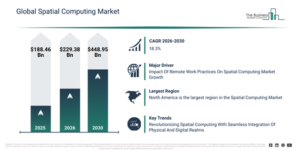
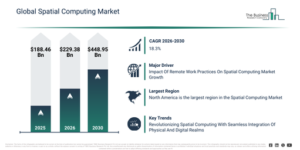
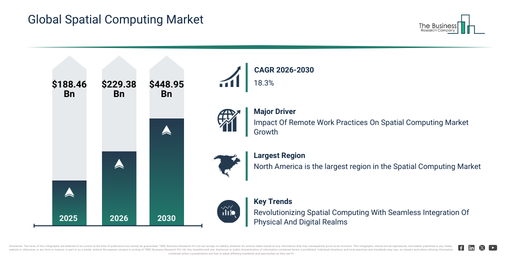
The spatial computing market has witnessed substantial expansion in recent years. Its valuation is anticipated to climb from $188.46 billion in 2025 to $229.38 billion in 2026, registering a compound annual growth rate (CAGR) of 21.7%. This historic growth can be attributed to advancements in sensor and camera technologies, the initial adoption of AR and VR devices, the proliferation of gaming and visualization platforms, an increase in industrial simulation use cases, and enhanced investment in immersive interfaces.
The spatial computing market is projected to experience substantial expansion in the coming years. This market is forecast to reach $448.95 billion by 2030, exhibiting a compound annual growth rate (CAGR) of 18.3%. Key drivers for this growth during the forecast period include the expanding application of spatial computing in manufacturing and healthcare sectors, enhanced integration with AI-powered perception systems, the proliferation of metaverse applications, increasing need for real-time spatial analytics, and the wider uptake of mixed reality solutions for businesses. Noteworthy trends shaping this period encompass the growing acceptance of augmented reality (AR) and virtual reality (VR) applications in enterprises, a surge in the utilization of 3D mapping and spatial analytics, the increasing convergence of digital twins with physical settings, the evolution of wearable spatial computing devices, and a heightened emphasis on intuitive human-computer interaction.
Want Deeper Spatial Computing Market Insights? Get A Free Sample Report:
Primary Growth Driver Shaping The Spatial Computing Market Outlook
The growing prevalence of remote work is anticipated to fuel the expansion of the spatial computing market. Remote work involves strategies organizations use to carry out tasks away from conventional offices, driven by factors such as technological progress, global networks, work flexibility, improved work-life balance, the effects of the pandemic, and employee choices. Spatial computing has revolutionized remote work by offering more immersive collaborative interactions, enhancing training and new employee integration, establishing virtual workspaces, facilitating remote support, and developing specialized tools for productivity. For example, data from the UK’s Office for National Statistics in February 2023 indicated that from April 27 to May 8, 2022, around 38% of working adults reported engaging in remote work. More recently, between January 25 and February 5, 2023, approximately 40% of employed individuals stated they had worked from home at least once during the preceding seven days. Consequently, the rising uptake of remote work models is a significant driver for the growth of the spatial computing market.
Spatial Computing Market Structure: A Detailed Look At Segments And Subsegments
The spatial computing market covered in this report is segmented –
1) By Component: Hardware, Software, Services
2) By Technology: Augmented Reality, Virtual Reality, Mixed Reality
3) By End User: Automotive, Healthcare, Gaming, Manufacturing, Retail, Education, Other End Users
Subsegments:
1) By Hardware: Wearables (AR/VR Headsets, Smart Glasses), Sensors (Depth Sensors, Motion Sensors), Processors (Graphics Processing Units, Application Processors), Displays (Head-Up Displays, Holographic Displays), Controllers (Haptic Feedback Controllers, Gesture Control Devices)
2) By Software: Augmented Reality (AR) Software, Virtual Reality (VR) Software, Mixed Reality (MR) Software, 3D Mapping And Modeling Software, Spatial Analytics Software, Development Platforms (Game Engines, AR Or VR SDKs)
3) By Services: Consulting Services, Integration And Deployment Services, Maintenance And Support Services, Training And Education Services, Managed Services
Spatial Computing Market Innovation And Strategy Trends Among Leading Companies
Leading spatial computing companies are prioritizing the creation of advanced technological products, such as the Apple Vision Pro, to broaden their product range and attract a wider customer base. This groundbreaking spatial computer fluidly integrates digital content with the physical environment, providing an unparalleled user experience where natural inputs like motion gestures, eye tracking, and speech recognition interact smoothly with digital elements. For example, in June 2023, Apple Inc., a US-based technology firm, introduced the Apple Vision Pro, a transformative spatial computer designed to merge digital content with the physical world, enabling users to remain engaged and connected with others. The Vision Pro establishes an expansive digital workspace for applications that extends beyond the limits of conventional displays, incorporating hand and voice control, thereby boosting user productivity through limitless screen space, access to preferred applications, and advanced multitasking functionalities. Furthermore, its distinctive design sets it apart from other augmented reality (AR) and virtual reality (VR) headsets, including an external battery pack linked by a cable, engineered to minimize weight and discomfort during prolonged periods of operation.
Top Companies Competing In The Spatial Computing Market
Major companies operating in the spatial computing market are Apple Inc, Google plc, Samsung Corporation, Microsoft Corporation, Meta Platforms Inc, Huawei Technologies Co. Ltd, Sony Corporation, Lenovo Group Limited, Intel Corporation, Qualcomm Incorporated, NVIDIA Corporation, Vuzix Corporation, Seiko Epson Corporation, Dassault Systèmes, Autodesk Inc, Snap Inc, PTC Inc, Unity Technologies, Melexis NV, Niantic Inc, RealWear Inc, Atheer Inc, OnScale Inc, Blippar Ltd, Wikitude GmbH
View The Complete Spatial Computing Market Study With Segment And Regional Data:
Spatial Computing Market Regional Outlook Across Major Geographies
North America was the largest region in the spatial computing market in 2025. The regions covered in the spatial computing market report are Asia-Pacific, South East Asia, Western Europe, Eastern Europe, North America, South America, Middle East, Africa.
Reach Out To Our Team:
The Business Research Company: https://www.thebusinessresearchcompany.com/
Americas: +1 310-496-7795
Asia: +44 7882 955267 & +91 8897263534
Europe: +44 7882 955267
Email us at: marketing@tbrc.info
Follow us on:
LinkedIn: https://in.linkedin.com/company/the-business-research-company
YouTube: https://www.youtube.com/channel/UC24_fI0rV8cR5DxlCpgmyFQ
Global Market Model: https://www.thebusinessresearchcompany.com/global-market-model

Wasay has over a decade of experience in market research, data modelling, and analytics, with prior experience at GlobalData and Decision Tree Consulting Services. At The Business Research Company , he leads research operations across syndicated studies, customized consulting engagements, and the Global Market Model platform. His professional experience includes supporting organizations such as Boston Consulting Group, KPMG, and Ernst & Young. Wasay holds a degree in Electronics and Communications Engineering, postgraduate management qualifications from International Management Institute Belgium and Indian School of Business and Entrepreneurship, and completed the Integrated Program in Business Analytics from Indian Institute of Management Indore.