Featuring market attractiveness scoring, total addressable market sizing, company benchmarking matrices, interactive Excel dashboards, deeper supply chain intelligence, emerging startup tracking, and granular product-level insights, The Business Research Company’s 2026 market reports are built to deliver research that is both more actionable and more strategically valuable.
Supply Chain Digital Twin Market Revenue Growth On Track For A 12.2% CAGR Through 2030
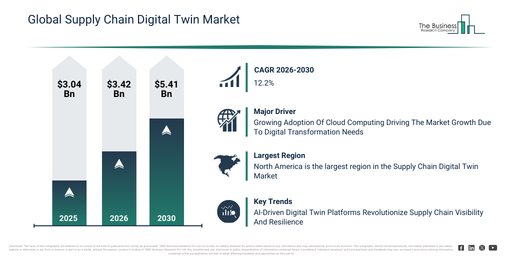
The supply chain digital twin market has experienced substantial expansion recently. Its projected expansion will see it increase from $3.04 billion in 2025 to $3.42 billion in 2026, demonstrating a compound annual growth rate (CAGR) of 12.4%. Historically, this growth was driven by factors such as the globalization of supply chains and sourcing activities, the imperative to cut logistics expenses and improve efficiency, the increasing adoption of ERP and supply chain software, a surge in supply disruptions and fluctuating demand, and the rising availability of data from interconnected systems.
The supply chain digital twin market is projected to experience substantial expansion in the coming years. It is anticipated to reach a valuation of $5.41 billion by 2030, exhibiting a compound annual growth rate (CAGR) of 12.2%. This expansion during the projection period can be attributed to factors such as enhanced adoption of AI-driven predictive planning, the broadening application of digital twins for resilience strategies, increased capital expenditure in comprehensive end-to-end traceability, a stronger emphasis on reporting for sustainable supply chains, and the incorporation of autonomous warehouse and logistics systems. Key trends anticipated within the forecast horizon encompass real-time visibility across supply chains, scenario modeling combined with risk prediction, the use of predictive analytics for optimizing inventory, seamless integration with IoT and various tracking systems, and advanced modeling for sustainability and carbon footprints.
Get A Free Sample Report With In-Depth Market Insights:
Supply Chain Digital Twin Market Growth Catalysts And Demand Drivers
The increased reliance on cloud computing is projected to drive expansion in the supply chain digital twin market. Cloud computing, a technology delivering computing services such as servers, storage, databases, networking, software, and analytics via the internet, is experiencing surging adoption. This surge is due to organizations’ rising demand for scalable and economical infrastructure, as they accelerate digital transformations to mitigate operational risks and optimize costs. This growing adoption facilitates the seamless integration, real-time data processing, and scalable storage crucial for supporting supply chain digital twins. This capability enables organizations to construct precise, dynamic virtual models of their supply chains, thereby enhancing visibility, predictive analytics, and informed decision-making. For instance, in March 2024, Flexera, a US-based computer software company, noted a slight increase in multi-cloud usage, moving from 87% in 2023 to 89% in 2024. Consequently, the expanding utilization of cloud computing is a primary driver for the growth of the supply chain digital twin market.
Supply Chain Digital Twin Market Breakdown By Product Type And Application
The supply chain digital twin market covered in this report is segmented –
1) By Component: Hardware, Software, Services
2) By Technology: Internet Of Things (IoT), Big Data Analytics, Artificial Intelligence (AI), Blockchain, Other Technologies
3) By Deployment Mode: On-Premise, Cloud
4) By Enterprise Size: Large Enterprises, Small And Medium Size Enterprises (SMEs)
5) By End-User Industry: Manufacturing, Automotive, Aerospace And Defense, Retail, Pharmaceuticals, Consumer Goods, Other End-User Industries
Subsegments:
1) By Hardware: Sensors And Internet Of Things (IoT) Devices, Edge Computing Units, Networking Equipment, Data Storage Devices
2) By Software: Digital Twin Modeling Software, Simulation And Analytics Software, Visualization Platforms, Integration Software
3) By Services: Implementation Services, Consulting Services, Maintenance And Support Services, Training And Education Services
Supply Chain Digital Twin Market Trends Shaping Long-Term Demand
Major companies operating in the supply chain digital twin market are concentrating on employing innovative solutions, specifically artificial intelligence (AI)-driven digital twin platforms, to boost real-time transparency, enhance operational efficiency, and facilitate predictive decision-making. These AI-driven digital twin platforms act as sophisticated virtual representations of physical supply chains, utilizing AI algorithms to analyze live data, simulate various scenarios, and optimize operations. This approach helps organizations anticipate disruptions, improve decision-making, optimize resource usage, and ultimately increase overall supply chain resilience and agility. For example, in June 2025, FourKites Inc., a US-based software company, launched a supply chain digital twin solution in collaboration with Chorus Ltd., a UK-based company. This partnership integrates Chorus Ltd.’s item-level sensors and AI-powered orchestration tools with the FourKites Intelligent Control Tower platform. The aim is to create digital twins that combine real-time supply chain events with granular package-level insights, thereby enabling enterprises to improve visibility, reduce inventory carrying costs, prevent stockouts and overstocking, mitigate risks such as theft and damage, and enhance overall service performance. This digital twin technology operates by using real-time data from connected devices and advanced analytics to virtually mirror physical supply chain operations.
Supply Chain Digital Twin Market Company Landscape And Competitive Strategy
Major companies operating in the supply chain digital twin market are Microsoft Corporation, Huawei Technologies Co. Ltd., Siemens AG, Accenture plc, IBM Corporation, NVIDIA Corporation, Cisco Systems Inc., General Electric Company, Oracle Corporation, Schneider Electric SE, Honeywell International Inc., SAP SE, Tata Consultancy Services Limited (TCS), Rockwell Automation Inc., Dassault Systèmes SE, PTC Inc., BearingPoint Consulting GmbH, Bentley Systems Incorporated, Manhattan Associates Inc., Kinaxis Inc., Resilinc Corporation, Logivations GmbH, The AnyLogic Company, Mondra Ltd.
View The Full Supply Chain Digital Twin Market Report:
Supply Chain Digital Twin Market Regional Analysis: Which Geography Leads On Revenue?
North America was the largest region in the supply chain digital twin market in 2025. The regions covered in the supply chain digital twin market report are Asia-Pacific, South East Asia, Western Europe, Eastern Europe, North America, South America, Middle East, Africa.
Reach Out To Our Team:
The Business Research Company: https://www.thebusinessresearchcompany.com/
Americas: +1 310-496-7795
Asia: +44 7882 955267 & +91 8897263534
Europe: +44 7882 955267
Email us at: marketing@tbrc.info
Follow us on:
LinkedIn: https://in.linkedin.com/company/the-business-research-company
YouTube: https://www.youtube.com/channel/UC24_fI0rV8cR5DxlCpgmyFQ
Global Market Model: https://www.thebusinessresearchcompany.com/global-market-model

Wasay has over a decade of experience in market research, data modelling, and analytics, with prior experience at GlobalData and Decision Tree Consulting Services. At The Business Research Company , he leads research operations across syndicated studies, customized consulting engagements, and the Global Market Model platform. His professional experience includes supporting organizations such as Boston Consulting Group, KPMG, and Ernst & Young. Wasay holds a degree in Electronics and Communications Engineering, postgraduate management qualifications from International Management Institute Belgium and Indian School of Business and Entrepreneurship, and completed the Integrated Program in Business Analytics from Indian Institute of Management Indore.