
Delivering more actionable and strategically valuable research, The Business Research Company’s 2026 market reports feature market attractiveness analysis, total addressable market evaluation, company benchmarking matrices, interactive Excel dashboards, expanded supply chain intelligence, emerging startup coverage, and detailed product insights.
#Synthetic Tabular Data Generation Software Market Size And Revenue Forecast Through 2030
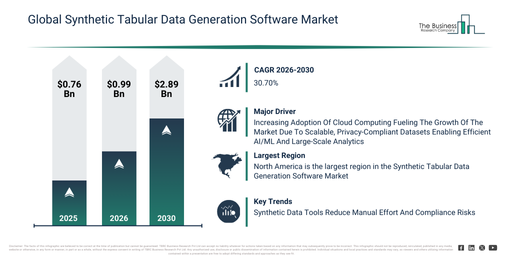
The market size for synthetic tabular data generation software has undergone rapid expansion in recent years. It is anticipated to grow from $0.76 billion in 2025 to $0.99 billion in 2026, achieving a compound annual growth rate (CAGR) of 30.9%. This historical growth can be ascribed to several factors, including the increasing demand for data that preserves privacy, the rising requirement for large-scale data simulation, the broader adoption of AI and ML technologies, the expansion of decision-making processes based on data, and the escalating demands for regulatory compliance.
The market for synthetic tabular data generation software is projected to experience substantial expansion over the upcoming years. This market is anticipated to reach a valuation of $2.89 billion by 2030, demonstrating a compound annual growth rate (CAGR) of 30.7%. This anticipated growth during the forecast period is driven by several factors, including the increasing integration of synthetic data within businesses, a heightened emphasis on data security and privacy protocols, escalating investments in artificial intelligence (AI) and machine learning (ML), the broadening scope of data analytics in the healthcare and financial sectors, and a growing need for effective data augmentation solutions. Key trends expected throughout this period encompass technological progress in AI and ML models, novel advancements in data anonymization methodologies, the evolution of cloud-hosted synthetic data platforms, ongoing research and development efforts in algorithmic data generation, and persistent enhancements in the quality and practical application of generated data.
Download A Free Sample Report For Comprehensive Market Insights:
Synthetic Tabular Data Generation Software Market Development Factors: Which Trends Are Supporting Demand?
The future expansion of the synthetic tabular data generation software market is anticipated to be spurred by the growing uptake of cloud computing. This technology involves providing computing resources—including servers, storage, databases, networking, software, and analytics—via the internet, facilitating quicker innovation, adaptable resources, and cost efficiencies. Its widespread use is primarily motivated by its inherent scalability, enabling businesses to readily scale computing capabilities according to operational needs and simultaneously lower infrastructure expenditures. Synthetic tabular data generation software improves cloud computing ecosystems by supplying scalable, privacy-compliant datasets, which are perfectly suited for multi-tenant setups and extensive analytical tasks. This software also minimizes the effort required for data preparation through its capacity for rapid and precise synthetic dataset generation, thereby enhancing AI/ML model development and overall efficiency within cloud operations. For example, data from Eurostat, a Luxembourg-based government organization, indicated that in December 2023, 45.2% of businesses throughout the European Union acquired cloud computing services. Specifically, 77.6% of large enterprises, 59% of medium-sized enterprises, and 41.7% of small businesses had adopted these services. Consequently, the expanding embrace of cloud computing is fueling the growth within the synthetic tabular data generation software market.
Synthetic Tabular Data Generation Software Market Segment Performance And Strategic Opportunities
The synthetic tabular data generation software market covered in this report is segmented –
1) By Component: Software, Services
2) By Deployment Mode: On-Premises, Cloud-Based
3) By Enterprise Size: Large Enterprises, Small And Medium Enterprises
4) By Application: Data Augmentation, Machine Learning And AI Model Training, Data Privacy And Security, Testing And Quality Assurance (QA), Other Applications
5) By End-User: Banking, Financial Services, Insurance (BFSI), Healthcare, Retail And E-commerce, IT And Telecommunications, Government, Manufacturing, Other End-Users
Subsegments:
1) By Software: Data Modeling, Data Masking, Data Augmentation, Data Synthesis
2) By Services: Consulting, Implementation, Support And Maintenance, Training
Synthetic Tabular Data Generation Software Market Transformation Trends: Which Innovations Are Driving Change?
Major companies in the synthetic tabular data generation software market are focusing on developing advanced solutions, such as synthetic data management platforms, to enhance data utility, improve privacy compliance, and decrease the manual effort and risks associated with using real data. These synthetic data management platforms are integrated systems that automate the creation, governance, and deployment of statistically representative artificial data that accurately mimics real datasets without revealing sensitive information. For example, in October 2023, K2view, an Israel-based enterprise data management company, introduced its K2view Synthetic Data Management Solution. This comprehensive platform generates business-purpose synthetic data for non-production environments, featuring patented entity-based generation that maintains the integrity of complex business relationships across millions of records. It includes automated data discovery and classification, allowing for seamless alignment with specific data privacy regulations and testing needs without manual intervention. Additionally, it incorporates data subsetting and referential integrity preservation, which accelerates development cycles and lowers compliance risk for enterprises in regulated industries.
Synthetic Tabular Data Generation Software Market Key Players: Which Companies Shape Industry Competition?
Major companies operating in the synthetic tabular data generation software market are Amazon Web Services Inc., Microsoft Corporation, International Business Machines Corporation, NVIDIA Corporation, Databricks Inc., Sogeti, K2View Ltd., Datagen Technologies Ltd., Anonos Inc., Tonic.ai Inc., Mostly AI Solutions MP GmbH, OneView Inc., MDClone Ltd., Facteus Inc., Synthesized Ltd., GenRocket Inc., YData Inc., Betterdata Pte. Ltd., Aindo S.p.A., Syntho B.V.
Access The Complete Synthetic Tabular Data Generation Software Market Report:
Synthetic Tabular Data Generation Software Market Leading Geography: Which Region Generates The Most Revenue?
North America was the largest region in the synthetic tabular data generation software market in 2025. Asia-Pacific is expected to be the fastest-growing region in the forecast period. The regions covered in the synthetic tabular data generation software market report are Asia-Pacific, South East Asia, Western Europe, Eastern Europe, North America, South America, Middle East, Africa.
Get in touch with us:
The Business Research Company: https://www.thebusinessresearchcompany.com/
Americas: +1 310-496-7795
Asia: +44 7882 955267 & +91 8897263534
Europe: +44 7882 955267
Email us at: marketing@tbrc.info
Follow us on:
LinkedIn: https://in.linkedin.com/company/the-business-research-company
YouTube: https://www.youtube.com/channel/UC24_fI0rV8cR5DxlCpgmyFQ
Global Market Model: https://www.thebusinessresearchcompany.com/global-market-model

Wasay has over a decade of experience in market research, data modelling, and analytics, with prior experience at GlobalData and Decision Tree Consulting Services. At The Business Research Company , he leads research operations across syndicated studies, customized consulting engagements, and the Global Market Model platform. His professional experience includes supporting organizations such as Boston Consulting Group, KPMG, and Ernst & Young. Wasay holds a degree in Electronics and Communications Engineering, postgraduate management qualifications from International Management Institute Belgium and Indian School of Business and Entrepreneurship, and completed the Integrated Program in Business Analytics from Indian Institute of Management Indore.