Featuring market attractiveness scoring, total addressable market sizing, company benchmarking matrices, interactive Excel dashboards, deeper supply chain intelligence, emerging startup tracking, and granular product-level insights, The Business Research Company’s 2026 market reports are built to deliver research that is both more actionable and more strategically valuable.
Telecom Edge Load Balancer Market Size, Value And Growth Trajectory Through 2030
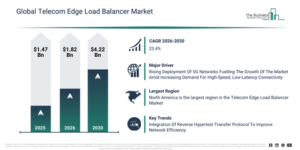
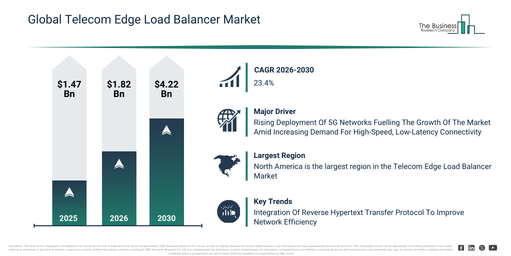
The telecom edge load balancer market has seen substantial growth in recent years. It is forecast to increase from $1.47 billion in 2025 to $1.82 billion in 2026, achieving a compound annual growth rate (CAGR) of 23.7%. This historical expansion can be attributed to several factors, including the proliferation of 5G network rollouts, a surge in edge compute deployments, the increasing need for low latency services, the complexity inherent in distributed network functions, and the imperative to bolster service reliability at the edge.
The telecom edge load balancer market is projected to experience substantial growth over the upcoming years. It is anticipated to reach $4.22 billion in 2030 at a compound annual growth rate (CAGR) of 23.4%. This expansion throughout the forecast period can be ascribed to several factors, including AI-driven traffic optimization and predictive scaling, the increasing embrace of cloud-native network functions, seamless integration with network slicing and QoS policies, the proliferation of IoT and AR/VR edge workloads, and a heightened emphasis on edge security and compliance. Key trends anticipated during this period encompass cloud-native edge load balancing for 5G core and RAN, real-time traffic steering enabled by application-aware policies, service mesh integration for edge network functions, enhanced scaling and resilience in Multi-access Edge Computing (MEC), and security-aware load balancing incorporating zero-trust controls.
Get A Free Sample Report With In-Depth Market Insights:
Telecom Edge Load Balancer Market Expansion Drivers: What’s Shaping Future Growth?
The increasing rollout of 5G networks is anticipated to drive the expansion of the telecom edge load balancer market in the future. 5G networks represent the fifth generation of mobile network technology, engineered to provide extremely high data speeds, minimal latency, and extensive connectivity essential for advanced digital services. The expansion of 5G networks is fueled by the growing need for high-capacity communication infrastructure capable of supporting data-heavy applications like the internet of things (IoT), cloud computing, and edge analytics. Telecom edge load balancers facilitate the deployment of 5G networks by effectively distributing network traffic across various distributed edge nodes, thereby guaranteeing ultra-low latency, superior reliability, and seamless scalability for real-time, bandwidth-intensive applications. For instance, in July 2024, according to the Organisation for Economic Co-operation and Development (OECD), a France-based intergovernmental organization, 5G accounted for 28% of all mobile broadband subscriptions across OECD countries in 2023, marking a 9% rise from the close of 2022. Consequently, the expanding deployment of 5G networks is a key driver for the growth of the telecom edge load balancer market.
Telecom Edge Load Balancer Market Segments: Where Is Growth Concentrated?
The telecom edge load balancer market covered in this report is segmented –
1) By Component: Hardware, Software, Services
2) By Deployment Mode: On-Premises, Cloud, Hybrid
3) By Application: Network Function Virtualization, Content Delivery Networks, Internet Of Things (IoT), 5G Networks, Other Applications
4) By End-User: Telecom Operators, Enterprises, Data Centers, Other End-Users
Subsegments:
1) By Hardware: Load Balancing Appliances, Edge Routers, Switches, Network Interface Cards, Signal Processing Units, Performance Monitoring Devices
2) By Software: Load Balancing Algorithms, Traffic Management Software, Network Orchestration Tools, Application Delivery Controllers, Analytics And Monitoring Software, Security And Compliance Software
3) By Services: Deployment And Integration Services, Consulting And Advisory Services, Managed Load Balancing Services, Maintenance And Support Services, Training And Certification Services, Network Optimization Services
Telecom Edge Load Balancer Market Strategic Trends: What Defines The Next Growth Phase?
Leading companies in the telecom edge load balancer market are concentrating on integrating reverse hypertext transfer protocol (HTTP) to elevate network efficiency, achieve low-latency communication, and enable real-time edge management. Reverse HTTP is an advanced connection management technology that allows a datacentre load balancer to establish outbound connections with edge load balancer instances, even when these are situated behind firewalls or private networks. These persistent channels are then utilized for bidirectional traffic flow and dynamic service registration. For instance, in December 2023, HAProxy Technologies, a France-based provider of high-performance load balancing and application delivery solutions, unveiled HAProxy 2.9. This platform is enabled with reverse HTTP and engineered to optimize communication between datacentre cores and edge nodes through improved protocol support and sophisticated observability tools. HAProxy 2.9 significantly boosts traffic management efficiency, enhances reliability across distributed edge deployments, and improves the scalability of telecom-edge infrastructures.
Telecom Edge Load Balancer Market Key Participants And Competitive Landscape
Major companies operating in the telecom edge load balancer market are Amazon.com Inc., Google LLC, Microsoft Corporation, Cisco Systems Inc., Telefonaktiebolaget LM Ericsson, Enea AB, Equinix Inc., Fortinet Inc., AkamAI Technologies Inc., Cloud Software Group Inc., F5 Inc., Cloudflare Inc., Fastly Inc., Barracuda Networks Inc., Radware Ltd., A10 Networks Inc., Array Networks Inc., HAProxy Technologies LLC, Inlab Networks GmbH, AVANU LLC.
View The Full Telecom Edge Load Balancer Market Report:
Telecom Edge Load Balancer Market Geographic Spread And Regional Opportunities
North America was the largest region in the telecom edge load balancer market in 2025. Asia-Pacific is expected to be the fastest-growing region in the forecast period. The regions covered in the telecom edge load balancer market report are Asia-Pacific, South East Asia, Western Europe, Eastern Europe, North America, South America, Middle East, Africa.
Reach Out To Our Team:
The Business Research Company: https://www.thebusinessresearchcompany.com/
Americas: +1 310-496-7795
Asia: +44 7882 955267 & +91 8897263534
Europe: +44 7882 955267
Email us at: marketing@tbrc.info
Follow us on:
LinkedIn: https://in.linkedin.com/company/the-business-research-company
YouTube: https://www.youtube.com/channel/UC24_fI0rV8cR5DxlCpgmyFQ
Global Market Model: https://www.thebusinessresearchcompany.com/global-market-model

Wasay has over a decade of experience in market research, data modelling, and analytics, with prior experience at GlobalData and Decision Tree Consulting Services. At The Business Research Company , he leads research operations across syndicated studies, customized consulting engagements, and the Global Market Model platform. His professional experience includes supporting organizations such as Boston Consulting Group, KPMG, and Ernst & Young. Wasay holds a degree in Electronics and Communications Engineering, postgraduate management qualifications from International Management Institute Belgium and Indian School of Business and Entrepreneurship, and completed the Integrated Program in Business Analytics from Indian Institute of Management Indore.