Through market attractiveness analysis, total addressable market evaluation, company benchmarking matrices, interactive Excel dashboards, expanded supply chain intelligence, emerging startup coverage, and detailed product insights, The Business Research Company’s 2026 market reports provide more actionable and strategically valuable research.
Time-Sensitive Networking (TSN) Market Value Analysis: What Growth Is Expected Over The Forecast Period?
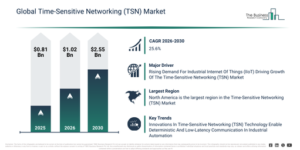
The time-sensitive networking (TSN) market has seen rapid expansion over recent years. It is projected to increase from $0.81 billion in 2025 to $1.02 billion in 2026, exhibiting a compound annual growth rate (CAGR) of 25.6%. The historical growth can be attributed to several factors, including the demand from industrial automation for low latency communication, the evolution of Ethernet standards for real-time control, early adoption in professional audio and video systems, the necessity for precise synchronization in control networks, and the expansion of factory automation infrastructure.
The time-sensitive networking (TSN) market is projected to experience rapid expansion in the coming years, with its size anticipated to reach $2.55 billion by 2030, exhibiting a compound annual growth rate (CAGR) of 25.6%. This growth during the forecast period can be attributed to the proliferation of smart factories and Industry 4.0 adoption, the increasing deployment of autonomous and connected vehicles, the rise of time-critical IoT applications, the integration of TSN with 5G and edge computing, and the growing demand for converged deterministic networks. Key trends shaping this period include the adoption of deterministic Ethernet, the convergence of IT and OT networks, the development of in-vehicle TSN networks for automotive applications, Ethernet replacing fieldbus protocols, and the necessity for high-precision network synchronization.
Download A Free Sample Report For Comprehensive Market Insights:
Time-Sensitive Networking (TSN) Market Growth Factors Supporting Long-Term Expansion
The expanding requirement for the industrial internet of things (IIoT) is anticipated to fuel the progression of the time-sensitive networking (TSN) market in the future. IIoT involves the integration of connected devices, sensors, and machinery with existing industrial systems and operations, facilitating real-time data gathering, supervision, and command across diverse industrial domains such as manufacturing, energy, and transportation. The impetus behind IIoT adoption stems from industries’ aspirations to boost operational effectiveness, minimize downtime via predictive maintenance strategies, bolster safety measures, and acquire immediate insights into their production workflows. Within the industrial internet of things (IIoT), time-sensitive networking (TSN) performs an essential function by facilitating real-time communication among devices within industrial networks. This technology guarantees the reliable and predictable transmission of time-critical data, which is fundamental for applications in industrial automation, robotics, and smart manufacturing systems. As an illustration, in June 2024, IOT Analytics, a Germany-based firm specializing in IoT sector information, reported that mobile operators worldwide collectively earned $15 billion from 3.56 billion cellular IoT connections. Furthermore, 5G and 5G RedCap are anticipated to drive an 18% compound annual growth rate (CAGR) in the global cellular IoT market between 2024 and 2030. Consequently, the increasing need for the industrial internet of things is propelling the expansion of the time-sensitive networking (TSN) market.
Time-Sensitive Networking (TSN) Market Categorization By Product Type And Application
The time-sensitive networking (tsn) market covered in this report is segmented –
1) By Type: IEEE 802.1 AS, IEEE 8021 Qbv, IEEE 802.1 CB, IEEE 8021 Qbu, IEEE 8021 Qc, Other Types
2) By Component: Controllers And Processors, Power Supply Devices, Connectors, Memory, Switches, Routers And Gateways
3) By Application: Industrial Automation, Power And Energy, Automotive And Transportation, Oil And Gas, Aerospace, Other Applications
Subsegments:
1) By IEEE 802.1 AS: Timing And Synchronization For Time-Sensitive Applications, Network Time Protocol (NTP) Support
2) By IEEE 802.1 Qbv: Time-Aware Queuing, Scheduled Traffic Control
3) By IEEE 802.1 CB: Frame Replication And Elimination, Redundant Stream Handling
4) By IEEE 802.1 Qbu: Priority-Based Flow Control, Enhanced Frame Handling
5) By IEEE 802.1 Qc: Stream Reservation Protocol (SRP), Resource Reservation For Time-Sensitive Traffic
6) By Other Types: Custom TSN Solutions, Industry-Specific TSN Protocols
#Time-Sensitive Networking (TSN) Market Growth Trends: What Is Influencing The Future Outlook?
Major companies in the industrial networking market are concentrating on developing advanced solutions, such as real-time data processing engines, to improve communication reliability, reduce latency, and enhance automation performance. Real-time engines are technological functionalities in network switches that process high-speed cyclical data in transit, ensuring deterministic and time-critical transmission of information for industrial applications. For instance, in August 2023, Microchip Technology Incorporated, a US-based semiconductor company, unveiled the LAN9662 Gigabit Ethernet Switch with Audio-Video Bridging (AVB) and Time-Sensitive Networking (TSN) support, alongside integrated PHYs and a 600 MHz Arm Cortex-A7 CPU subsystem. This switch, designed to enable deterministic and low-latency communication, supports high-speed industrial automation applications and integrates a real-time engine to optimize data flow and improve network performance.
Time-Sensitive Networking (TSN) Market Company Landscape And Strategic Competition
Major companies operating in the time-sensitive networking (tsn) market are Mitsubishi Electric Corporation, Siemens AG , Intel Corporation, Cisco Systems Inc., Broadcom Limited, Nokia Corporation Inc., Texas Instruments Inc., Emerson Electric Co., NXP Semiconductors, Analog Devices Inc., Renesas Electronics Corporation, Microchip Technology Inc., Marvell Technology Group Ltd., Mouser Electronics Inc., Belden Inc., Advantech Co. Ltd., Microsemi Corporation, Spirent Communications PLC, TTTech Computertechnik AG, HMS Networks AB
Access The Complete Time-Sensitive Networking (TSN) Market Report:
Time-Sensitive Networking (TSN) Market Regional Outlook: Where Are The Largest Opportunities Located?
North America was the largest region in the time-sensitive networking (TSN) market in 2025. Asia-Pacific is expected to be the fastest-growing region in the forecast period. The regions covered in the time-sensitive networking (tsn) market report are Asia-Pacific, South East Asia, Western Europe, Eastern Europe, North America, South America, Middle East, Africa.
Get in touch with us:
The Business Research Company: https://www.thebusinessresearchcompany.com/
Americas: +1 310-496-7795
Asia: +44 7882 955267 & +91 8897263534
Europe: +44 7882 955267
Email us at: marketing@tbrc.info
Follow us on:
LinkedIn: https://in.linkedin.com/company/the-business-research-company
YouTube: https://www.youtube.com/channel/UC24_fI0rV8cR5DxlCpgmyFQ
Global Market Model: https://www.thebusinessresearchcompany.com/global-market-model

Wasay has over a decade of experience in market research, data modelling, and analytics, with prior experience at GlobalData and Decision Tree Consulting Services. At The Business Research Company , he leads research operations across syndicated studies, customized consulting engagements, and the Global Market Model platform. His professional experience includes supporting organizations such as Boston Consulting Group, KPMG, and Ernst & Young. Wasay holds a degree in Electronics and Communications Engineering, postgraduate management qualifications from International Management Institute Belgium and Indian School of Business and Entrepreneurship, and completed the Integrated Program in Business Analytics from Indian Institute of Management Indore.