
Backed by market attractiveness analysis, total addressable market sizing, company benchmarking matrices, interactive Excel dashboards, wider supply chain intelligence, emerging startup coverage, and detailed product-level insights, The Business Research Company’s 2026 market reports are designed to offer research that is more actionable and strategically valuable than ever.
Trapped Ion Devices Market Size And Revenue Outlook Through 2030
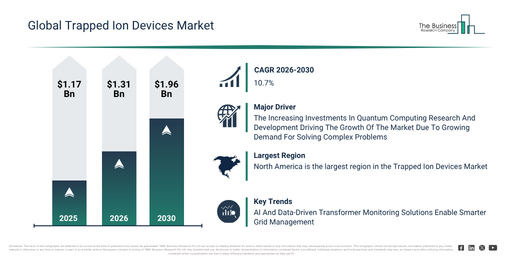
The market for trapped ion devices has experienced significant growth over the past few years. It is projected to expand from $1.17 billion in 2025 to $1.31 billion in 2026, demonstrating a compound annual growth rate (CAGR) of 11.2%. The historical expansion of this market can be attributed to several factors, including increasing investment in quantum computing research, the ongoing development of trapped ion quantum processors, a rising demand for high-precision quantum measurement, augmented government funding for quantum technology, and the broader adoption of quantum computing research platforms.
The trapped ion devices market is projected to expand significantly in the coming years. Its value is anticipated to reach $1.96 billion by 2030, exhibiting a compound annual growth rate (CAGR) of 10.7%. This expansion during the forecast period is primarily driven by an escalating need for fault-tolerant quantum computing, the ongoing evolution of scalable ion trap architectures, the increasing adoption of quantum computing as a service, a heightened demand for quantum-enhanced cryptography, and greater investment in commercial quantum computing infrastructure. Key trends for the forecast period include the continuous advancement of scalable trapped ion quantum processing units, a wider embrace of laser-based ion manipulation techniques, the development of sophisticated ion trap architectures, the broader integration of high-precision qubit measurement systems, and an increasing requirement for improved quantum error correction capabilities.
Get A Free Sample Report With In-Depth Market Insights:
Trapped Ion Devices Market Development Factors: What’s Supporting Demand?
The increasing financial commitments to quantum computing research and development are projected to drive the expansion of the trapped ion devices market moving forward. This research and development involves the methodical study, experimentation, and innovation aimed at enhancing the capacities of quantum computers. The surge in quantum computing research and development is attributed to the growing requirement for tackling intricate problems that classical computers cannot resolve, including simulating molecular interactions, optimizing large-scale systems, and strengthening cryptography. Higher investments in quantum computing research and development accelerate advancements in trapped ion devices by stimulating innovation in qubit stability, error correction, and scalability, thereby improving performance and broadening their adoption across commercial and scientific applications. For instance, in October 2025, the Private Equity Council (USPEC), a US-based professional body, noted that venture funding in quantum computing surpassed $1.25 billion in the first quarter of 2025, marking a 128% increase compared to the first quarter of 2024. Therefore, growing investments in quantum computing research are propelling the growth of the trapped ion devices market.
Trapped Ion Devices Market Segment Analysis Spotlighting Growth Areas
The trapped ion devices market covered in this report is segmented –
1) By Product Type: Ion Traps, Quantum Computers, Mass Spectrometers, Laser Cooling Systems
2) By Technology: Laser Based Technology, Microwave Technology, Optical Technology, Hybrid Technology
3) By Ion Type: Single Ion, Ensemble Ion, Neutral Atoms, Molecules And Clusters
4) By Application: Scientific Research, Medical Applications, Aerospace Engineering, Industrial Applications
5) By End User: Aerospace And Defense, Healthcare And Pharmaceuticals, Academia And Research Institutions, Manufacturing And Industrial Companies
Subsegments:
1) By Ion Traps: Linear Ion Traps, Quadrupole Ion Traps, Penning Ion Traps, Surface Electrode Ion Traps
2) By Quantum Computers: Universal Quantum Computers, Gate Based Quantum Computers, Programmable Quantum Computers, Networked Quantum Computers
3) By Mass Spectrometers: Ion Trap Mass Spectrometers, Quadrupole Mass Spectrometers, Time Of Flight Mass Spectrometers, Orbitrap Mass Spectrometers
4) By Laser Cooling Systems: Doppler Cooling Systems, Sideband Cooling Systems, Raman Cooling Systems, Polarization Gradient Cooling Systems
Trapped Ion Devices Market Transformation Trends: What Innovations Are Driving Change?
Leading firms in the trapped ion devices market are concentrating on creating novel solutions, such as high-fidelity trapped-ion quantum computers, aimed at boosting computational accuracy, scalability, and performance for intricate quantum applications. These high-fidelity trapped-ion quantum computers represent sophisticated quantum computing setups utilizing electromagnetically trapped ions as qubits to execute quantum operations, achieving remarkably low error rates and offering superior computational precision and stability compared to numerous traditional quantum computing designs. For example, in June 2024, Quantinuum Ltd., a UK-based quantum computing company, introduced H2-1, which stands as the industry’s inaugural quantum computer equipped with 56 trapped-ion qubits. This system accomplished a 100-fold improvement in the Random Circuit Sampling benchmark over prior industry records, showcasing outstanding hardware fidelity and computational capacity. Furthermore, H2-1 provides substantially reduced estimated power consumption compared to classical supercomputers, all while facilitating advanced quantum research across sectors such as finance, logistics, transportation, and chemistry.
Trapped Ion Devices Market Key Players Shaping Industry Direction
Major companies operating in the trapped ion devices market are Thermo Fisher Scientific Inc, Infineon Technologies AG, Agilent Technologies Inc, Coherent Corp, Waters Corporation, Bruker Corporation, Hamamatsu Photonics KK, Thorlabs Inc, Quantinuum Ltd, IonQ Inc, Menlo Systems GmbH, HUBNER Photonics GmbH, Oxford Ionics Ltd, Universal Quantum Ltd, Alpine Quantum Technologies GmbH, eleQtron GmbH, Vescent Photonics Inc, Qubitcore Inc
View The Full Trapped Ion Devices Market Report:
Trapped Ion Devices Market Regional Analysis: Which Geography Leads On Revenue?
North America was the largest region in the trapped ion devices market in 2025. Asia-Pacific is expected to be the fastest-growing region in the forecast period. The regions covered in the trapped ion devices market report are Asia-Pacific, South East Asia, Western Europe, Eastern Europe, North America, South America, Middle East, Africa.
Reach Out To Our Team:
The Business Research Company: https://www.thebusinessresearchcompany.com/
Americas: +1 310-496-7795
Asia: +44 7882 955267 & +91 8897263534
Europe: +44 7882 955267
Email us at: marketing@tbrc.info
Follow us on:
LinkedIn: https://in.linkedin.com/company/the-business-research-company
YouTube: https://www.youtube.com/channel/UC24_fI0rV8cR5DxlCpgmyFQ
Global Market Model: https://www.thebusinessresearchcompany.com/global-market-model

Wasay has over a decade of experience in market research, data modelling, and analytics, with prior experience at GlobalData and Decision Tree Consulting Services. At The Business Research Company , he leads research operations across syndicated studies, customized consulting engagements, and the Global Market Model platform. His professional experience includes supporting organizations such as Boston Consulting Group, KPMG, and Ernst & Young. Wasay holds a degree in Electronics and Communications Engineering, postgraduate management qualifications from International Management Institute Belgium and Indian School of Business and Entrepreneurship, and completed the Integrated Program in Business Analytics from Indian Institute of Management Indore.