Designed to make market research more actionable and strategically valuable, The Business Research Company’s 2026 market reports feature market attractiveness scoring, total addressable market sizing, company benchmarking matrices, interactive Excel dashboards, deeper supply chain intelligence, emerging startup tracking, and granular product-level insights.
Ultra-Low-Loss Fiber Market To Expand At A 18% CAGR: Size And Growth Projections Through 2030
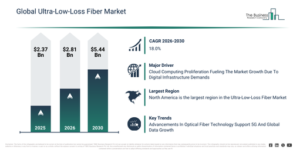
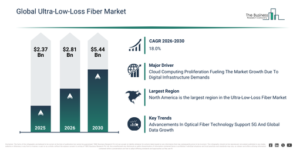
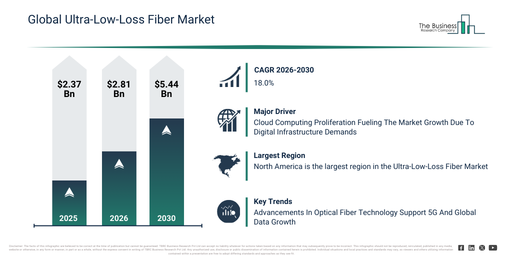
The ultra-low-loss fiber market size has demonstrated rapid expansion in recent years. Its valuation is set to increase from $2.37 billion in 2025 to $2.81 billion in 2026, reflecting a compound annual growth rate (CAGR) of 18.3%. The market’s historical growth can be attributed to an escalating demand for long-distance telecommunications, the integration of single-mode fibers within telecom networks, the expansion of data center infrastructure, a rising requirement for reliable submarine cable systems, and initial industrial automation necessitating optical connectivity.
The ultra-low-loss fiber market is projected to experience swift expansion over the coming years. By 2030, this market is anticipated to reach $5.44 billion, exhibiting a compound annual growth rate (CAGR) of 18.0%. This growth during the forecast period is largely due to factors such as the proliferation of 5G and future 6G networks, the expansion of hyperscale data centers, an increasing uptake of ultra-low-loss fibers in military and aerospace sectors, a surge in demand for high-capacity internet backbone networks, and improvements in optical fiber manufacturing methods. Key trends for the upcoming period encompass bend-insensitive single-mode fiber, dispersion-shifted single-mode fiber, high-capacity submarine cables, low-attenuation data center fibers, and advanced multi-mode optical fibers.
Get Your Free Ultra-Low-Loss Fiber Market Report Sample Today:
Which Factor Is Expected To Drive The Ultra-Low-Loss Fiber Market Over The Forecast Period?
The expansion of cloud computing is anticipated to stimulate the growth of the ultra-low-loss fiber market in the coming years. Cloud computing is defined as a model that provides convenient, on-demand network access to shared, configurable computing resources, which can be rapidly deployed and managed with minimal effort. The adoption of cloud computing is increasing due to ongoing digital transformation initiatives, as businesses increasingly relocate their IT infrastructure to cloud platforms to achieve enhanced scalability, reduced costs, and improved operational efficiency. Ultra-low-loss fiber supports cloud computing by enabling faster and more reliable long-distance data transmission with minimal signal attenuation, thereby enhancing data center interconnectivity, decreasing latency, boosting bandwidth efficiency, and ensuring the smooth delivery of high-performance cloud services across global networks. For instance, in October 2025, AAG IT Services, a UK-based IT and digital transformation services company, reported that public cloud services generated revenue exceeding $415 billion in 2022, with forecasts indicating a rise to $526 billion in 2023. Consequently, the widespread adoption of cloud computing is a significant driver for the growth of the ultra-low-loss fiber market.
Ultra-Low-Loss Fiber Market Segmentation Insights: How Is The Industry Categorized?
The ultra-low-loss fiber market covered in this report is segmented –
1) By Type: Single-Mode, Multi-Mode
2) By Material: Silica, Plastic, Other Materials
3) By Application: Telecommunications, Data Centers, Submarine Cable, Military And Aerospace, Industrial, Other Applications
4) By End-User: Telecom Operators, Internet Service Providers, Enterprises, Government, Other End-Users
Subsegments:
1) By Single-Mode: Standard Single-Mode Fiber, Dispersion-Shifted Single-Mode Fiber, Non-Zero Dispersion Single-Mode Fiber, Bend-Insensitive Single-Mode Fiber
2) By Multi-Mode: Optical Multimode 1 Fiber, Optical Multimode 2 Fiber, Optical Multimode 3 Fiber, Optical Multimode 4 Fiber
Ultra-Low-Loss Fiber Market Trends Explained: What Is Changing And Why It Matters
Leading firms in the ultra-low-loss fiber market are concentrating on creating advanced products, particularly multi-core fibers, to enhance transmission capacity and improve network efficiency. These multi-core fibers are defined as optical fibers featuring several cores enclosed within a single cladding. Their benefit lies in substantially boosting data transmission capacity without enlarging the cable dimensions. Additionally, they contribute to better network efficiency, lower infrastructure expenses, and support demanding applications like 5G, data centers, and submarine communications. As an illustration, Sumitomo Electric Industries Ltd., a manufacturing company based in Japan, introduced the world’s inaugural mass-produced ultra-low-loss multi-core fiber in September 2023. This groundbreaking fiber effectively doubles the transmission capacity while maintaining the same outer dimensions as standard single-core fibers, thereby resolving bandwidth constraints without any increase in cable size. With an ultra-low transmission loss of 0.158 dB/km at 1550 nm and minimal inter-core cross-talk, it is ideal for rigorous uses including submarine networks, long-haul terrestrial transmission, inter-data center connectivity, and quantum communications. This introduction marks a pivotal achievement in enhancing next-generation optical communication infrastructure, given that multi-core fiber technology is anticipated to be vital in sustaining the rapid expansion of 5G, cloud services, and worldwide data traffic.
Ultra-Low-Loss Fiber Market Competitor Landscape: Who Are The Major Companies?
Major companies operating in the ultra-low-loss fiber market are Sumitomo Electric Industries Ltd., Heraeus Covantics GmbH, Prysmian Group, Corning Incorporated, Nexans S.A., Furukawa Electric Co. Ltd., Hengtong Group Co. Ltd., Leoni AG, Fujikura Ltd., CommScope Holding Company Inc., LS Cable & System Ltd., FiberHome Telecommunication Technologies Co. Ltd., Yangtze Optical Fibre and Cable Joint Stock Limited Company (YOFC), OFS Fitel LLC, Hexatronic Group AB, Sterlite Technologies Limited, Tongding Group Co. Ltd., Optical Cable Corporation, Remee Products Corporation, DIAMOND S.A.
See The Full Ultra-Low-Loss Fiber Market Report For Complete Market Sizing And Trends:
Ultra-Low-Loss Fiber Market Regional Demand Analysis And Leading Geography
North America was the largest region in the ultra-low-loss fiber market in 2025. Asia-Pacific is expected to be the fastest-growing region in the forecast period. The regions covered in the ultra-low-loss fiber market report are Asia-Pacific, South East Asia, Western Europe, Eastern Europe, North America, South America, Middle East, Africa.
Reach Out To Our Team:
The Business Research Company: https://www.thebusinessresearchcompany.com/
Americas: +1 310-496-7795
Asia: +44 7882 955267 & +91 8897263534
Europe: +44 7882 955267
Email us at: marketing@tbrc.info
Follow us on:
LinkedIn: https://in.linkedin.com/company/the-business-research-company
YouTube: https://www.youtube.com/channel/UC24_fI0rV8cR5DxlCpgmyFQ
Global Market Model: https://www.thebusinessresearchcompany.com/global-market-model

Wasay has over a decade of experience in market research, data modelling, and analytics, with prior experience at GlobalData and Decision Tree Consulting Services. At The Business Research Company , he leads research operations across syndicated studies, customized consulting engagements, and the Global Market Model platform. His professional experience includes supporting organizations such as Boston Consulting Group, KPMG, and Ernst & Young. Wasay holds a degree in Electronics and Communications Engineering, postgraduate management qualifications from International Management Institute Belgium and Indian School of Business and Entrepreneurship, and completed the Integrated Program in Business Analytics from Indian Institute of Management Indore.