The Business Research Company’s 2026 market reports are designed to deliver research that is more actionable and strategically valuable. Key offerings include market attractiveness scoring, total addressable market sizing, company benchmarking matrices, interactive Excel dashboards, deeper supply chain intelligence, emerging startup tracking, and granular product-level insights.
Vector Index Lifecycle Management Market Size 2026: Valuation, Growth Rate And Forecast To 2030
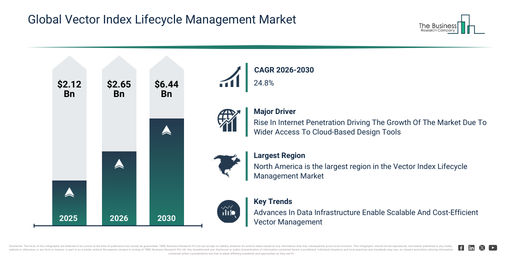
The size of the vector index lifecycle management market has expanded considerably over recent years. This market is projected to grow from $2.12 billion in 2025 to $2.65 billion by 2026, at a compound annual growth rate (CAGR) of 25.1%. Historically, this expansion has been driven by factors such as the increasing adoption of AI and machine learning, a greater reliance on embeddings within search systems, the proliferation of big data analytics platforms, an escalating need for real-time information retrieval, and the integration of vector databases into enterprises.
The vector index lifecycle management market size is projected to experience substantial growth in the upcoming years. It is anticipated to expand to $6.44 billion in 2030, demonstrating a compound annual growth rate (CAGR) of 24.8%. This expansion during the forecast period stems from the increasing deployment of large-scale AI models, the rising need for lifecycle automation in data pipelines, a greater emphasis on AI infrastructure cost optimization, the demand for scalable vector index management, and the integration of lifecycle tools with MLOps platforms. Notable trends expected include automated vector index creation and retirement, continuous index optimization workflows, scalable embedding lifecycle governance, cost-efficient index storage management, and performance-centric index versioning.
Get A Free Sample Of The Vector Index Lifecycle Management Market Report 2026:
What Is Driving The Growth Of The Vector Index Lifecycle Management Market?
The escalating internet penetration is anticipated to foster the expansion of the vector index lifecycle management market. Internet penetration defines the percentage of individuals in a given region or country who can access and actively use the internet. This increase in penetration stems from the rapid deployment of affordable mobile networks, which enhances internet accessibility for residents in rural and distant areas. For vector index lifecycle management, internet penetration is crucial as it facilitates uninterrupted data connectivity, enabling real-time updates, synchronization, and optimization of vector indexes across distributed systems. As an illustration, in December 2024, Ofcom, a UK government body, reported that 63% of SMEs in the UK were linked to a full-fibre network by July 2024, indicating a 12% rise compared to September 2023. Thus, the growing internet penetration is a significant force propelling the vector index lifecycle management market forward.
How Is The Vector Index Lifecycle Management Market Segmented?
The vector index lifecycle management market covered in this report is segmented –
1) By Component: Software, Hardware, Services
2) By Deployment Mode: On-Premises, Cloud
3) By Application: Data Analytics, Machine Learning, Information Retrieval, Recommendation Systems
4) By End-User: Banking, Financial Services, And Insurance (Bfsi), Healthcare, Information Technology (It) And Telecommunications, Retail And E-Commerce, Government
Subsegments:
1) By Software: Vector Database Management Systems, Embedding Generation Platforms, Index Optimization Tools, Data Integration Software, Artificial Intelligence Model Integration Software, Real Time Analytics Software
2) By Hardware: High Performance Computing Servers, Graphics Processing Units, Vector Processing Units, Data Storage Appliances, Networking Equipment, Memory Accelerators
3) By Services: Implementation And Integration Services, Consulting Services, Training And Support Services, Managed Services, Maintenance And Upgradation Services, Data Engineering Services
What Are The Latest Trends In The Vector Index Lifecycle Management Market?
Leading companies in the vector index lifecycle management market are prioritizing the development of lakehouse-native vector embeddings. This focus aims to enable more rapid, economical, and scalable management of vector data, while simultaneously supporting real-time artificial intelligence (AI) applications and facilitating seamless integration with operational vector databases. Lakehouse-native vector embeddings are defined as vectors directly stored and managed within a data lakehouse, which facilitates scalable, cost-effective, real-time AI analytics. For example, in August 2024, Onehouse, a US-based company specializing in cloud-native, fully managed universal data lakehouse solutions, introduced its vector embeddings generator as a component of its managed ELT cloud service. This platform automates embedding pipelines by continuously ingesting data from streams, databases, and cloud storage, transmitting it to foundational models such as OpenAI and Voyage artificial intelligence (AI), and subsequently storing the resulting vectors in optimized lakehouse tables. It leverages the lakehouse’s capabilities, including incremental updates, concurrency control, handling of late-arriving data, and scalable storage, all while integrating with vector databases for high-scale, low-latency serving. By centralizing embeddings and strategically moving only frequently accessed (“hot”) vectors to operational stores, Onehouse delivers an architecture that is cost-efficient, scalable, and high-performing. This solution is designed to support large-scale artificial intelligence (AI) applications, including natural language processing (NLP), content generation, and intelligent search.
Who Are The Key Players In The Vector Index Lifecycle Management Market?
Major companies operating in the vector index lifecycle management market are Amazon Inc., Google LLC, Microsoft Corporation, Alibaba Group Holding Limited, Oracle Corporation, Databricks Inc., MongoDB Inc., Elastic N.V., Redis Ltd., Searce Inc., Pinecone Systems Inc., Zilliz Technologies Inc., ClickHouse Inc., OpenSearch Project, Weaviate B.V., Qdrant Inc., Vespa AI by Verizon Media, Activeloop Inc., Vald Project, LanceDB Inc.
Read The Complete Vector Index Lifecycle Management Market Report 2026:
Which Region Is The Largest In The Vector Index Lifecycle Management Market?
North America was the largest region in the vector index lifecycle management market in 2025. Asia-Pacific is expected to be the fastest-growing region in the forecast period. The regions covered in the vector index lifecycle management market report are Asia-Pacific, South East Asia, Western Europe, Eastern Europe, North America, South America, Middle East, Africa.
Reach Out To Our Team:
The Business Research Company: https://www.thebusinessresearchcompany.com/
Americas: +1 310-496-7795
Asia: +44 7882 955267 & +91 8897263534
Europe: +44 7882 955267
Email us at: marketing@tbrc.info
Follow us on:
LinkedIn: https://in.linkedin.com/company/the-business-research-company
YouTube: https://www.youtube.com/channel/UC24_fI0rV8cR5DxlCpgmyFQ
Global Market Model: https://www.thebusinessresearchcompany.com/global-market-model

Wasay has over a decade of experience in market research, data modelling, and analytics, with prior experience at GlobalData and Decision Tree Consulting Services. At The Business Research Company , he leads research operations across syndicated studies, customized consulting engagements, and the Global Market Model platform. His professional experience includes supporting organizations such as Boston Consulting Group, KPMG, and Ernst & Young. Wasay holds a degree in Electronics and Communications Engineering, postgraduate management qualifications from International Management Institute Belgium and Indian School of Business and Entrepreneurship, and completed the Integrated Program in Business Analytics from Indian Institute of Management Indore.